Difficulty distribution
How the classified questions are distributed by difficulty.
3questions
Not classified
3
100%
Your cart is empty.
Practice Moving Charges And Magnetism - Electricity - Physics previous year questions organised from real papers, with year-wise coverage and clear topic navigation.
Every graph below is calculated only from this selection.
Year-wise coverage for Moving Charges And Magnetism. Each bar uses a separate theme-derived color.
How the classified questions are distributed by difficulty.
MCQ, numerical, multiple-select and other formats found in these papers.
Top subjects by unique question coverage.
Top topics across the included previous year papers.
Top subtopics inside this exact selection.
Question coverage for the most populated papers. Every active PYP paper remains listed below.
Newest papers appear first. Sort by year, question coverage or name.
| Paper | Year / session | Questions in this view | Open |
|---|---|---|---|
| RE-NEET 2026 | 2026 | 2 | View paper |
| AIPMT 2010 PRELIMS | 2010 | 1 | View paper |
Practice every matching question in batches of 20, with every available option.
Two infinitely long parallel conducting wires $A$ and $B$ carry currents $I$ and $2 I$, respectively, in the same direction. The wire $A$ has uniform mass per unit length $\lambda$ and lies on an insulated floor. The wire $B$ is kept fixed at a height $h$ above the floor. The minimum magnitude of $h$ so that the wire $A$ does not rise from the floor is: [ $g$ is the acceleration due to gravity and $\mu_0$ is the permeability of free space.]
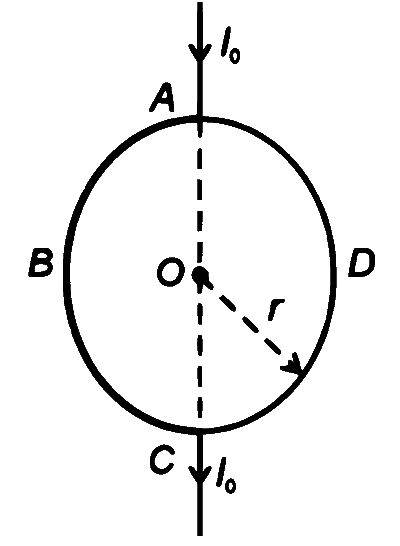
A current $l_0$ flows through a metallic circular loop of radius $r$ as shown in the figure. Resistance of the segment $A B C$ is half that of $A D C$. Magnitude of magnetic field at the centre $O$ of the loop is :