Difficulty distribution
How the classified questions are distributed by difficulty.
15questions
Not classified
15
100%
Your cart is empty.
Practice Physical Chemistry - Chemistry previous year questions organised from real papers, with year-wise coverage and clear topic navigation.
Every graph below is calculated only from this selection.
Year-wise coverage for Physical Chemistry. Each bar uses a separate theme-derived color.
How the classified questions are distributed by difficulty.
MCQ, numerical, multiple-select and other formats found in these papers.
Top subjects by unique question coverage.
Top topics across the included previous year papers.
Top subtopics inside this exact selection.
Question coverage for the most populated papers. Every active PYP paper remains listed below.
Open a focused page built from the same verified paper data.
Newest papers appear first. Sort by year, question coverage or name.
| Paper | Year / session | Questions in this view | Open |
|---|---|---|---|
| RE-NEET 2026 | 2026 | 15 | View paper |
A varied preview from the papers represented in this selection, with every available option.
The numbers 17.0145 and 21.0235 were rounded to three figures after the decimal point. The resulting numbers, respectively, are
$$\text { Consider the following schematic plots of orbital wavefunction }\left(\psi_r\right) \text { against distance }(r) \text { from the nucleus. }$$
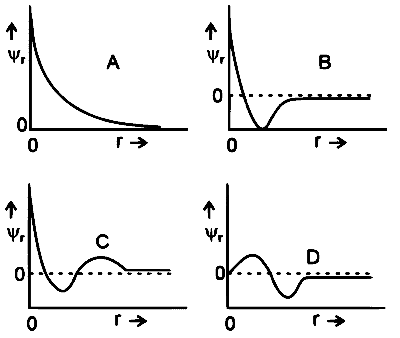
The figure representing two radial nodes in the orbital is
In an acidic medium, 10 mL of 0.25 M oxalic acid is titrated with $\mathrm{KMnO}_4$ solution. If the volume of $\mathrm{KMnO}_4$ solution required to reach end point is 10 mL , the strength of the $\mathrm{KMnO}_4$ solution is
$$\text { The correct order of solubility of the given salts in water at } 298 \mathrm{~K} \text { is }$$
$$\begin{array}{|l|l|} \hline \text { Salt } & \mathbf{K}_{\text {sp }} \text { at } \mathbf{2 9 8} \text { K } \\ \hline \mathrm{AgBr} & 5.0 \times 10^{-13} \\ \hline \mathrm{Zn}(\mathrm{OH})_2 & 1.0 \times 10^{-15} \\ \hline \mathrm{Hg}_2 \mathrm{Cl}_2 & 1.3 \times 10^{-18} \\ \hline \end{array}$$
Consider the following statements about the solutions formed by mixing two liquids.
A. An ideal solution thus formed obeys Raoult's law throughout the composition range.
B. Mixture of chloroform and acetone shows negative deviation from Raoult's law.
C. Mixture of aniline and phenol shows positive deviation from Raoult's law
$$\text { Consider the reversible processes for } 1.0 \mathrm{~mol} \text { of an ideal gas as shown in the figure. }$$
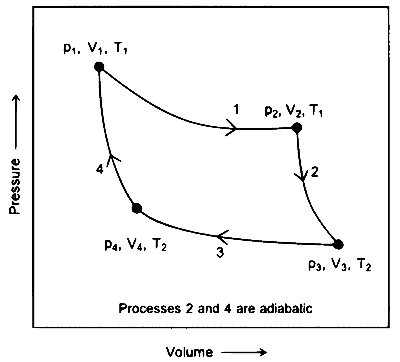
$w_1, w_2, w_3$ and $w_4$ represent work done (in calories) in the processes $1,2,3$ and 4 , respectively; $\Delta U_2$ and $\Delta U_4$ are changes in the internal energy for the processes 2 and 4, respectively.
[use $\mathrm{R}=2 \mathrm{cal} \mathrm{K}^{-1} \mathrm{~mol}^{-1}$ ]
The correct option is