My Cart
Your Cart 0

    Your cart is empty.

  • Total (Amount) ₹0.00
Previous year question hub

Transport In Plants - Botany - Biology Previous Year Questions

Practice Transport In Plants - Botany - Biology previous year questions organised from real papers, with year-wise coverage and clear topic navigation.

26Papers
21Years
41Questions
1Topics

Transport In Plants question pattern

Every graph below is calculated only from this selection.

Questions by year

Year-wise coverage for Transport In Plants. Each bar uses a separate theme-derived color.

Difficulty distribution

How the classified questions are distributed by difficulty.

Not classified 40 97.6%
Easy 1 2.4%

Question type distribution

MCQ, numerical, multiple-select and other formats found in these papers.

Multiple Choices 41 100%

Subject weightage

Top subjects by unique question coverage.

Biology
41 Qs

Most asked topics

Top topics across the included previous year papers.

Botany
41 Qs

Subtopic coverage

Top subtopics inside this exact selection.

Transport In Plants
41 Qs

Paper coverage

Question coverage for the most populated papers. Every active PYP paper remains listed below.

NEET 2023
4 Qs
NEET 2023 MANIPUR
3 Qs
NEET 2022 Phase 1
2 Qs
NEET 2022 PHASE 2
1 Qs
NEET 2021
1 Qs
NEET 2020 PHASE 1
1 Qs
NEET 2019
1 Qs
AIIMS 2018
3 Qs
NEET 2018
1 Qs
NEET 2017
2 Qs
NEET 2016 PHASE 2
1 Qs
AIPMT 2015 Cancelled Paper
3 Qs
AIPMT 2015
2 Qs
NEET 2013
1 Qs
AIPMT 2011 MAINS
1 Qs
AIPMT 2011 PRELIMS
1 Qs
AIPMT 2010 MAINS
1 Qs
AIPMT 2009
1 Qs
AIPMT 2008
1 Qs
AIPMT 2007
1 Qs
AIPMT 2006
1 Qs
AIPMT 2005
1 Qs
AIPMT 2003
1 Qs
AIPMT 2002
2 Qs
AIPMT 2001
3 Qs
AIPMT 2000
1 Qs

Included previous year papers

Newest papers appear first. Sort by year, question coverage or name.

PaperYear / sessionQuestions in this viewOpen
NEET 202320234View paper
NEET 2023 MANIPUR20233View paper
NEET 2022 Phase 120222View paper
NEET 2022 PHASE 220221View paper
NEET 202120211View paper
NEET 2020 PHASE 120201View paper
NEET 201920191View paper
AIIMS 201820183View paper
NEET 201820181View paper
NEET 201720172View paper
NEET 2016 PHASE 220161View paper
AIPMT 201520152View paper
AIPMT 2015 Cancelled Paper20153View paper
NEET 201320131View paper
AIPMT 2011 MAINS20111View paper
AIPMT 2011 PRELIMS20111View paper
AIPMT 2010 MAINS20101View paper
AIPMT 200920091View paper
AIPMT 200820081View paper
AIPMT 200720071View paper
AIPMT 200620061View paper
AIPMT 200520051View paper
AIPMT 200320031View paper
AIPMT 200220022View paper
AIPMT 200120013View paper
AIPMT 200020001View paper

All Transport In Plants previous year questions

Practice every matching question in batches of 20, with every available option.

1
2000 · Biology · Botany · Transport In Plants
AIPMT 2000
The movement of ions against the concentration gradient will be
A
active transport
B
osmosis
C
diffusion
D
all of the above.
Open complete paper
2
2001 · Biology · Botany · Transport In Plants
AIPMT 2001
Loading of phloem is related to
A
increase of sugar in phloem cell
B
elongation of phloem cell
C
separation of phloem parenchyma
D
strengthening of phloem fiber.
Open complete paper
3
2001 · Biology · Botany · Transport In Plants
AIPMT 2001
Glycolate induces opening of stomata in
A
presence of oxygen
B
low CO2 concentration
C
high CO2
D
CO2 absent.
Open complete paper
4
2001 · Biology · Botany · Transport In Plants
AIPMT 2001
Passive absorption of minerals depends on
A
temperature
B
temperature and metabolic inhibitor
C
metabolic inhibitor
D
humidity.
Open complete paper
5
2002 · Biology · Botany · Transport In Plants
AIPMT 2002
Opening and closing of stomata is due to the
A
hormonal change in guard cells
B
change in turgor pressure of guard cells
C
gaseous exchange
D
respiration.
Open complete paper
6
2002 · Biology · Botany · Transport In Plants
AIPMT 2002
Main functional of lenticel is
A
transpiration
B
guttation
C
gaseous exchange
D
bleeding.
Open complete paper
7
2003 · Biology · Botany · Transport In Plants
AIPMT 2003
Stomata of a plant open due to
A
influx of potassium ions
B
efflux of potassium ions
C
influx of hydrogen ions
D
influx of calcium ions.
Open complete paper
8
2005 · Biology · Botany · Transport In Plants
AIPMT 2005
Potometer works on the principle of
A
osmotic pressure
B
amount of water absorbed equals the amount transpired
C
root pressure
D
potential difference between the tip of the tube and that of the plant.
Open complete paper
9
2006 · Biology · Botany · Transport In Plants
AIPMT 2006
The translocation of organic solutes in sieve tube members is supported by
A
cytoplasmic streaming
B
root pressure and transpiration pull
C
P-proteins
D
mass flow involving a carrier and ATP.
Open complete paper
10
2007 · Biology · Botany · Transport In Plants
AIPMT 2007
Two cells A and B are contiguous. Cell A has osmotic pressure 10 atm, turgor pressure 7 atm and diffusion pressure deficit 3 atm. Cell B has osmotic pressure 8 atm, turgor pressure 3 atm and diffusion pressure deficit 5 atm. The result will be
A
no movement of water
B
equilibrium between the two
C
movement of water from cell A to B
D
movement of water from cell B to A.
Open complete paper
11
2008 · Biology · Botany · Transport In Plants
AIPMT 2008
The rupture and fractionation do not usually occur in the water column in vessel/tracheids during the ascent of sap because of
A
weak gravitational pull
B
transpiration pull
C
lignified thick walls
D
cohesion and adhesion.
Open complete paper
12
2009 · Biology · Botany · Transport In Plants
AIPMT 2009
Guard cells help in
A
transpiration
B
guttation
C
fighting against infection
D
protection against grazing
Open complete paper
13
2010 · Biology · Botany · Transport In Plants
AIPMT 2010 MAINS
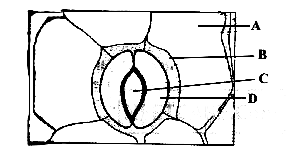
Given below is the diagram of a stomatal apparatus. In which of the following all the four parts labelled as A, B, C and D are correctly identified? AIPMT 2010 Mains Biology - Transport in Plants Question 15 English
A
A \(\to\) Epidermal Cell , B \(\to\) Subsidiary cell, C \(\to\) Stomatal aperture, D \(\to\) Guard cell
B
A \(\to\) Subsidiary cell, B \(\to\) Epidermal Cell , C \(\to\) Guard cell, D \(\to\) Stomatal aperture
C
A \(\to\) Guard cell, B \(\to\) Stomatal aperture, C \(\to\) Subsidiary cell, D \(\to\) Epidermal Cell
D
A \(\to\) Epidermal Cell , B \(\to\) Guard cell, C \(\to\) Stomatal aperture, D \(\to\) Subsidiary cell
Open complete paper
14
2011 · Biology · Botany · Transport In Plants
AIPMT 2011 MAINS
Guttation is the result of
A
diffusion
B
transpiration
C
osmosis
D
root pressure.
Open complete paper
15
2011 · Biology · Botany · Transport In Plants
AIPMT 2011 PRELIMS
In land plants, the guard cells differ from other epidermal cells in having
A
cytoskeleton
B
mitochondria
C
endoplasmic reticulum
D
chloroplasts
Open complete paper
16
2015 · Biology · Botany · Transport In Plants
AIPMT 2015
Root pressure develops due to
A
passive absorption
B
active absorption
C
increase in transpiration
D
low osmotic potential in soil.
Open complete paper
17
2015 · Biology · Botany · Transport In Plants
AIPMT 2015
A column of water within xylem vessels of tall trees does not break under its weight because of
A
lignification of xylem vessels
B
positive root pressure
C
dissolved sugars in water
D
tensile strength of water.
Open complete paper
18
2013 · Biology · Botany · Transport In Plants
NEET 2013
Which of the following criteria does not pertain to facilitated transport?
A
Transport saturation
B
Uphill transport
C
Requirement of special membrane proteins
D
High selectivity
Open complete paper
19
2016 · Biology · Botany · Transport In Plants
NEET 2016 PHASE 2
A few drops of sap were collected by cutting across a plant stem by a suitable method. The sap was tested chemically. Which one of the following test results indicates that it is phloem sap?
A
Acidic
B
Alkaline
C
Low refractive index
D
Absence of sugar
Open complete paper
20
2017 · Biology · Botany · Transport In Plants
NEET 2017
Which of the following facilitates opening of stomatal aperture?
A
Decrease in turgidity of guard cells
B
Radial orientation of cellulose microfibrils in the cell wall of guard cells
C
Longitudinal orientation of cellulose microfibrils in the cell wall of guard cells
D
Contraction of outer wall of guard cells
Open complete paper

Showing 20 of 41 questions