My Cart
Your Cart 0

    Your cart is empty.

  • Total (Amount) ₹0.00
Previous year question hub

Thermodynamics - Thermodynamics and Marine Engineering - Naval Architecture & Marine Engineering Previous Year Questions

Practice Thermodynamics - Thermodynamics and Marine Engineering - Naval Architecture & Marine Engineering previous year questions organised from real papers, with year-wise coverage and clear topic navigation.

6Papers
5Years
31Questions
1Topics

Thermodynamics question pattern

Every graph below is calculated only from this selection.

Questions by year

Year-wise coverage for Thermodynamics. Each bar uses a separate theme-derived color.

Difficulty distribution

How the classified questions are distributed by difficulty.

Medium 17 54.8%
Easy 14 45.2%

Question type distribution

MCQ, numerical, multiple-select and other formats found in these papers.

MSQ 12 38.7%
Numerical Answer Type (NAT) 12 38.7%
MCQ 7 22.6%

Subject weightage

Top subjects by unique question coverage.

Naval Architecture & Marine Engineering
31 Qs

Most asked topics

Top topics across the included previous year papers.

Thermodynamics and Marine Engineering
31 Qs

Subtopic coverage

Top subtopics inside this exact selection.

Thermodynamics
31 Qs

Paper coverage

Question coverage for the most populated papers. Every active PYP paper remains listed below.

Naval Architecture and Marine Engineering (NM) 2026
6 Qs
Mining Engineering (MN) 2026
3 Qs
Naval Architecture & Marine Engineering (NM) 2025
4 Qs
Naval Architecture & Marine Engineering (NM) 2024
7 Qs
Naval Architecture & Marine Engineering (NM) 2023
5 Qs
Naval Architecture & Marine Engineering (NM) 2022
6 Qs

Included previous year papers

Newest papers appear first. Sort by year, question coverage or name.

PaperYear / sessionQuestions in this viewOpen
Mining Engineering (MN) 202620263View paper
Naval Architecture and Marine Engineering (NM) 202620266View paper
Naval Architecture & Marine Engineering (NM) 202520254View paper
Naval Architecture & Marine Engineering (NM) 202420247View paper
Naval Architecture & Marine Engineering (NM) 202320235View paper
Naval Architecture & Marine Engineering (NM) 202220226View paper

All Thermodynamics previous year questions

Practice every matching question in batches of 20, with every available option.

1
2022 · Naval Architecture & Marine Engineering · Thermodynamics and Marine Engineering · Thermodynamics
Naval Architecture & Marine Engineering (NM) 2022

Which of the following are TRUE for pressure, temperature and density of a thermodynamic system?

Open complete paper
2
2022 · Naval Architecture & Marine Engineering · Thermodynamics and Marine Engineering · Thermodynamics
Naval Architecture & Marine Engineering (NM) 2022
For a simple vapour compression refrigeration, which of the following thermodynamic cycles (1-2-3-4) are possible? Here, \( T \), \( P \), \( s \) and \( h \) indicate temperature, pressure, specific entropy and specific enthalpy, respectively.
Open complete paper
3
2022 · Naval Architecture & Marine Engineering · Thermodynamics and Marine Engineering · Thermodynamics
Naval Architecture & Marine Engineering (NM) 2022
An Otto cycle has states 1 and 2 at the beginning and the end of the compression stroke, respectively. The states 3 and 4 are at the beginning and the end of the expansion stroke, respectively.
Let the compression ratio of the cycle be \( r \), specific heat ratio of air be \( \gamma \), specific heat of air at constant volume be \( C_v \), and \( P \), \( v \), and \( T \) be pressure, specific volume and temperature of the air, respectively. Then, which of the following expressions represent the thermal efficiency of the cycle?
Open complete paper
4
2022 · Naval Architecture & Marine Engineering · Thermodynamics and Marine Engineering · Thermodynamics
Naval Architecture & Marine Engineering (NM) 2022
An air standard Otto cycle has a compression ratio of 6 and a mean effective pressure of 1000 kPa. Assume that the specific heat ratio \(\gamma\) as 1.4 and specific gas constant \(R\) as 0.287 kJ/kgK for the air. If the pressure and temperature at the beginning of the compression stroke are 100 kPa and 300 K, respectively, then the specific work output of the cycle is __________ kJ/kg (rounded off to one decimal place).
Open complete paper
5
2022 · Naval Architecture & Marine Engineering · Thermodynamics and Marine Engineering · Thermodynamics
Naval Architecture & Marine Engineering (NM) 2022
If methane (\(CH_4\)) gas reacts with air at a stoichiometric proportion, then the air-fuel ratio of the combustion process is __________ (rounded off to one decimal place).
Open complete paper
6
2022 · Naval Architecture & Marine Engineering · Thermodynamics and Marine Engineering · Thermodynamics
Naval Architecture & Marine Engineering (NM) 2022
In a vapour compression refrigeration cycle using R134 as the refrigerant, the enthalpies are (i) 240 kJ/kg at the beginning of the compression, (ii) 275 kJ/kg at the end of the compression and (iii) 96 kJ/kg at the beginning of the throttling.
Then the coefficient of performance of the cycle is __________ (rounded off to one decimal place).
Open complete paper
7
2023 · Naval Architecture & Marine Engineering · Thermodynamics and Marine Engineering · Thermodynamics
Naval Architecture & Marine Engineering (NM) 2023

The vapor quality of steam in the turbine of a Rankine cycle can be improved by employing

Open complete paper
8
2023 · Naval Architecture & Marine Engineering · Thermodynamics and Marine Engineering · Thermodynamics
Naval Architecture & Marine Engineering (NM) 2023
A closed system undergoing a thermodynamic cycle consisting of two reversible isothermal and two reversible adiabatic processes is shown in the following figure. If $\delta Q$ is the infinitesimal heat transfer and T is the instantaneous temperature, then the value of the contour integral $\oint \frac{\delta Q}{T}$
Open complete paper
9
2023 · Naval Architecture & Marine Engineering · Thermodynamics and Marine Engineering · Thermodynamics
Naval Architecture & Marine Engineering (NM) 2023

In a marine steam power cycle employing regeneration, the feed water heater for waste heat recovery is placed after the

Open complete paper
10
2023 · Naval Architecture & Marine Engineering · Thermodynamics and Marine Engineering · Thermodynamics
Naval Architecture & Marine Engineering (NM) 2023
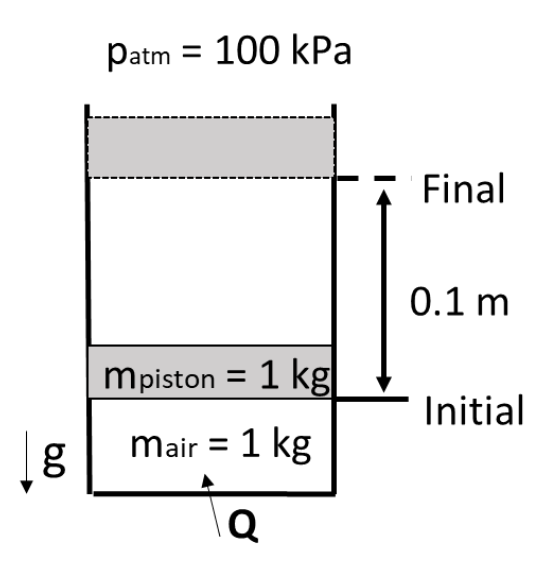
A vertical frictionless piston-cylinder arrangement contains air of mass 1 kg. During a process, 50 J of heat is transferred from outside to the system such that the piston is raised slowly by 0.1 m from its initial equilibrium position. The mass of the piston is 1 kg, and the diameter is 0.1 m. Assume that g = 9.81 m/s², and P_atm = 100 kPa. The change in internal energy of the air in J (round off to two decimal places) lies between

Source question diagram

Open complete paper
11
2023 · Naval Architecture & Marine Engineering · Thermodynamics and Marine Engineering · Thermodynamics
Naval Architecture & Marine Engineering (NM) 2023
An insulated nozzle has an inlet cross-sectional area of 314 cm². Air flows through the nozzle with an inlet temperature of 300 K at a steady rate of 1.256 m³/s. The velocity at the exit is greater than that at the inlet by 210 m/s. Assume a constant Cp = 1.004 kJ/kg·K. The temperature (in K) of air at the exit of the nozzle lies between
Open complete paper
12
2024 · Naval Architecture & Marine Engineering · Thermodynamics and Marine Engineering · Thermodynamics
Naval Architecture & Marine Engineering (NM) 2024
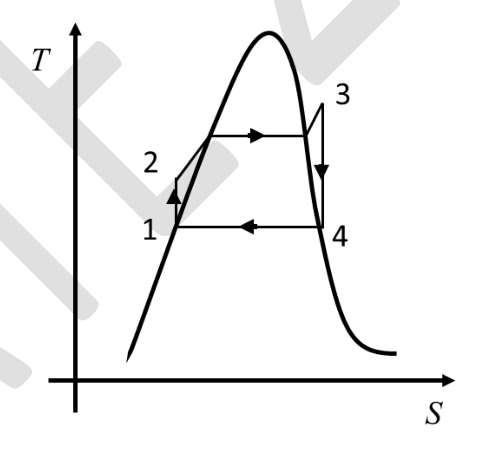
Consider an ideal Rankine cycle as shown in the figure, where \(T\) and \(S\) represent the temperature and entropy respectively. The overall efficiency of the cycle can be improved by

Source question diagram

Source question diagram

Open complete paper
13
2024 · Naval Architecture & Marine Engineering · Thermodynamics and Marine Engineering · Thermodynamics
Naval Architecture & Marine Engineering (NM) 2024

Which of the following statement(s) is/are correct for a thermodynamic closed system?

Open complete paper
14
2024 · Naval Architecture & Marine Engineering · Thermodynamics and Marine Engineering · Thermodynamics
Naval Architecture & Marine Engineering (NM) 2024
Which one of the following \(p-h\) plots represents the ideal vapour compression cycle with intercooling?
Here, \(p\) and \(h\) denote pressure and specific enthalpy respectively.
Open complete paper
15
2024 · Naval Architecture & Marine Engineering · Thermodynamics and Marine Engineering · Thermodynamics
Naval Architecture & Marine Engineering (NM) 2024

Which one of the following psychrometric processes is represented by the line 1-2 in the figure?

Open complete paper
16
2024 · Naval Architecture & Marine Engineering · Thermodynamics and Marine Engineering · Thermodynamics
Naval Architecture & Marine Engineering (NM) 2024
A 4-cylinder, 4-stroke diesel engine operating at 3000 rpm has a compression ratio \(r\) of 12 and cut-off ratio \(r_c\) of 2.5. The temperature rise during the heat addition process is 2400 K. The efficiency of an air-standard diesel cycle is given by \(\eta = 1 - \frac{1}{r^{\gamma-1}} \left( \frac{1}{\gamma} \frac{r_c^{\gamma}-1}{r_c-1} \right)\). Assume the working fluid as air with a mass flow rate of 0.05 kg/s, \(\gamma = 1.4\), and \(C_p = 1.004\) kJ/kg·K.

The power output of the engine is ______ kW (rounded off to the nearest integer).
Open complete paper
17
2024 · Naval Architecture & Marine Engineering · Thermodynamics and Marine Engineering · Thermodynamics
Naval Architecture & Marine Engineering (NM) 2024
Consider a gas turbine combustor with air as the working fluid. The flow enters the device at 500 K and leaves at 1400 K with a mass flow rate of 0.1 kg/s. The changes in kinetic energy and potential energy of the flow are neglected. Assuming \(C_p = 0.717\) kJ/kg-K and \(R = 0.287\) kJ/kg-K, the rate of heat addition is _____ kW (rounded off to the nearest integer).
Open complete paper
18
2024 · Naval Architecture & Marine Engineering · Thermodynamics and Marine Engineering · Thermodynamics
Naval Architecture & Marine Engineering (NM) 2024
A new absolute temperature scale is proposed based on a Carnot engine operating between hot and cold reservoirs of temperatures \(T_L\) and \(T_H\) respectively. Let \(Q_L\) and \(Q_H\) be the respective heat transfers, with the relation given by \(\frac{T_L}{T_H} = \frac{Q_L}{Q_H}\). On the new scale, the difference between the steam and ice points of water is 500 units and the efficiency of the engine is 0.268. The steam point of water on this scale is __________ units (rounded off to the nearest integer).
Open complete paper
19
2025 · Naval Architecture & Marine Engineering · Thermodynamics and Marine Engineering · Thermodynamics
Naval Architecture & Marine Engineering (NM) 2025
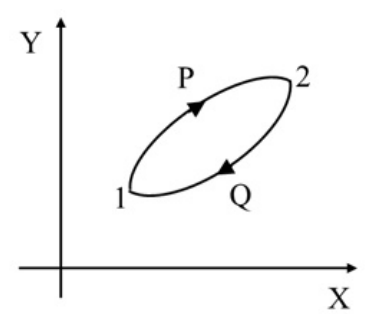
A closed system is undergoing a reversible process 1-P-2 from state 1 to 2, as shown in the figure, where X and Y are thermodynamic properties. An irreversible process 2-Q-1 brings the system back from 2 to 1.
The net change in entropy of the system and surroundings during the above-mentioned cycle are ______ respectively.

Source question diagram

Open complete paper
20
2025 · Naval Architecture & Marine Engineering · Thermodynamics and Marine Engineering · Thermodynamics
Naval Architecture & Marine Engineering (NM) 2025
An ideal Brayton cycle (1-2-3-4) consisting of two isentropic and two isobaric processes is shown in the T-s plot, where T is the temperature and s is the specific entropy of the system. Which one of the following plots represents the corresponding actual cycle 1-2'-3-4' (denoted by dashed lines) between the same two pressures p1 and p2?
Open complete paper

Showing 20 of 31 questions