My Cart
Your Cart 0

    Your cart is empty.

  • Total (Amount) ₹0.00
Previous year question hub

Fluid Mechanics - Fluid Mechanics and Marine Hydrodynamics - Naval Architecture & Marine Engineering Previous Year Questions

Practice Fluid Mechanics - Fluid Mechanics and Marine Hydrodynamics - Naval Architecture & Marine Engineering previous year questions organised from real papers, with year-wise coverage and clear topic navigation.

6Papers
5Years
34Questions
1Topics

Fluid Mechanics question pattern

Every graph below is calculated only from this selection.

Questions by year

Year-wise coverage for Fluid Mechanics. Each bar uses a separate theme-derived color.

Difficulty distribution

How the classified questions are distributed by difficulty.

Easy 20 58.8%
Medium 14 41.2%

Question type distribution

MCQ, numerical, multiple-select and other formats found in these papers.

Numerical Answer Type (NAT) 15 44.1%
MCQ 12 35.3%
MSQ 7 20.6%

Subject weightage

Top subjects by unique question coverage.

Naval Architecture & Marine Engineering
34 Qs

Most asked topics

Top topics across the included previous year papers.

Fluid Mechanics and Marine Hydrodynamics
34 Qs

Subtopic coverage

Top subtopics inside this exact selection.

Fluid Mechanics
34 Qs

Paper coverage

Question coverage for the most populated papers. Every active PYP paper remains listed below.

Mining Engineering (MN) 2026
5 Qs
Naval Architecture and Marine Engineering (NM) 2026
5 Qs
Naval Architecture & Marine Engineering (NM) 2025
8 Qs
Naval Architecture & Marine Engineering (NM) 2024
7 Qs
Naval Architecture & Marine Engineering (NM) 2023
4 Qs
Naval Architecture & Marine Engineering (NM) 2022
5 Qs

Included previous year papers

Newest papers appear first. Sort by year, question coverage or name.

PaperYear / sessionQuestions in this viewOpen
Mining Engineering (MN) 202620265View paper
Naval Architecture and Marine Engineering (NM) 202620265View paper
Naval Architecture & Marine Engineering (NM) 202520258View paper
Naval Architecture & Marine Engineering (NM) 202420247View paper
Naval Architecture & Marine Engineering (NM) 202320234View paper
Naval Architecture & Marine Engineering (NM) 202220225View paper

All Fluid Mechanics previous year questions

Practice every matching question in batches of 20, with every available option.

1
2022 · Naval Architecture & Marine Engineering · Fluid Mechanics and Marine Hydrodynamics · Fluid Mechanics
Naval Architecture & Marine Engineering (NM) 2022
A truck loaded with a half-filled water tank is moving at a constant horizontal acceleration \( a \). The acceleration due to gravity is \( g \). At steady state, the angle \( \theta \) made by the free surface with the horizontal plane is
Open complete paper
2
2022 · Naval Architecture & Marine Engineering · Fluid Mechanics and Marine Hydrodynamics · Fluid Mechanics
Naval Architecture & Marine Engineering (NM) 2022
A 1:20 scaled model of a surface ship is tested in a towing tank. The model is towed at 3 m/s and drag force measured is 10 N. The velocity of the prototype and the drag force acting on the prototype, respectively, are ______ m/s and ______ kN.
Open complete paper
3
2022 · Naval Architecture & Marine Engineering · Fluid Mechanics and Marine Hydrodynamics · Fluid Mechanics
Naval Architecture & Marine Engineering (NM) 2022
Which of the following flows are represented by the velocity field, $\vec{V} = (x^2 - y^2)\hat{i} - 2xy\hat{j}$?
Open complete paper
4
2022 · Naval Architecture & Marine Engineering · Fluid Mechanics and Marine Hydrodynamics · Fluid Mechanics
Naval Architecture & Marine Engineering (NM) 2022
Consider a steady flow through a horizontal nozzle. The nozzle inlet area is 1 m² and the outlet area is 0.05 m². At the outlet, the flow discharges to atmosphere. Assuming the flow to be incompressible and frictionless, and the density of the fluid as 1 kg/m³, the gauge pressure required at the nozzle inlet to produce an outlet speed of 100 m/s is _____ N/m² (rounded off to nearest integer).
Open complete paper
5
2022 · Naval Architecture & Marine Engineering · Fluid Mechanics and Marine Hydrodynamics · Fluid Mechanics
Naval Architecture & Marine Engineering (NM) 2022
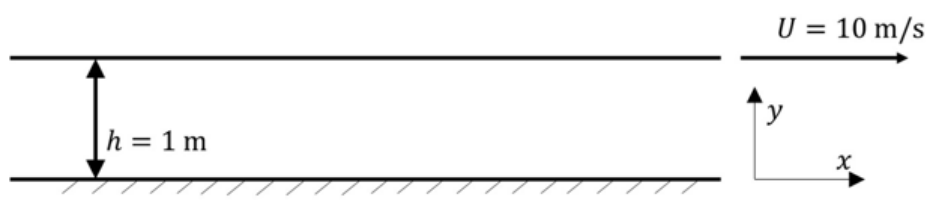
Consider a steady incompressible laminar flow between two parallel long plates separated by a distance \(h = 1\) m as shown in the figure. The bottom plate is fixed, and the flow is driven by the motion of the upper plate alone. No externally imposed pressure exists.
If the upper plate has a velocity of \(U = 10\) m/s, the kinematic viscosity of the fluid is \(10^{-5}\) m²/s and the density of the fluid is \(10^3\) kg/m³, then the shear stress at the bottom plate is __________ N/m² (correct to two decimal places).

Source question diagram

Open complete paper
6
2023 · Naval Architecture & Marine Engineering · Fluid Mechanics and Marine Hydrodynamics · Fluid Mechanics
Naval Architecture & Marine Engineering (NM) 2023
A fully filled water tank OABCD has a circular arc (AB) of radius 10 m at the bottom as shown in the following figure. The height BC is 10 m. The length OA and CD are 5 m and 15 m, respectively. The density of the water is ρ kg/m³ and the acceleration due to gravity is g m/s². The magnitude of the resultant hydrostatic force per unit width acting on AB in N/m lies between
Open complete paper
7
2023 · Naval Architecture & Marine Engineering · Fluid Mechanics and Marine Hydrodynamics · Fluid Mechanics
Naval Architecture & Marine Engineering (NM) 2023
The velocity vector of a 2D flow field is given by \(\vec{V} = 2y^2 \, \hat{i} + x^2 t \, \hat{j}\) .
The acceleration is
Open complete paper
8
2023 · Naval Architecture & Marine Engineering · Fluid Mechanics and Marine Hydrodynamics · Fluid Mechanics
Naval Architecture & Marine Engineering (NM) 2023
For a 2D ideal flow, let \(\varphi\) be the velocity potential and \(\psi\) be the stream function. Which one of the following is TRUE?
Open complete paper
9
2023 · Naval Architecture & Marine Engineering · Fluid Mechanics and Marine Hydrodynamics · Fluid Mechanics
Naval Architecture & Marine Engineering (NM) 2023
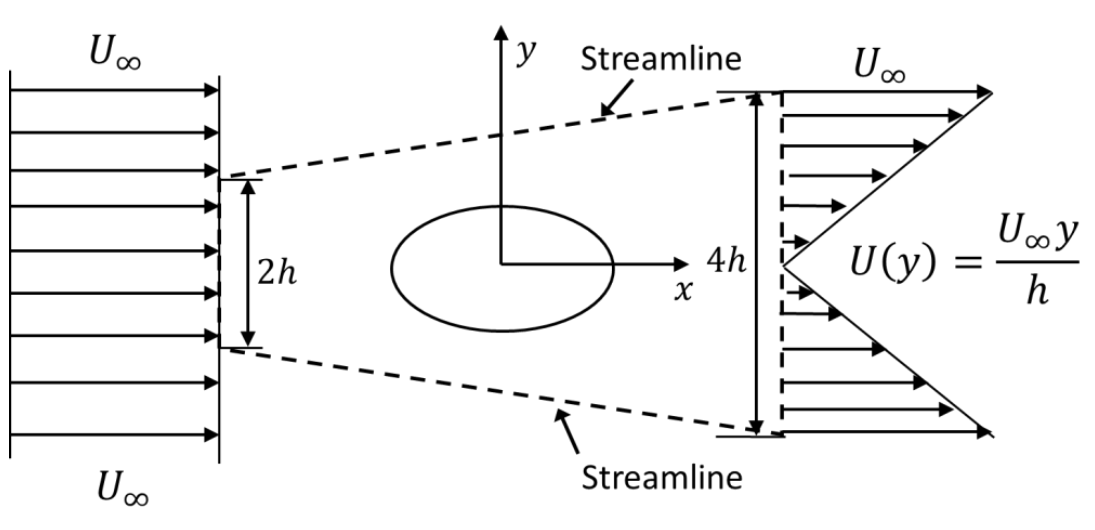
A long body with elliptical cross section is held perpendicular to a 2D uniform steady flow field of horizontal velocity \(U_{\infty}\) as shown in the following figure. The heights of the control volume (bounded by the dashed lines) at the inlet and outlet are \(2h\) and \(4h\), respectively. The profile of the horizontal velocity far downstream is given by \(U(y) = \frac{U_{\infty} y}{2h}\). The density of the fluid is \(\rho\). The magnitude of the drag force per unit length acting on the body is

Source question diagram

Open complete paper
10
2024 · Naval Architecture & Marine Engineering · Fluid Mechanics and Marine Hydrodynamics · Fluid Mechanics
Naval Architecture & Marine Engineering (NM) 2024

Which one of the following is the mass conservation equation?

Open complete paper
11
2024 · Naval Architecture & Marine Engineering · Fluid Mechanics and Marine Hydrodynamics · Fluid Mechanics
Naval Architecture & Marine Engineering (NM) 2024

Identify the type of flow from the time series plots of instantaneous fluid velocity (u) at a point.

Open complete paper
12
2024 · Naval Architecture & Marine Engineering · Fluid Mechanics and Marine Hydrodynamics · Fluid Mechanics
Naval Architecture & Marine Engineering (NM) 2024
A 10 m long pipe with inlet and outlet diameters of 40 cm and 20 cm respectively, is carrying an incompressible fluid with a flow rate of 0.04 m³/s. The ratio of the velocity at the outlet to that at the inlet is _____ (rounded off to one decimal place)
Open complete paper
13
2024 · Naval Architecture & Marine Engineering · Fluid Mechanics and Marine Hydrodynamics · Fluid Mechanics
Naval Architecture & Marine Engineering (NM) 2024
A 100 m long ship has a cruising speed of 25 knots. A geometrically similar model of 4 m length is used for resistance prediction in a towing tank. The corresponding speed of the model is _____ knots.
Open complete paper
14
2024 · Naval Architecture & Marine Engineering · Fluid Mechanics and Marine Hydrodynamics · Fluid Mechanics
Naval Architecture & Marine Engineering (NM) 2024
Consider a fluid between two horizontal parallel flat plates 5 mm apart as shown in the figure. The top plate of dimensions 0.5 m × 2 m is towed with an applied horizontal force F of 0.01 N, while the infinitely long bottom plate is kept fixed. The horizontal velocity profile between the plates is assumed to be linear. If the dynamic viscosity (μ) of the fluid is 0.89 × 10⁻³ N-s/m², then the towing velocity of the top plate is ______ m/s (rounded off to three decimal places).
Open complete paper
15
2024 · Naval Architecture & Marine Engineering · Fluid Mechanics and Marine Hydrodynamics · Fluid Mechanics
Naval Architecture & Marine Engineering (NM) 2024
Consider model testing where \(\lambda\) is the prototype to model length scale ratio. Let \(v_p\) and \(v_m\) denote the corresponding fluid kinematic viscosities. If Froude and Reynolds similarities are maintained between the prototype and model, then which one of the following is correct?
Open complete paper
16
2024 · Naval Architecture & Marine Engineering · Fluid Mechanics and Marine Hydrodynamics · Fluid Mechanics
Naval Architecture & Marine Engineering (NM) 2024
Consider the following momentum equation. Let A, B and C denote the first, second and third term on the left-hand side respectively and, D and E denote the first and second term on the right-hand side respectively. Which of the following statement(s) is/are correct?
\[ \rho \left[ \frac{\partial \boldsymbol{V}}{\partial t} + grad \left( \frac{|\boldsymbol{V}|^2}{2} \right) + (curl \boldsymbol{V}) \times \boldsymbol{V} \right] = -grad(P + \rho gz) + \mu \nabla^2 \boldsymbol{V} \]
Open complete paper
17
2025 · Naval Architecture & Marine Engineering · Fluid Mechanics and Marine Hydrodynamics · Fluid Mechanics
Naval Architecture & Marine Engineering (NM) 2025
The sum of the static pressure and dynamic pressure at a point in a fluid flow is called the ______.
Open complete paper
18
2025 · Naval Architecture & Marine Engineering · Fluid Mechanics and Marine Hydrodynamics · Fluid Mechanics
Naval Architecture & Marine Engineering (NM) 2025

Identify the range of Reynolds number (Re) for a creeping flow.

Open complete paper
19
2025 · Naval Architecture & Marine Engineering · Fluid Mechanics and Marine Hydrodynamics · Fluid Mechanics
Naval Architecture & Marine Engineering (NM) 2025
The ratio of the magnitudes of vorticity to rate of rotation in a fluid flow is ______.
Open complete paper
20
2025 · Naval Architecture & Marine Engineering · Fluid Mechanics and Marine Hydrodynamics · Fluid Mechanics
Naval Architecture & Marine Engineering (NM) 2025

Match the non-dimensional numbers in Column 1 with the corresponding definitions in Column 2

Column 1Column 2
I. Froude numberP. Ratio of inertial force to surface tension force
II. Reynolds numberQ. Ratio of inertial force to gravitational force
III. Euler numberR. Ratio of inertial force to viscous force
IV. Weber numberS. Ratio of pressure force to inertial force
Open complete paper

Showing 20 of 34 questions