My Cart
Your Cart 0

    Your cart is empty.

  • Total (Amount) ₹0.00
Previous year question hub

Underground Hazards - Surface Environment, Mine Ventilation and Underground Hazards - Mining Engineering Previous Year Questions

Practice Underground Hazards - Surface Environment, Mine Ventilation and Underground Hazards - Mining Engineering previous year questions organised from real papers, with year-wise coverage and clear topic navigation.

17Papers
17Years
37Questions
1Topics

Underground Hazards question pattern

Every graph below is calculated only from this selection.

Questions by year

Year-wise coverage for Underground Hazards. Each bar uses a separate theme-derived color.

Difficulty distribution

How the classified questions are distributed by difficulty.

Easy 23 62.2%
Medium 14 37.8%

Question type distribution

MCQ, numerical, multiple-select and other formats found in these papers.

MCQ 34 91.9%
Numerical Answer Type (NAT) 3 8.1%

Subject weightage

Top subjects by unique question coverage.

Mining Engineering
37 Qs

Most asked topics

Top topics across the included previous year papers.

Surface Environment, Mine Ventilation and Underground Hazards
37 Qs

Subtopic coverage

Top subtopics inside this exact selection.

Underground Hazards
37 Qs

Paper coverage

Question coverage for the most populated papers. Every active PYP paper remains listed below.

Mining Engineering (MN) 2025
1 Qs
Mining Engineering (MN) 2024
2 Qs
Mining Engineering (MN) 2023
2 Qs
Mining Engineering (MN) 2022
2 Qs
Mining Engineering (MN) 2020
1 Qs
Mining Engineering (MN) 2019
2 Qs
Mining Engineering (MN) 2018
1 Qs
Mining Engineering (MN) 2017
3 Qs
Mining Engineering (MN) 2016
2 Qs
Mining Engineering (MN) 2014
1 Qs
Mining Engineering (MN) 2013
4 Qs
Mining Engineering (MN) 2012
4 Qs
Mining Engineering (MN) 2011
2 Qs
Mining Engineering (MN) 2010
3 Qs
Mining Engineering (MN) 2009
3 Qs
Mining Engineering (MN) 2008
1 Qs
Mining Engineering (MN) 2007
3 Qs

Included previous year papers

Newest papers appear first. Sort by year, question coverage or name.

PaperYear / sessionQuestions in this viewOpen
Mining Engineering (MN) 202520251View paper
Mining Engineering (MN) 202420242View paper
Mining Engineering (MN) 202320232View paper
Mining Engineering (MN) 202220222View paper
Mining Engineering (MN) 202020201View paper
Mining Engineering (MN) 201920192View paper
Mining Engineering (MN) 201820181View paper
Mining Engineering (MN) 201720173View paper
Mining Engineering (MN) 201620162View paper
Mining Engineering (MN) 201420141View paper
Mining Engineering (MN) 201320134View paper
Mining Engineering (MN) 201220124View paper
Mining Engineering (MN) 201120112View paper
Mining Engineering (MN) 201020103View paper
Mining Engineering (MN) 200920093View paper
Mining Engineering (MN) 200820081View paper
Mining Engineering (MN) 200720073View paper

All Underground Hazards previous year questions

Practice every matching question in batches of 20, with every available option.

1
2007 · Mining Engineering · Surface Environment, Mine Ventilation and Underground Hazards · Underground Hazards
Mining Engineering (MN) 2007
The amount of total stone dust required in kg for a secondary/heavy type stone dust barrier in a roadway of size 4.0 m × 3.0 m is
Open complete paper
2
2007 · Mining Engineering · Surface Environment, Mine Ventilation and Underground Hazards · Underground Hazards
Mining Engineering (MN) 2007

Zener barriers are associated with

Open complete paper
3
2007 · Mining Engineering · Surface Environment, Mine Ventilation and Underground Hazards · Underground Hazards
Mining Engineering (MN) 2007

An underground coal mine employing 1200 persons experienced 12 roof fall injuries during the year 2005. The roof fall injury rate per 1000 persons employed during the period 2005, as per the DGMS norms, is

Open complete paper
4
2008 · Mining Engineering · Surface Environment, Mine Ventilation and Underground Hazards · Underground Hazards
Mining Engineering (MN) 2008
Determine the correctness or otherwise of the following Assertion [a] and the Reason [r]

Assertion: While stone dust barrier may be effective against a coal dust explosion, the same is not true in case of firedamp explosions.

Reason: In general firedamp explosions are much more powerful than coal dust explosions.
Open complete paper
5
2009 · Mining Engineering · Surface Environment, Mine Ventilation and Underground Hazards · Underground Hazards
Mining Engineering (MN) 2009

A gas mask does NOT include

Open complete paper
6
2009 · Mining Engineering · Surface Environment, Mine Ventilation and Underground Hazards · Underground Hazards
Mining Engineering (MN) 2009

As per the DGMS norms, the severity index is a measure of

Open complete paper
7
2009 · Mining Engineering · Surface Environment, Mine Ventilation and Underground Hazards · Underground Hazards
Mining Engineering (MN) 2009

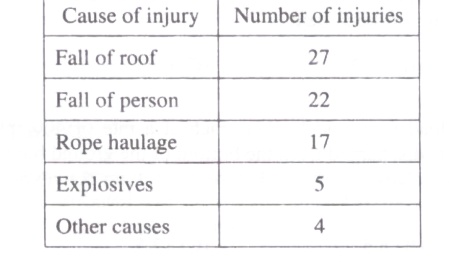
Cause-wise data of injuries in an underground coal mine for a five-year period is given below:

Cause of injuryNumber of injuries
Fall of roof27
Fall of person22
Rope haulage17
Explosives5
Other causes4
The cumulative probability of injury due to fall of roof and fall of person is

Question diagram

Open complete paper
8
2010 · Mining Engineering · Surface Environment, Mine Ventilation and Underground Hazards · Underground Hazards
Mining Engineering (MN) 2010

A coolant is a desirable component in the design of a Self-Contained Breathing Apparatus since

Open complete paper
9
2010 · Mining Engineering · Surface Environment, Mine Ventilation and Underground Hazards · Underground Hazards
Mining Engineering (MN) 2010

Determine the correctness or otherwise of the following Assertion [a] and the Reason [r]

Assertion : Both intake and return side stoppings must be closed simultaneously in the event of sealing off a coal mine panel with explosion hazard following a fire.

Reason : By continuously ventilating the area till simultaneous closure of the stoppings, the possibility of an explosion hazard due to gas build-up is avoided.

Open complete paper
10
2010 · Mining Engineering · Surface Environment, Mine Ventilation and Underground Hazards · Underground Hazards
Mining Engineering (MN) 2010

For electric signaling systems in underground coal mines, the statement that is NOT true is

Open complete paper
11
2011 · Mining Engineering · Surface Environment, Mine Ventilation and Underground Hazards · Underground Hazards
Mining Engineering (MN) 2011

The type of fire extinguisher that must NOT be used in case of fire in an electric substation located in an underground metal mine is

Open complete paper
12
2011 · Mining Engineering · Surface Environment, Mine Ventilation and Underground Hazards · Underground Hazards
Mining Engineering (MN) 2011

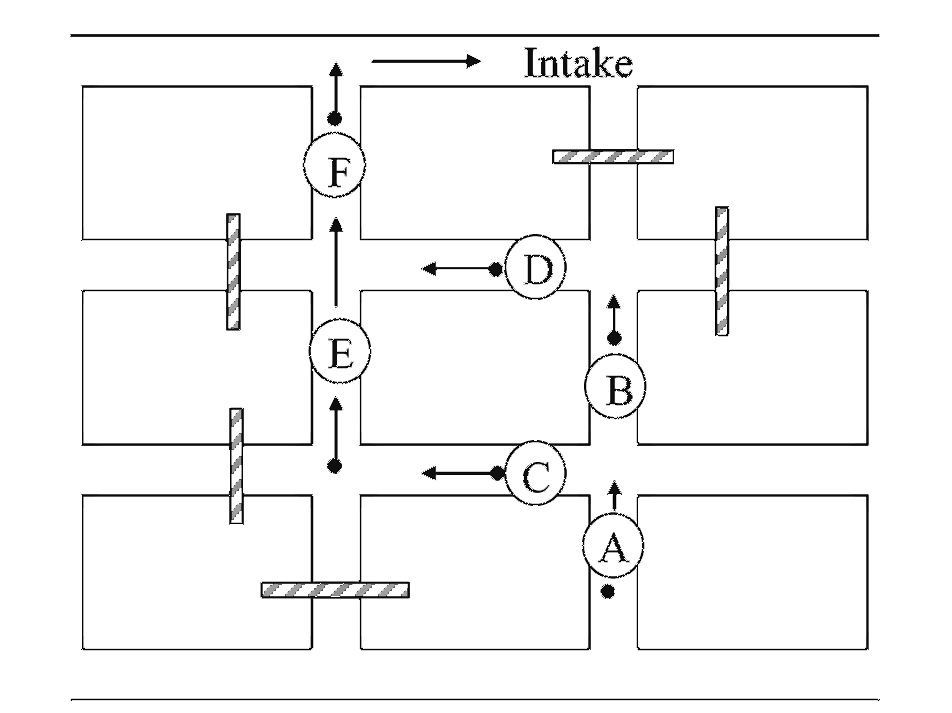
A sudden increase of CO incidence has occurred in an underground mine section. A man at point A starts to run out to the main intake of the mine where he will be safe. Refer figure below for the mine section and the logic diagram. The probabilities that he will successfully cross the gallery sections A, B, C, D, E, and F are 0.9, 0.8, 0.7, 0.8, 0.7 and 0.9 respectively. The probability that he will successfully reach the main intake is

Open complete paper
13
2012 · Mining Engineering · Surface Environment, Mine Ventilation and Underground Hazards · Underground Hazards
Mining Engineering (MN) 2012

Nystagmus is a miner’s disease associated with

Open complete paper
14
2012 · Mining Engineering · Surface Environment, Mine Ventilation and Underground Hazards · Underground Hazards
Mining Engineering (MN) 2012
The match the following
Mine gasPrincipal constituent
PStink damp1CO
QWhite damp2H2S
RBlack damp3CH4
SFire damp4CO2

Question diagram

Open complete paper
15
2012 · Mining Engineering · Surface Environment, Mine Ventilation and Underground Hazards · Underground Hazards
Mining Engineering (MN) 2012
A Dragger Gas Mask DOES NOT filter
Open complete paper
16
2012 · Mining Engineering · Surface Environment, Mine Ventilation and Underground Hazards · Underground Hazards
Mining Engineering (MN) 2012
The injury rates of mine workers in an underground coal mine based on age group are given below:
Age group of mine workersAge-specific injury rate (per 1000 persons)Age-specific population in the mine
18 – 321.81000
33 – 462.5500
47 – 604.5300

The injury rate per 1000 persons employed in the mine for the total population is

Question diagram

Open complete paper
17
2013 · Mining Engineering · Surface Environment, Mine Ventilation and Underground Hazards · Underground Hazards
Mining Engineering (MN) 2013
In the Coward flammability diagram, the respective percentages of methane and oxygen at the nose limit are
Open complete paper
18
2013 · Mining Engineering · Surface Environment, Mine Ventilation and Underground Hazards · Underground Hazards
Mining Engineering (MN) 2013

Incubation period is NOT related to

Open complete paper
19
2013 · Mining Engineering · Surface Environment, Mine Ventilation and Underground Hazards · Underground Hazards
Mining Engineering (MN) 2013

In an experiment to study coal dust explosibility, it is found that at least 3.0 g of limestone dust should be added to a sample of 2.0 g of coal dust to ensure that propagation of flame does not take place. The explosibility factor of coal dust is

Open complete paper
20
2013 · Mining Engineering · Surface Environment, Mine Ventilation and Underground Hazards · Underground Hazards
Mining Engineering (MN) 2013
Given the following,
Rescue apparatusCharacteristic
P. Draeger BG-41. Open circuit chemical oxygen self-rescuer
Q. MSA IW-652. Filter type self-rescuer
R. Draeger Pulmotor3. Self-contained breathing apparatus
S. Oxyboks4. Resuscitation apparatus
the correct match is
Open complete paper

Showing 20 of 37 questions