My Cart
Your Cart 0

    Your cart is empty.

  • Total (Amount) ₹0.00
Previous year question hub

Systems Engineering - Mineral Economics, Mine Planning, Systems Engineering - Mining Engineering Previous Year Questions

Practice Systems Engineering - Mineral Economics, Mine Planning, Systems Engineering - Mining Engineering previous year questions organised from real papers, with year-wise coverage and clear topic navigation.

17Papers
17Years
43Questions
1Topics

Systems Engineering question pattern

Every graph below is calculated only from this selection.

Questions by year

Year-wise coverage for Systems Engineering. Each bar uses a separate theme-derived color.

Difficulty distribution

How the classified questions are distributed by difficulty.

Medium 22 51.2%
Easy 21 48.8%

Question type distribution

MCQ, numerical, multiple-select and other formats found in these papers.

MCQ 29 67.4%
Numerical Answer Type (NAT) 14 32.6%

Subject weightage

Top subjects by unique question coverage.

Mining Engineering
43 Qs

Most asked topics

Top topics across the included previous year papers.

Mineral Economics, Mine Planning, Systems Engineering
43 Qs

Subtopic coverage

Top subtopics inside this exact selection.

Systems Engineering
43 Qs

Paper coverage

Question coverage for the most populated papers. Every active PYP paper remains listed below.

Mining Engineering (MN) 2025
1 Qs
Mining Engineering (MN) 2024
1 Qs
Mining Engineering (MN) 2023
4 Qs
Mining Engineering (MN) 2022
3 Qs
Mining Engineering (MN) 2021
3 Qs
Mining Engineering (MN) 2020
3 Qs
Mining Engineering (MN) 2019
1 Qs
Mining Engineering (MN) 2018
2 Qs
Mining Engineering (MN) 2016
2 Qs
Mining Engineering (MN) 2014
2 Qs
Mining Engineering (MN) 2013
1 Qs
Mining Engineering (MN) 2012
2 Qs
Mining Engineering (MN) 2011
2 Qs
Mining Engineering (MN) 2010
2 Qs
Mining Engineering (MN) 2009
4 Qs
Mining Engineering (MN) 2008
6 Qs
Mining Engineering (MN) 2007
4 Qs

Included previous year papers

Newest papers appear first. Sort by year, question coverage or name.

PaperYear / sessionQuestions in this viewOpen
Mining Engineering (MN) 202520251View paper
Mining Engineering (MN) 202420241View paper
Mining Engineering (MN) 202320234View paper
Mining Engineering (MN) 202220223View paper
Mining Engineering (MN) 202120213View paper
Mining Engineering (MN) 202020203View paper
Mining Engineering (MN) 201920191View paper
Mining Engineering (MN) 201820182View paper
Mining Engineering (MN) 201620162View paper
Mining Engineering (MN) 201420142View paper
Mining Engineering (MN) 201320131View paper
Mining Engineering (MN) 201220122View paper
Mining Engineering (MN) 201120112View paper
Mining Engineering (MN) 201020102View paper
Mining Engineering (MN) 200920094View paper
Mining Engineering (MN) 200820086View paper
Mining Engineering (MN) 200720074View paper

All Systems Engineering previous year questions

Practice every matching question in batches of 20, with every available option.

1
2007 · Mining Engineering · Mineral Economics, Mine Planning, Systems Engineering · Systems Engineering
Mining Engineering (MN) 2007
The cost of diesel is Rs. $\left( 25 + \frac{x}{90} \right)$ per km to drive a dump truck at a speed of $x$ km/hour. The maintenance cost of the truck is Rs. 10 per hour. To minimize the cost per km, the truck speed in km/hour is
Open complete paper
2
2007 · Mining Engineering · Mineral Economics, Mine Planning, Systems Engineering · Systems Engineering
Mining Engineering (MN) 2007
The time between successive failures (in hours) of a side discharge loader operating in a mechanised underground coal mine are as follows: 62, 58, 54, 50, 52, 60, 58, 57, 50, 53 If the failure data follow an exponential distribution, then reliability of the equipment for a period of 50 hours is
Open complete paper
3
2007 · Mining Engineering · Mineral Economics, Mine Planning, Systems Engineering · Systems Engineering
Mining Engineering (MN) 2007
Three jobs A, B, and C are to be assigned to three machines X, Y, and Z. The processing costs are given below: The minimum total cost of assigning the jobs to the machines is
Open complete paper
4
2007 · Mining Engineering · Mineral Economics, Mine Planning, Systems Engineering · Systems Engineering
Mining Engineering (MN) 2007
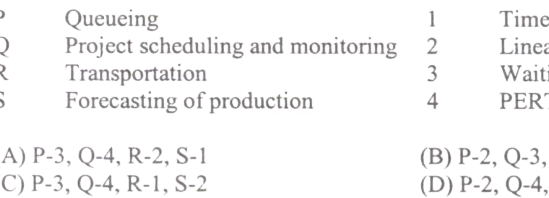
Match the following Problem P Queueing Q Project scheduling and monitoring R Transportation S Forecasting of production Technique 1 Time series models 2 Linear programming models 3 Waiting line models 4 PERT and CPM

Question diagram

Open complete paper
5
2008 · Mining Engineering · Mineral Economics, Mine Planning, Systems Engineering · Systems Engineering
Mining Engineering (MN) 2008
Q.18 In PERT network, the activity duration is assumed to follow
Open complete paper
6
2008 · Mining Engineering · Mineral Economics, Mine Planning, Systems Engineering · Systems Engineering
Mining Engineering (MN) 2008
Q.19 For an LP problem, identify the INCORRECT statement
Open complete paper
7
2008 · Mining Engineering · Mineral Economics, Mine Planning, Systems Engineering · Systems Engineering
Mining Engineering (MN) 2008
In a mine, a control chart constructed for fixed carbon has upper and lower limits of 49% and 41% respectively. On a day, the five group average values of fixed carbon are 42%, 43%, 40%, 50% and 49.5%. If the process control rule of the mine is to have not more than 2 out of 5 samples to be out of the control chart, the process on that day is
Open complete paper
8
2008 · Mining Engineering · Mineral Economics, Mine Planning, Systems Engineering · Systems Engineering
Mining Engineering (MN) 2008

A system of two identical mine pumps connected in series has reliability 0.49. If the pumps were to be connected in parallel, the system reliability would be

Open complete paper
9
2008 · Mining Engineering · Mineral Economics, Mine Planning, Systems Engineering · Systems Engineering
Mining Engineering (MN) 2008
The total cost of transportation based on the initial basic feasible solution obtained by the North-West corner rule is
Open complete paper
10
2008 · Mining Engineering · Mineral Economics, Mine Planning, Systems Engineering · Systems Engineering
Mining Engineering (MN) 2008
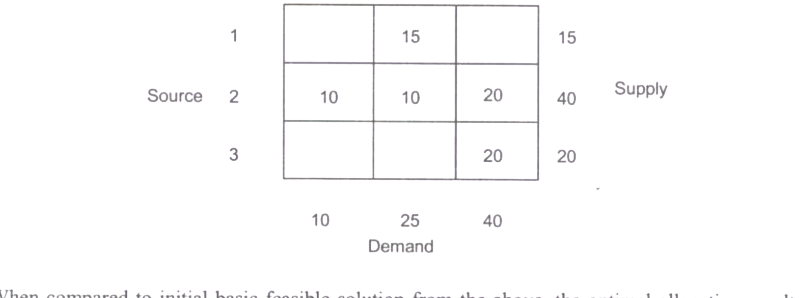
The optimal solution for the transportation problem has allocation as shown below:
Destination
Source123Supply
11515
210102040
32020
Demand102540

When compared to initial basic feasible solution from the above, the optimal allocation results in savings of

Question diagram

Open complete paper
11
2009 · Mining Engineering · Mineral Economics, Mine Planning, Systems Engineering · Systems Engineering
Mining Engineering (MN) 2009

A balanced transportation problem is characterized by

Open complete paper
12
2009 · Mining Engineering · Mineral Economics, Mine Planning, Systems Engineering · Systems Engineering
Mining Engineering (MN) 2009

In the context of project management techniques, the TRUE statement is

Open complete paper
13
2009 · Mining Engineering · Mineral Economics, Mine Planning, Systems Engineering · Systems Engineering
Mining Engineering (MN) 2009

Two belt conveyors load a ground bunker, each at a rate of 400 tph, which is initially filled with 10000 t of coal. Coal is discharged from the bottom of the ground bunker onto a belt conveyor at a rate of 1200 tph. The time elapsed in hours before the bottom conveyor starts to operate below its rated capacity is

Open complete paper
14
2009 · Mining Engineering · Mineral Economics, Mine Planning, Systems Engineering · Systems Engineering
Mining Engineering (MN) 2009
Average time spent by a workman waiting for his turn to be served in min is
Open complete paper
15
2010 · Mining Engineering · Mineral Economics, Mine Planning, Systems Engineering · Systems Engineering
Mining Engineering (MN) 2010

The queue of trucks at a crusher plant hopper is known to be M/M/1 queue. The probability that there is no truck to unload is 0.3. Due to rains the mean service time at the hopper is increased by 30%. As a consequence, the expected number of trucks in the queuing system (including the one possibly unloading) becomes

Open complete paper
16
2010 · Mining Engineering · Mineral Economics, Mine Planning, Systems Engineering · Systems Engineering
Mining Engineering (MN) 2010
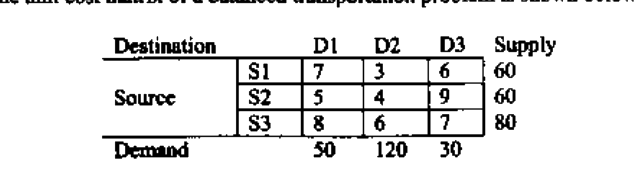
The unit cost matrix of a balanced transportation problem is shown below
DestinationD1D2D3Supply
S173660
SourceS254960
S386780
Demand5012030

The transportation cost of the initial basic feasible solution obtained by the North-West corner rule is

Question diagram

Open complete paper
17
2011 · Mining Engineering · Mineral Economics, Mine Planning, Systems Engineering · Systems Engineering
Mining Engineering (MN) 2011

ISO 9000 Quality Systems DO NOT contain

Open complete paper
18
2011 · Mining Engineering · Mineral Economics, Mine Planning, Systems Engineering · Systems Engineering
Mining Engineering (MN) 2011
The time study data of an equipment deployed in a mine during a calendar month is given below.
Total working hours = 400
Total maintenance hours = 100
Total hours of actual work = 240

The percentage of utilization of the equipment is
Open complete paper
19
2012 · Mining Engineering · Mineral Economics, Mine Planning, Systems Engineering · Systems Engineering
Mining Engineering (MN) 2012

A system consists of four elements A, B, C and D which are connected functionally in a parallel configuration. The individual reliability of the elements is 0.80, 0.82, 0.85 and 0.90 respectively. The reliability of the system is

Open complete paper
20
2012 · Mining Engineering · Mineral Economics, Mine Planning, Systems Engineering · Systems Engineering
Mining Engineering (MN) 2012

The standard deviation of the project length in months is

Open complete paper

Showing 20 of 43 questions