My Cart
Your Cart 0

    Your cart is empty.

  • Total (Amount) ₹0.00
Previous year question hub

Mineral Economics - Mineral Economics, Mine Planning, Systems Engineering - Mining Engineering Previous Year Questions

Practice Mineral Economics - Mineral Economics, Mine Planning, Systems Engineering - Mining Engineering previous year questions organised from real papers, with year-wise coverage and clear topic navigation.

18Papers
18Years
54Questions
1Topics

Mineral Economics question pattern

Every graph below is calculated only from this selection.

Questions by year

Year-wise coverage for Mineral Economics. Each bar uses a separate theme-derived color.

Difficulty distribution

How the classified questions are distributed by difficulty.

Easy 31 57.4%
Medium 23 42.6%

Question type distribution

MCQ, numerical, multiple-select and other formats found in these papers.

MCQ 33 61.1%
Numerical Answer Type (NAT) 20 37%
MSQ 1 1.9%

Subject weightage

Top subjects by unique question coverage.

Mining Engineering
54 Qs

Most asked topics

Top topics across the included previous year papers.

Mineral Economics, Mine Planning, Systems Engineering
54 Qs

Subtopic coverage

Top subtopics inside this exact selection.

Mineral Economics
54 Qs

Paper coverage

Question coverage for the most populated papers. Every active PYP paper remains listed below.

Mining Engineering (MN) 2025
2 Qs
Mining Engineering (MN) 2024
3 Qs
Mining Engineering (MN) 2023
2 Qs
Mining Engineering (MN) 2022
4 Qs
Mining Engineering (MN) 2021
6 Qs
Mining Engineering (MN) 2020
5 Qs
Mining Engineering (MN) 2019
3 Qs
Mining Engineering (MN) 2018
3 Qs
Mining Engineering (MN) 2017
3 Qs
Mining Engineering (MN) 2016
3 Qs
Mining Engineering (MN) 2014
1 Qs
Mining Engineering (MN) 2013
2 Qs
Mining Engineering (MN) 2012
1 Qs
Mining Engineering (MN) 2011
4 Qs
Mining Engineering (MN) 2010
2 Qs
Mining Engineering (MN) 2009
4 Qs
Mining Engineering (MN) 2008
3 Qs
Mining Engineering (MN) 2007
3 Qs

Included previous year papers

Newest papers appear first. Sort by year, question coverage or name.

PaperYear / sessionQuestions in this viewOpen
Mining Engineering (MN) 202520252View paper
Mining Engineering (MN) 202420243View paper
Mining Engineering (MN) 202320232View paper
Mining Engineering (MN) 202220224View paper
Mining Engineering (MN) 202120216View paper
Mining Engineering (MN) 202020205View paper
Mining Engineering (MN) 201920193View paper
Mining Engineering (MN) 201820183View paper
Mining Engineering (MN) 201720173View paper
Mining Engineering (MN) 201620163View paper
Mining Engineering (MN) 201420141View paper
Mining Engineering (MN) 201320132View paper
Mining Engineering (MN) 201220121View paper
Mining Engineering (MN) 201120114View paper
Mining Engineering (MN) 201020102View paper
Mining Engineering (MN) 200920094View paper
Mining Engineering (MN) 200820083View paper
Mining Engineering (MN) 200720073View paper

All Mineral Economics previous year questions

Practice every matching question in batches of 20, with every available option.

1
2007 · Mining Engineering · Mineral Economics, Mine Planning, Systems Engineering · Mineral Economics
Mining Engineering (MN) 2007

A company invested Rs. 4 lakh in a machine with an expected useful life of 12 years. The net income expected from the operation of the machine is Rs. 80,000 per annum. The payback period for the machine in years is

Open complete paper
2
2007 · Mining Engineering · Mineral Economics, Mine Planning, Systems Engineering · Mineral Economics
Mining Engineering (MN) 2007
The net present value in Rs. of a 3 -year annuity of Rs. 10,000 discounted at 10% is
Open complete paper
3
2007 · Mining Engineering · Mineral Economics, Mine Planning, Systems Engineering · Mineral Economics
Mining Engineering (MN) 2007

Assume the grade at A to be the average grade of copper, mill recovery to be 85% and the smelting & refining losses to be 1.0 kg of copper per tonne of ore. The amount of saleable copper in kg/tonne of ore is

Open complete paper
4
2008 · Mining Engineering · Mineral Economics, Mine Planning, Systems Engineering · Mineral Economics
Mining Engineering (MN) 2008
If the value of ore is Rs. 600 per tonne, production cost Rs. 400 per tonne, and cost of overburden removal Rs. 50 per m³, the break-even stripping ratio in m³/tonne is
Open complete paper
5
2008 · Mining Engineering · Mineral Economics, Mine Planning, Systems Engineering · Mineral Economics
Mining Engineering (MN) 2008
The following information is provided for an ore deposit:
Number of waste blocks = 10
Number of ore blocks = 5
Volume of each waste block, m³ = 600
Total cost of waste handling per m³ = Rs. 100
Tonnage of each ore block = 400
Total cost of ore handling per ton = Rs. 150
Sale price of ore per ton = Rs. 500
The net cash flow of mining the deposit in lakhs of rupees, is
Open complete paper
6
2008 · Mining Engineering · Mineral Economics, Mine Planning, Systems Engineering · Mineral Economics
Mining Engineering (MN) 2008
A cash flow diagram is shown below. Based on NPV, at 10% rate of interest, the minimum annuity ‘x’ at which the investment becomes viable is
Open complete paper
7
2009 · Mining Engineering · Mineral Economics, Mine Planning, Systems Engineering · Mineral Economics
Mining Engineering (MN) 2009

An iron ore deposit has a mean grade of 63% Fe. During the course of mining, 30% fines by weight are generated at a grade of 72% Fe which are rejected. The effective mean grade of the deposit in Fe percentage is

Open complete paper
8
2009 · Mining Engineering · Mineral Economics, Mine Planning, Systems Engineering · Mineral Economics
Mining Engineering (MN) 2009

For mining property appraisals, typical reports prepared are Bankable Feasibility Report (BFR), Conceptual Plan Report (CPR), Feasibility Report (FR) and Detailed Project Report (DPR). The chronological order for the preparation of these reports is

Open complete paper
9
2009 · Mining Engineering · Mineral Economics, Mine Planning, Systems Engineering · Mineral Economics
Mining Engineering (MN) 2009

A mining equipment has a life of 5 years with no salvage value. Assuming that the depreciation of the equipment is calculated by the straight line method, the average annual value of the equipment in percentage of its original value is

Open complete paper
10
2009 · Mining Engineering · Mineral Economics, Mine Planning, Systems Engineering · Mineral Economics
Mining Engineering (MN) 2009

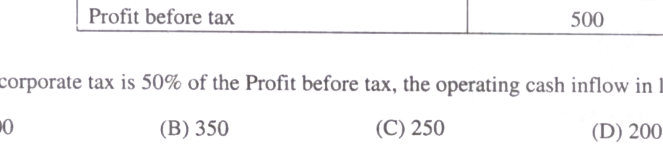
The cash flow table of a manganese mine for a particular year is shown below:

ItemAmount (Rs. in lakhs)
Revenue900
Cost (other than depreciation)300
Depreciation100
Profit before tax500
If the corporate tax is 50% of the Profit before tax, the operating cash inflow in lakhs of Rupees is

Question diagram

Open complete paper
11
2010 · Mining Engineering · Mineral Economics, Mine Planning, Systems Engineering · Mineral Economics
Mining Engineering (MN) 2010
For a mine of production \( t \) per year, the total cost of production is given by \( at^2 + b \). The revenue from sale is given by \( ct \). If \( a, b, \) and \( c \) are constants, the breakeven value of \( t \) is
Open complete paper
12
2010 · Mining Engineering · Mineral Economics, Mine Planning, Systems Engineering · Mineral Economics
Mining Engineering (MN) 2010

Payback period is time required

Open complete paper
13
2011 · Mining Engineering · Mineral Economics, Mine Planning, Systems Engineering · Mineral Economics
Mining Engineering (MN) 2011
The sale value of chromite ore from an open pit mine is Rs. 6500 per tonne. Cost of mining, excluding stripping cost, is Rs. 2450 per tonne. If the cost of stripping is Rs. 1150 per m³, the break-even stripping ratio in m³/tonne is
Open complete paper
14
2011 · Mining Engineering · Mineral Economics, Mine Planning, Systems Engineering · Mineral Economics
Mining Engineering (MN) 2011

An investment at 10% yearly interest rate, compounded quarterly, accumulates to a sum of Rs. 120,000 in 5 years. The present value of the sum in rupees is

Open complete paper
15
2011 · Mining Engineering · Mineral Economics, Mine Planning, Systems Engineering · Mineral Economics
Mining Engineering (MN) 2011
The amount of copper in concentrate in kg is
Open complete paper
16
2011 · Mining Engineering · Mineral Economics, Mine Planning, Systems Engineering · Mineral Economics
Mining Engineering (MN) 2011
Amount of concentrate produced from 1 tonne of ore in kg is
Open complete paper
17
2012 · Mining Engineering · Mineral Economics, Mine Planning, Systems Engineering · Mineral Economics
Mining Engineering (MN) 2012

An investment of Rs. 10,000, compounded annually, is estimated to return Rs. 20,000 after 6 years from the date of investment. The expected rate of return on this investment in percentage is

Open complete paper
18
2013 · Mining Engineering · Mineral Economics, Mine Planning, Systems Engineering · Mineral Economics
Mining Engineering (MN) 2013
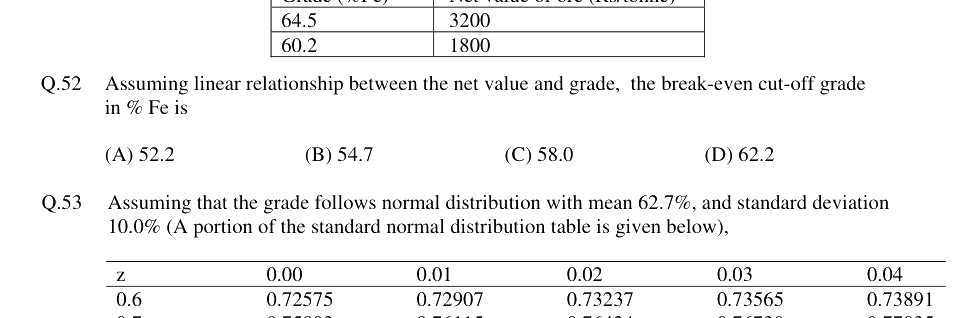
Assuming linear relationship between the net value and grade, the break-even cut-off grade in % Fe is

Question diagram

Open complete paper
19
2013 · Mining Engineering · Mineral Economics, Mine Planning, Systems Engineering · Mineral Economics
Mining Engineering (MN) 2013
Assuming that the grade follows normal distribution with mean 62.7%, and standard deviation 10.0% (A portion of the standard normal distribution table is given below),
z0.000.010.020.030.04
0.60.725750.729070.732370.735650.73891
0.70.758030.761150.764240.767300.77035
0.80.788140.791030.793890.796730.79954
0.90.815940.818590.821210.823810.82639
1.00.841340.843750.846130.848490.85083
the percentage of waste in the deposit based on the break-even cut-off grade is

Question diagram

Open complete paper
20
2014 · Mining Engineering · Mineral Economics, Mine Planning, Systems Engineering · Mineral Economics
Mining Engineering (MN) 2014
A coal mine receives two bids for purchase of a new dragline. The first bid quotes Rs. 150 crore as a price to be paid in full on delivery. The second bid quotes Rs. 180 crore as a price payable at the end of the third year after delivery. If the discount rate is 12%, the difference in NPV between the first and second bids in crore of rupees is ______
Open complete paper

Showing 20 of 53 questions