My Cart
Your Cart 0

    Your cart is empty.

  • Total (Amount) ₹0.00
Previous year question hub

Mine Planning - Mineral Economics, Mine Planning, Systems Engineering - Mining Engineering Previous Year Questions

Practice Mine Planning - Mineral Economics, Mine Planning, Systems Engineering - Mining Engineering previous year questions organised from real papers, with year-wise coverage and clear topic navigation.

13Papers
13Years
30Questions
1Topics

Mine Planning question pattern

Every graph below is calculated only from this selection.

Questions by year

Year-wise coverage for Mine Planning. Each bar uses a separate theme-derived color.

Difficulty distribution

How the classified questions are distributed by difficulty.

Medium 22 73.3%
Easy 7 23.3%
Hard 1 3.3%
Question type distribution

MCQ, numerical, multiple-select and other formats found in these papers.

MCQ 22 73.3%
Numerical Answer Type (NAT) 7 23.3%
Fill in the blanks 1 3.3%

Subject weightage

Top subjects by unique question coverage.

Mining Engineering
30 Qs

Most asked topics

Top topics across the included previous year papers.

Mineral Economics, Mine Planning, Systems Engineering
30 Qs

Subtopic coverage

Top subtopics inside this exact selection.

Mine Planning
30 Qs

Paper coverage

Question coverage for the most populated papers. Every active PYP paper remains listed below.

Mining Engineering (MN) 2024
3 Qs
Mining Engineering (MN) 2022
2 Qs
Mining Engineering (MN) 2021
1 Qs
Mining Engineering (MN) 2020
1 Qs
Mining Engineering (MN) 2019
2 Qs
Mining Engineering (MN) 2018
2 Qs
Mining Engineering (MN) 2017
4 Qs
Mining Engineering (MN) 2013
2 Qs
Mining Engineering (MN) 2012
3 Qs
Mining Engineering (MN) 2010
2 Qs
Mining Engineering (MN) 2009
3 Qs
Mining Engineering (MN) 2008
4 Qs
Mining Engineering (MN) 2007
1 Qs

Included previous year papers

Newest papers appear first. Sort by year, question coverage or name.

PaperYear / sessionQuestions in this viewOpen
Mining Engineering (MN) 202420243View paper
Mining Engineering (MN) 202220222View paper
Mining Engineering (MN) 202120211View paper
Mining Engineering (MN) 202020201View paper
Mining Engineering (MN) 201920192View paper
Mining Engineering (MN) 201820182View paper
Mining Engineering (MN) 201720174View paper
Mining Engineering (MN) 201320132View paper
Mining Engineering (MN) 201220123View paper
Mining Engineering (MN) 201020102View paper
Mining Engineering (MN) 200920093View paper
Mining Engineering (MN) 200820084View paper
Mining Engineering (MN) 200720071View paper

All Mine Planning previous year questions

Practice every matching question in batches of 20, with every available option.

1
2007 · Mining Engineering · Mineral Economics, Mine Planning, Systems Engineering · Mine Planning
Mining Engineering (MN) 2007
Consider the following linear programming problem: Maximize \(Z = 6X_1 + 4X_2\) Subject to \(2X_1 \leq 8\) \(2X_2 \leq 12\) \(3X_1 + 2X_2 \leq 18\) \(X_1 \geq 0, X_2 \geq 0\) The multiple optimal solutions lie on the line joining the corner points

Question diagram

Open complete paper
2
2008 · Mining Engineering · Mineral Economics, Mine Planning, Systems Engineering · Mine Planning
Mining Engineering (MN) 2008

Four mines A, B, C and D are located along a road as shown with production in Mt per year 1, 2, 1 and 3 respectively. In order to handle total coal produced, the ideal distance of a coal washery along the road from the mine A in km is

Open complete paper
3
2008 · Mining Engineering · Mineral Economics, Mine Planning, Systems Engineering · Mine Planning
Mining Engineering (MN) 2008
A mining project comprising of A, B, and C activities is scheduled for 90 days at a cost of Rs.1200 million. The manager of the project decides to reduce the time for completion of the project to 85 days. The decision was taken after 45 days.
ActivityABC
Duration(days)401535
Crashing cost/day (million rupees)152520
The minimum project cost in million rupees after crashing by 5 days is

Question diagram

Open complete paper
4
2008 · Mining Engineering · Mineral Economics, Mine Planning, Systems Engineering · Mine Planning
Mining Engineering (MN) 2008
Block economic values in a 2D block model are shown below. Then based on the assumption of 1:1 slope angle, the blocks (identified by row and column numbers) that constitute the ultimate pit are
1234
1-1-11-1
2-113-1
3-1-1-1-1
Open complete paper
5
2008 · Mining Engineering · Mineral Economics, Mine Planning, Systems Engineering · Mine Planning
Mining Engineering (MN) 2008

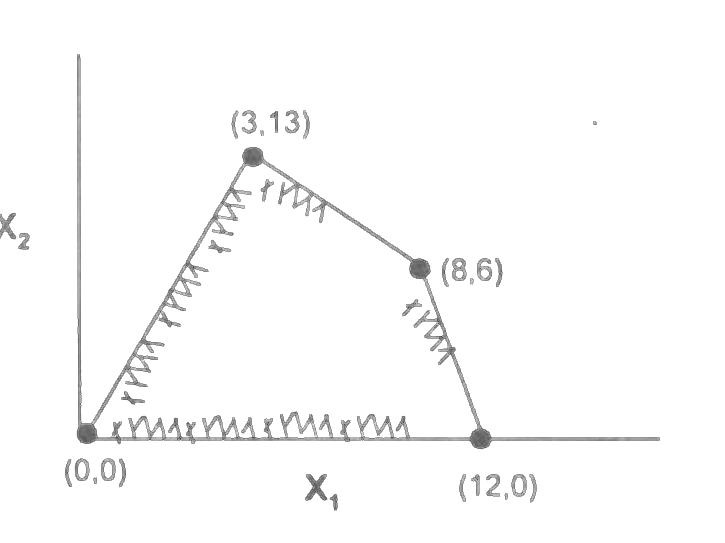
The feasible region of an LP problem is shown as given below. The maximum value of the objective function Z = 1600x1 + 1200x2 is

Open complete paper
6
2009 · Mining Engineering · Mineral Economics, Mine Planning, Systems Engineering · Mine Planning
Mining Engineering (MN) 2009
A mine having a reserve of 320 Mt produces 4 Mt of ore at the end of 1ˢᵗ year. If the mine increases production by 10% every year, the percentage of the reserve that still remains at the end of 21ˢᵗ year is
Open complete paper
7
2009 · Mining Engineering · Mineral Economics, Mine Planning, Systems Engineering · Mine Planning
Mining Engineering (MN) 2009
A mine workshop has 4 lathe machines and 4 tasks for completion. Each of the machines can perform each of the 4 tasks. Each task can be assigned to one and only one machine. Estimated cost in Rupees to complete each task is given in the matrix below.
TaskMachine
M1M2M3M4
T161925272
T242496985
T347598071
T465706872
The total optimum cost in Rupees for assigning the tasks to the machines is

Question diagram

Open complete paper
8
2009 · Mining Engineering · Mineral Economics, Mine Planning, Systems Engineering · Mine Planning
Mining Engineering (MN) 2009

In a mine site, the cost of shaft sinking in lakhs of Rupees is given as 2.64D + 34.8, where D is the shaft depth in m. In the same site, the corresponding cost of driving an incline is 0.96L, where L is the length of the incline in m. Assuming L by D ratio is 3.0, the depth in m beyond which the shaft sinking becomes more economical is

Open complete paper
9
2010 · Mining Engineering · Mineral Economics, Mine Planning, Systems Engineering · Mine Planning
Mining Engineering (MN) 2010

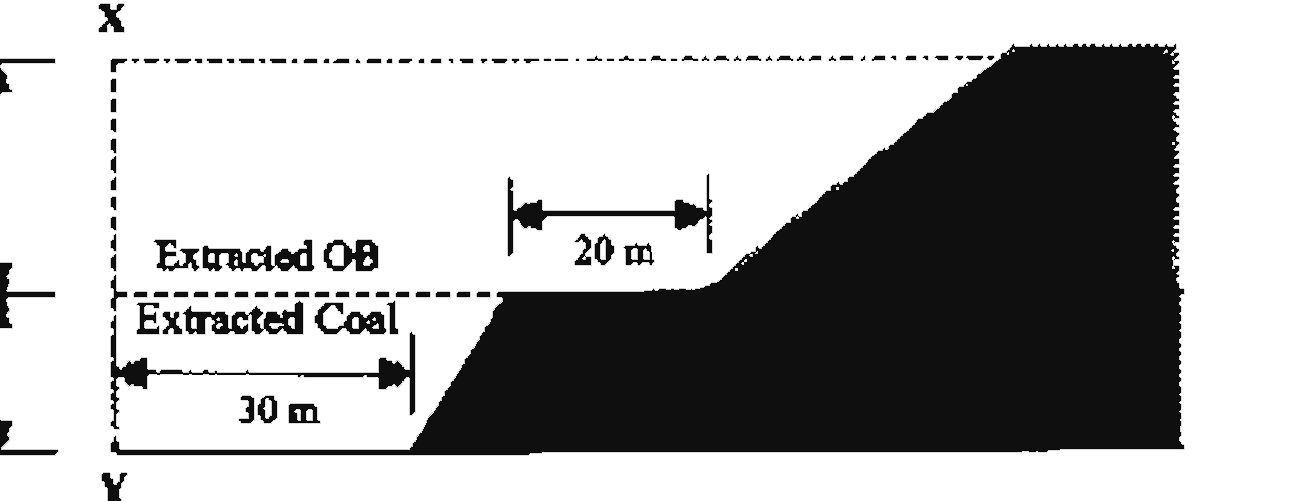
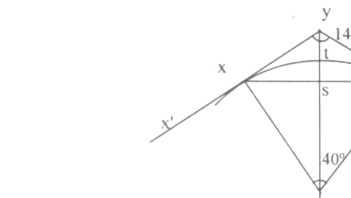
In an opencast mine shown in the figure below the coal has a density of 1.4 tonne/m3. Assuming mining operation started from plane XY, the operating stripping ratio under the given conditions in m3/tonne is

Open complete paper
10
2010 · Mining Engineering · Mineral Economics, Mine Planning, Systems Engineering · Mine Planning
Mining Engineering (MN) 2010

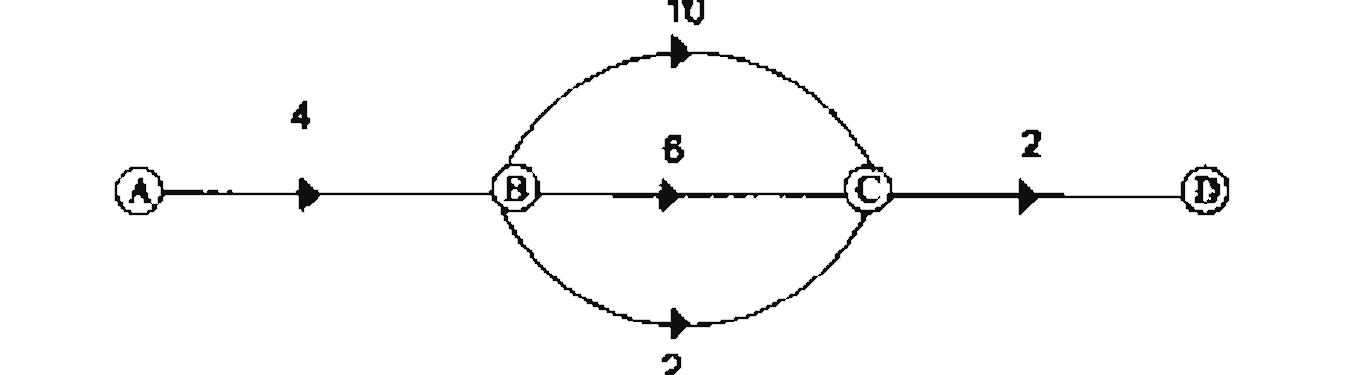
A project network comprises five activities as shown below. The activity durations, in days, are as indicated. Crashing of any activity costs Rs. 1000 per day. If the project is crashed to the shortest possible duration, the total crashing cost in Rupees is

Open complete paper
11
2012 · Mining Engineering · Mineral Economics, Mine Planning, Systems Engineering · Mine Planning
Mining Engineering (MN) 2012
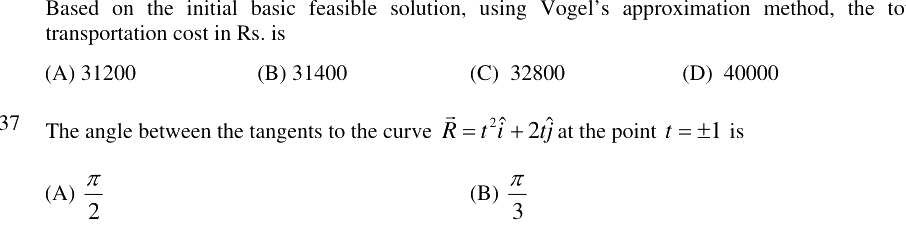
A mining company has three mines (M1, M2 and M3) that supply coal to three power plants (P1, P2 and P3). The three mines produce 900, 1000 and 1200 te of coal per day respectively. The power plant requirements from these three mines are 1200, 1000 and 900 te per day respectively. The unit cost of transporting coal from the three mines to the three power plants in Rs. is given below
Power plants
P1P2P3
M181012
Mines M2121312
M3141011

Based on the initial basic feasible solution, using Vogel’s approximation method, the total transportation cost in Rs. is

Question diagram

Open complete paper
12
2012 · Mining Engineering · Mineral Economics, Mine Planning, Systems Engineering · Mine Planning
Mining Engineering (MN) 2012
The annual production target in Mte is
Open complete paper
13
2012 · Mining Engineering · Mineral Economics, Mine Planning, Systems Engineering · Mine Planning
Mining Engineering (MN) 2012
The expected duration of the mining project in months is
Open complete paper
14
2013 · Mining Engineering · Mineral Economics, Mine Planning, Systems Engineering · Mine Planning
Mining Engineering (MN) 2013
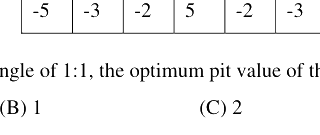
Block economic values in Lakhs of Rupees for a section of a block economic model are shown below.
-1-11-10-1
-1000-1-2
-5-3-25-2-3

At a permissible slope angle of 1:1, the optimum pit value of the section in Lakhs of Rupees is

Question diagram

Open complete paper
15
2013 · Mining Engineering · Mineral Economics, Mine Planning, Systems Engineering · Mine Planning
Mining Engineering (MN) 2013
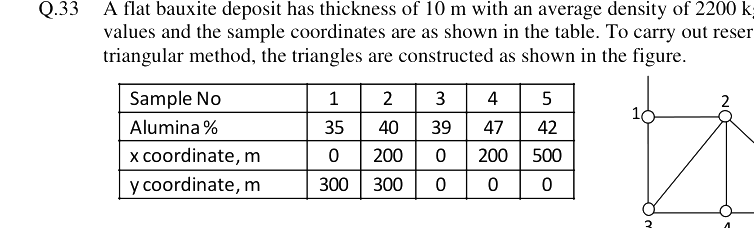
A flat bauxite deposit has thickness of 10 m with an average density of \(2200 ext{ kg/m}^3\). The grade values and the sample coordinates are as shown in the table. To carry out reserve estimation using triangular method, the triangles are constructed as shown in the figure.
Sample No12345
Alumina %3540394742
x coordinate, m02000200500
y coordinate, m300300000

The alumina content in million tonnes, in the region comprising the three triangles is __________

Question diagram

Open complete paper
16
2017 · Mining Engineering · Mineral Economics, Mine Planning, Systems Engineering · Mine Planning
Mining Engineering (MN) 2017
Semi-variogram modeling is used for reserve estimation of mineral deposit by
Open complete paper
17
2017 · Mining Engineering · Mineral Economics, Mine Planning, Systems Engineering · Mine Planning
Mining Engineering (MN) 2017
Lane's algorithm is applied to determine
Open complete paper
18
2017 · Mining Engineering · Mineral Economics, Mine Planning, Systems Engineering · Mine Planning
Mining Engineering (MN) 2017
The block grade model of an ore deposit is shown in the figure below. The relationship between block value per tonne (Bv) in rupees and the block grade in percentage (x) is given below:
Bv = -38500 + 700 × x, for x ≥ 55%
= -300, otherwise

If each square block contains 1000 tonne of material and the overall pit slope angle is 45°, the total value of the pit determined by the floating cone algorithm in Lakhs of rupees is ______

Open complete paper
19
2017 · Mining Engineering · Mineral Economics, Mine Planning, Systems Engineering · Mine Planning
Mining Engineering (MN) 2017
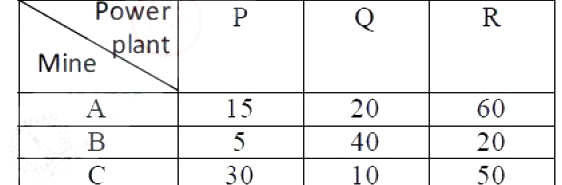
A mining company having three mines A, B and C supplies coal to three power plants P, Q and R located close to the mines. The daily production capacities of the three mines in tonnes are 700, 1200, and 1100 respectively. The daily requirements at the power plants in tonnes are 1000, 1000, and 1000 respectively. The transportation costs in rupees per tonne is given in the matrix below:
Power plant
Mine
PQR
A152060
B54020
C301050

The total cost of coal transportation in rupees from the three mines to three power plants using the least-cost method is ________

Question diagram

Open complete paper
20
2018 · Mining Engineering · Mineral Economics, Mine Planning, Systems Engineering · Mine Planning
Mining Engineering (MN) 2018

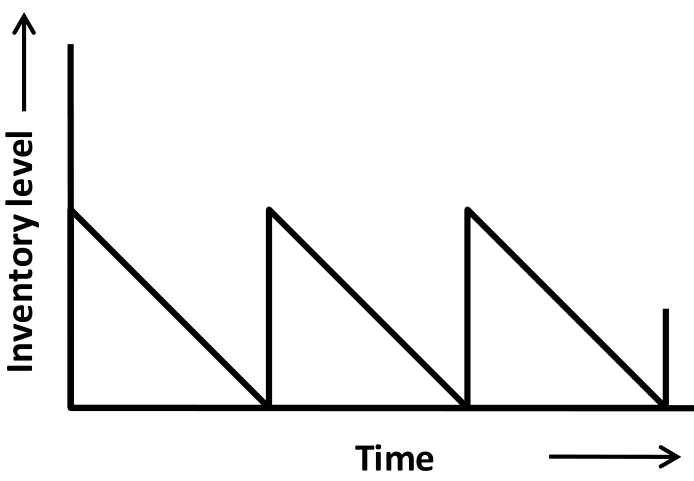
The inventory pattern shown does NOT represent the following.

Source question diagram

Open complete paper

Showing 20 of 30 questions