My Cart
Your Cart 0

    Your cart is empty.

  • Total (Amount) ₹0.00
Previous year question hub

Momentum Transfer - Transport Phenomena and Rate Processes - Metallurgical Engineering Previous Year Questions

Practice Momentum Transfer - Transport Phenomena and Rate Processes - Metallurgical Engineering previous year questions organised from real papers, with year-wise coverage and clear topic navigation.

15Papers
15Years
29Questions
1Topics

Momentum Transfer question pattern

Every graph below is calculated only from this selection.

Questions by year

Year-wise coverage for Momentum Transfer. Each bar uses a separate theme-derived color.

Difficulty distribution

How the classified questions are distributed by difficulty.

Easy 15 51.7%
Medium 13 44.8%
Hard 1 3.4%
Question type distribution

MCQ, numerical, multiple-select and other formats found in these papers.

MCQ 15 51.7%
Numerical Answer Type (NAT) 10 34.5%
MSQ 3 10.3%
Fill in the blanks 1 3.4%

Subject weightage

Top subjects by unique question coverage.

Metallurgical Engineering
29 Qs

Most asked topics

Top topics across the included previous year papers.

Transport Phenomena and Rate Processes
29 Qs

Subtopic coverage

Top subtopics inside this exact selection.

Momentum Transfer
29 Qs

Paper coverage

Question coverage for the most populated papers. Every active PYP paper remains listed below.

Metallurgical Engineering (MT) 2026
4 Qs
Metallurgical Engineering (MT) 2025
3 Qs
Metallurgical Engineering (MT) 2023
4 Qs
Metallurgical Engineering (MT) 2022
4 Qs
Metallurgical Engineering (MT) 2021
2 Qs
Metallurgical Engineering (MT) 2020
1 Qs
Metallurgical Engineering (MT) 2019
1 Qs
Metallurgical Engineering (MT) 2018
1 Qs
Metallurgical Engineering (MT) 2014
1 Qs
Metallurgical Engineering (MT) 2013
1 Qs
Metallurgical Engineering (MT) 2012
3 Qs
Metallurgical Engineering (MT) 2011
1 Qs
Metallurgical Engineering (MT) 2010
1 Qs
Metallurgical Engineering (MT) 2009
1 Qs
Metallurgical Engineering (MT) 2008
1 Qs

Included previous year papers

Newest papers appear first. Sort by year, question coverage or name.

PaperYear / sessionQuestions in this viewOpen
Metallurgical Engineering (MT) 202620264View paper
Metallurgical Engineering (MT) 202520253View paper
Metallurgical Engineering (MT) 202320234View paper
Metallurgical Engineering (MT) 202220224View paper
Metallurgical Engineering (MT) 202120212View paper
Metallurgical Engineering (MT) 202020201View paper
Metallurgical Engineering (MT) 201920191View paper
Metallurgical Engineering (MT) 201820181View paper
Metallurgical Engineering (MT) 201420141View paper
Metallurgical Engineering (MT) 201320131View paper
Metallurgical Engineering (MT) 201220123View paper
Metallurgical Engineering (MT) 201120111View paper
Metallurgical Engineering (MT) 201020101View paper
Metallurgical Engineering (MT) 200920091View paper
Metallurgical Engineering (MT) 200820081View paper

All Momentum Transfer previous year questions

Practice every matching question in batches of 20, with every available option.

1
2008 · Metallurgical Engineering · Transport Phenomena and Rate Processes · Momentum Transfer
Metallurgical Engineering (MT) 2008

Deoxidation of liquid steel with ferrosilicon produces spherical silica particles. The particles of 5 μm diameter take 3000 minutes to float up through a 2 m height of liquid steel. For particles of 50 μm diameter to float up through the same height, the time required in minutes is

Open complete paper
2
2009 · Metallurgical Engineering · Transport Phenomena and Rate Processes · Momentum Transfer
Metallurgical Engineering (MT) 2009
The figure below shows water over mercury manometer.
If the density of water is denoted by \( \rho_W \) and that of mercury by \( \rho_M \) and ‘g’ denotes the acceleration due to gravity, the pressure difference (\( P_A - P_B \)) will be equal to
Open complete paper
3
2010 · Metallurgical Engineering · Transport Phenomena and Rate Processes · Momentum Transfer
Metallurgical Engineering (MT) 2010
Two fluids of densities ρ₁ and ρ₂ are flowing at velocities v₁ and v₂, respectively, through smooth pipes of identical diameter and pressure per unit length. When the friction factor is same, the ratio ρ₁/ρ₂ is equal to
Open complete paper
4
2011 · Metallurgical Engineering · Transport Phenomena and Rate Processes · Momentum Transfer
Metallurgical Engineering (MT) 2011

During fully developed laminar flow in a circular pipe, the velocity profile is parabolic, and symmetric around the axis. The velocity at the tube wall is zero. The ratio of the average velocity to the maximum velocity is

Open complete paper
5
2012 · Metallurgical Engineering · Transport Phenomena and Rate Processes · Momentum Transfer
Metallurgical Engineering (MT) 2012

A fluid is flowing with a velocity of 0.5 m/s on a plate moving with a velocity of 0.01 m/s in the same direction. The velocity at the interface of the fluid and plate is

Open complete paper
6
2012 · Metallurgical Engineering · Transport Phenomena and Rate Processes · Momentum Transfer
Metallurgical Engineering (MT) 2012
The force exerted on the steel ball is
Open complete paper
7
2012 · Metallurgical Engineering · Transport Phenomena and Rate Processes · Momentum Transfer
Metallurgical Engineering (MT) 2012
The terminal velocity of a fine spherical steel particle having diameter dp in μm range, if allowed to fall in a quiescent liquid Al bath, is
Open complete paper
8
2013 · Metallurgical Engineering · Transport Phenomena and Rate Processes · Momentum Transfer
Metallurgical Engineering (MT) 2013
Ladle deoxidation of liquid steel is done at 1600°C by adding ferro-aluminium. By assuming Stokes law behaviour, time (in s) required for alumina particles of 50 μm diameter to float to the surface from a depth of 2 m would be __________
[Given: density of steel = 7000 kg/m³, density of alumina = 3650 kg/m³, viscosity of steel = 6×10⁻³ kg/m/s]
Open complete paper
9
2014 · Metallurgical Engineering · Transport Phenomena and Rate Processes · Momentum Transfer
Metallurgical Engineering (MT) 2014

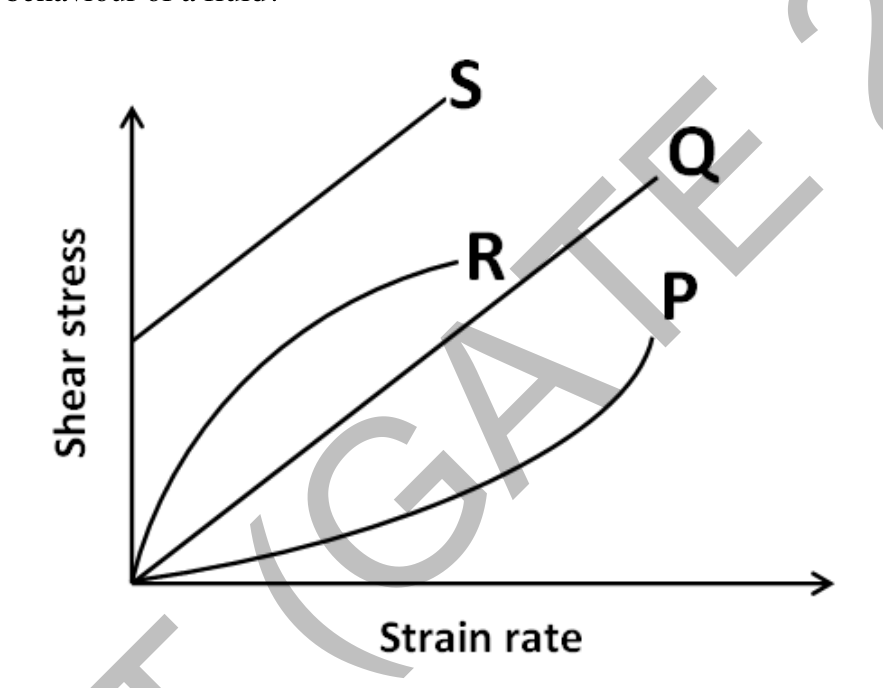
Which one of the following plots relating shear stress with strain rate represents Newtonian behaviour of a fluid?

Source question diagram

Open complete paper
10
2018 · Metallurgical Engineering · Transport Phenomena and Rate Processes · Momentum Transfer
Metallurgical Engineering (MT) 2018
The terminal velocity (\(v\)) of a spherical inclusion of diameter D = 50 micrometers rising in liquid steel is ______ (in mm s\(^{-1}\) to two decimal places) Assume Stokes law; i.e., drag force \(F_d = 3\pi\mu D v\), where \(\mu\) is the viscosity of steel. Given: Density of liquid steel = 7900 kg m\(^{-3}\); Viscosity of liquid steel = 0.0079 Pa s; Density of the inclusion = 2500 kg m\(^{-3}\); Acceleration due to gravity = 9.8 m s\(^{-2}\)
Open complete paper
11
2019 · Metallurgical Engineering · Transport Phenomena and Rate Processes · Momentum Transfer
Metallurgical Engineering (MT) 2019
Pressure drop in the granular zone of a blast furnace is 300 mm of water per meter of the bed height. The bed permeability is \(0.8 m^4.N^{-1}.s^{-1}\). The volumetric flow rate of gas per unit area through the bed [in (\(m^3.s^{-1}).m^{-2}\), rounded off to the nearest integer] is ______.
Assume Darcy's law is applicable and \(g = 9.8 m.s^{-2}\). Density of water = 1000 \(kg.m^{-3}\).
Open complete paper
12
2020 · Metallurgical Engineering · Transport Phenomena and Rate Processes · Momentum Transfer
Metallurgical Engineering (MT) 2020
Figure shows schematic of a venturimeter. The cross sectional area is 100 mm² at A and is 50 mm² at B. If air is flowing through the venturimeter at a flow rate of 10⁻³ m³.s⁻¹, the height H in the air-over-water manometer is ______ mm (round off to the nearest integer).\n\nAssume:\n1. Incompressible flow with no friction losses.\n2. Density of air is 1 kg m⁻³.\n3. Density of water is 1000 kg m⁻³.\n4. Acceleration due to gravity is 9.8 m s⁻².
Open complete paper
13
2021 · Metallurgical Engineering · Transport Phenomena and Rate Processes · Momentum Transfer
Metallurgical Engineering (MT) 2021
Water flows over a plate of finite length. At x = x₁ from the leading edge, the velocity of the flow is Vₓ = 0.5y – 0.5y³. The thickness, δ (in meter) of the boundary layer at x = x₁ is: ______ (round off to 2 decimal places).
Given: V∞ is the free stream velocity.
Open complete paper
14
2021 · Metallurgical Engineering · Transport Phenomena and Rate Processes · Momentum Transfer
Metallurgical Engineering (MT) 2021
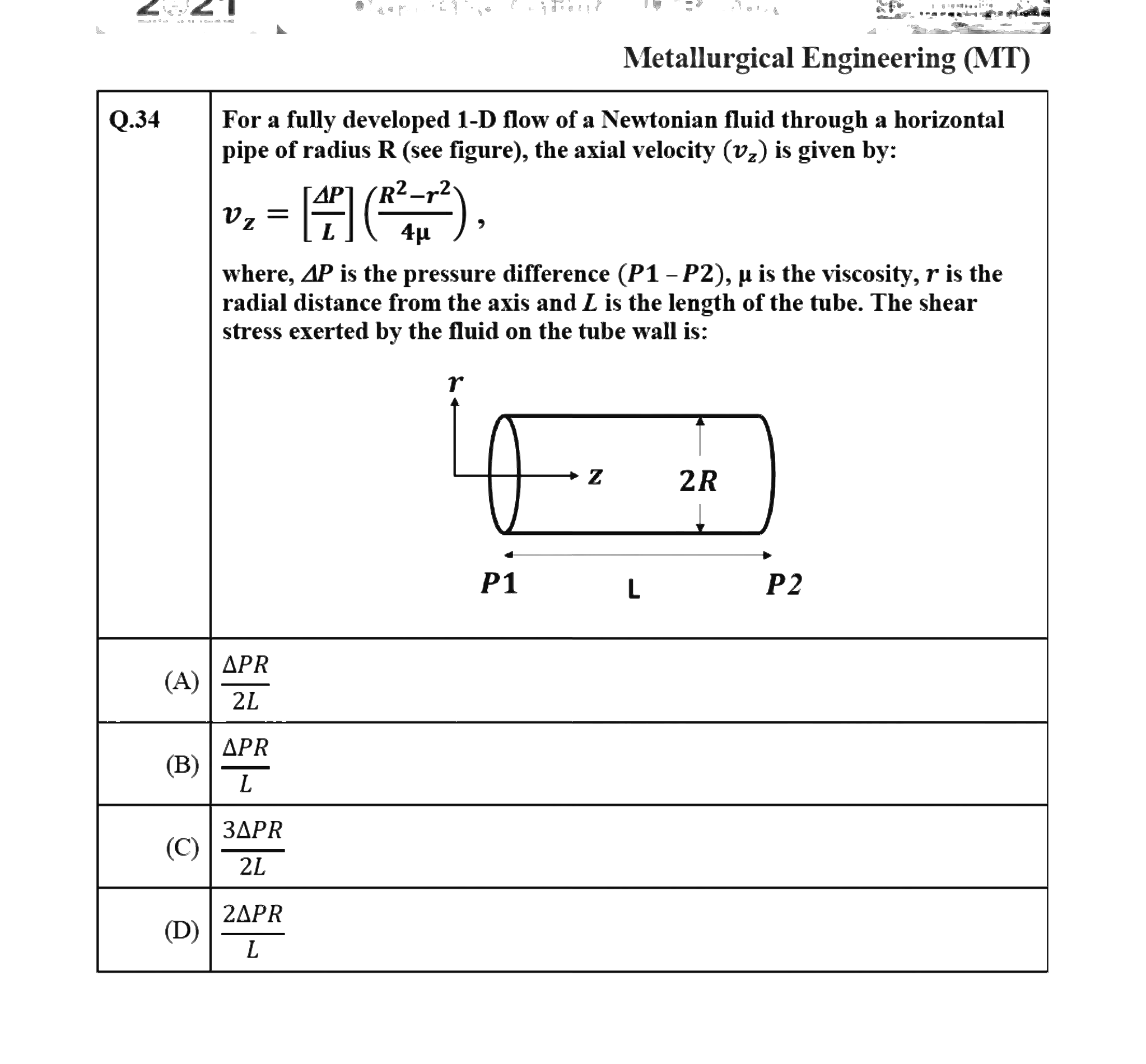
For a fully developed 1-D flow of a Newtonian fluid through a horizontal pipe of radius R (see figure), the axial velocity (\(v_z\)) is given by: \(v_z = \left[\frac{\Delta P}{L}\right]\left(\frac{R^2-r^2}{4\mu}\right)\), where, \(\Delta P\) is the pressure difference (\(P_1 - P_2\)), \(\mu\) is the viscosity, \(r\) is the radial distance from the axis and \(L\) is the length of the tube. The shear stress exerted by the fluid on the tube wall is:
Open complete paper
15
2022 · Metallurgical Engineering · Transport Phenomena and Rate Processes · Momentum Transfer
Metallurgical Engineering (MT) 2022

In fluid flow, the dimensionless number that describes the transition from laminar to turbulent flow is ________

Open complete paper
16
2022 · Metallurgical Engineering · Transport Phenomena and Rate Processes · Momentum Transfer
Metallurgical Engineering (MT) 2022
A Newtonian incompressible liquid is contained between two parallel metal plates separated by \(10^{-3}\) m (see figure). A stress of 5 Pa is required to maintain the upper plate in motion with a constant speed of 2 m s\(^{-1}\) in the horizontal direction relative to the bottom plate.
The viscosity of liquid contained between the plates is ______ \(\times 10^{-3}\) Pa·s (answer rounded off to 1 decimal place).
Open complete paper
17
2022 · Metallurgical Engineering · Transport Phenomena and Rate Processes · Momentum Transfer
Metallurgical Engineering (MT) 2022
A non-rotating smooth solid spherical object is fixed in the stream of an inviscid incompressible fluid of density ρ (see figure). The flow is horizontal, slow, steady, and fully developed far from the object as shown by the streamline arrows near point O. Which of the following statement(s) is(are) TRUE?
(Note: B is the center of the sphere and the straight horizontal line OAB intersects the surface of the sphere at the point A.)
Open complete paper
18
2022 · Metallurgical Engineering · Transport Phenomena and Rate Processes · Momentum Transfer
Metallurgical Engineering (MT) 2022
A spherical gas bubble of radius 0.01 mm is entrapped in molten steel held at 1773 K. If the pressure outside the bubble is 1.5 bar, the pressure inside the bubble is _____ bar (round off to 1 decimal place).
Given: 1 bar = 10⁵ Pa and the surface tension of the steel at 1773 K is 1.4 N·m⁻¹.
Open complete paper
19
2023 · Metallurgical Engineering · Transport Phenomena and Rate Processes · Momentum Transfer
Metallurgical Engineering (MT) 2023

For laminar fluid flow through a smooth circular tube, the relation between friction factor (f) and Reynolds number (Re) is

Open complete paper
20
2023 · Metallurgical Engineering · Transport Phenomena and Rate Processes · Momentum Transfer
Metallurgical Engineering (MT) 2023
A liquid of density 900 \(kg\ m^{-3}\) is flowing over a flat plate with a free stream velocity of 0.1 \(m\ s^{-1}\). The laminar boundary layer thickness at a distance of 0.2 m from the leading edge of the plate is 0.007 m. The viscosity of the liquid in centipoise is __________ (round off to 2 decimal places).
Given: 1 centipoise = \(10^{-3}\ kg\ m^{-1}s^{-1}\)
Open complete paper

Showing 20 of 29 questions