My Cart
Your Cart 0

    Your cart is empty.

  • Total (Amount) ₹0.00
Previous year question hub

Phase Transformation - Physical Metallurgy - Metallurgical Engineering Previous Year Questions

Practice Phase Transformation - Physical Metallurgy - Metallurgical Engineering previous year questions organised from real papers, with year-wise coverage and clear topic navigation.

19Papers
19Years
81Questions
1Topics

Phase Transformation question pattern

Every graph below is calculated only from this selection.

Questions by year

Year-wise coverage for Phase Transformation. Each bar uses a separate theme-derived color.

Difficulty distribution

How the classified questions are distributed by difficulty.

Medium 46 56.8%
Easy 35 43.2%

Question type distribution

MCQ, numerical, multiple-select and other formats found in these papers.

MCQ 59 72.8%
Numerical Answer Type (NAT) 17 21%
MSQ 5 6.2%

Subject weightage

Top subjects by unique question coverage.

Metallurgical Engineering
81 Qs

Most asked topics

Top topics across the included previous year papers.

Physical Metallurgy
81 Qs

Subtopic coverage

Top subtopics inside this exact selection.

Phase Transformation
81 Qs

Paper coverage

Question coverage for the most populated papers. Every active PYP paper remains listed below.

Metallurgical Engineering (MT) 2026
4 Qs
Metallurgical Engineering (MT) 2025
3 Qs
Metallurgical Engineering (MT) 2024
5 Qs
Metallurgical Engineering (MT) 2023
4 Qs
Metallurgical Engineering (MT) 2022
5 Qs
Metallurgical Engineering (MT) 2021
4 Qs
Metallurgical Engineering (MT) 2020
3 Qs
Metallurgical Engineering (MT) 2019
2 Qs
Metallurgical Engineering (MT) 2018
3 Qs
Metallurgical Engineering (MT) 2017
6 Qs
Metallurgical Engineering (MT) 2016
2 Qs
Metallurgical Engineering (MT) 2014
4 Qs
Metallurgical Engineering (MT) 2013
4 Qs
Metallurgical Engineering (MT) 2012
3 Qs
Metallurgical Engineering (MT) 2011
6 Qs
Metallurgical Engineering (MT) 2010
6 Qs
Metallurgical Engineering (MT) 2009
4 Qs
Metallurgical Engineering (MT) 2008
4 Qs
Metallurgical Engineering (MT) 2007
9 Qs

Included previous year papers

Newest papers appear first. Sort by year, question coverage or name.

PaperYear / sessionQuestions in this viewOpen
Metallurgical Engineering (MT) 202620264View paper
Metallurgical Engineering (MT) 202520253View paper
Metallurgical Engineering (MT) 202420245View paper
Metallurgical Engineering (MT) 202320234View paper
Metallurgical Engineering (MT) 202220225View paper
Metallurgical Engineering (MT) 202120214View paper
Metallurgical Engineering (MT) 202020203View paper
Metallurgical Engineering (MT) 201920192View paper
Metallurgical Engineering (MT) 201820183View paper
Metallurgical Engineering (MT) 201720176View paper
Metallurgical Engineering (MT) 201620162View paper
Metallurgical Engineering (MT) 201420144View paper
Metallurgical Engineering (MT) 201320134View paper
Metallurgical Engineering (MT) 201220123View paper
Metallurgical Engineering (MT) 201120116View paper
Metallurgical Engineering (MT) 201020106View paper
Metallurgical Engineering (MT) 200920094View paper
Metallurgical Engineering (MT) 200820084View paper
Metallurgical Engineering (MT) 200720079View paper

All Phase Transformation previous year questions

Practice every matching question in batches of 20, with every available option.

1
2007 · Metallurgical Engineering · Physical Metallurgy · Phase Transformation
Metallurgical Engineering (MT) 2007

In a niobium micro-alloyed steel joined by fusion welding the most likely cause of loss of strength in the heat affected zone (HAZ) is

Open complete paper
2
2007 · Metallurgical Engineering · Physical Metallurgy · Phase Transformation
Metallurgical Engineering (MT) 2007

Which one of the following alloy systems exhibits complete solid solubility?

Open complete paper
3
2007 · Metallurgical Engineering · Physical Metallurgy · Phase Transformation
Metallurgical Engineering (MT) 2007
In the TTT diagram for the eutectoid carbon steel, the nose of the characteristic C-curve is at 550 °C. This C-shape implies delayed transformation both above and below 550 °C. The delay at lower temperatures is due to low diffusivity. The delay at higher temperatures is due to
Open complete paper
4
2007 · Metallurgical Engineering · Physical Metallurgy · Phase Transformation
Metallurgical Engineering (MT) 2007

The maximum amount of proeutectic austenite that can form in an iron-carbon alloy containing 3.5% carbon is [Given: The maximum solubility of carbon in γ-iron is 2.11%]

Open complete paper
5
2007 · Metallurgical Engineering · Physical Metallurgy · Phase Transformation
Metallurgical Engineering (MT) 2007
Match each phase in group I with a description in group II.
Group-IGroup-II
(P) ε - Carbide(1) a three-component eutectic of iron, iron-carbide, iron-phosphite found in cast iron
(Q) Sigma phase(2) an embrittling compound found in ferritic stainless steels
(R) δ – Ferrite(3) obtained on tempering of hardened steels
(S) Steadite(4) responsible for causing the weld-deposit on austenitic stainless steels to be slightly magnetic
Open complete paper
6
2007 · Metallurgical Engineering · Physical Metallurgy · Phase Transformation
Metallurgical Engineering (MT) 2007
In normalized hypoeutectoid plain carbon steels, how do the fraction of proeutectoid ferrite (\(f\)) and yield strength (\(\sigma_y\)) change with increasing carbon content?
Open complete paper
7
2007 · Metallurgical Engineering · Physical Metallurgy · Phase Transformation
Metallurgical Engineering (MT) 2007

Identify the correct statement about manganese in steels from the following.

Open complete paper
8
2007 · Metallurgical Engineering · Physical Metallurgy · Phase Transformation
Metallurgical Engineering (MT) 2007
The size r** of the critical cluster is given by:
Open complete paper
9
2007 · Metallurgical Engineering · Physical Metallurgy · Phase Transformation
Metallurgical Engineering (MT) 2007
If ΔGv = 3.0 × 10⁷ J m-3, and γ = 3.3 × 10⁻³ J m-2, the number of atoms in the critical cluster is approximately (Given: the solid is an FCC crystal with a lattice parameter of 0.495 nm)
Open complete paper
10
2008 · Metallurgical Engineering · Physical Metallurgy · Phase Transformation
Metallurgical Engineering (MT) 2008
The time taken for 50% recrystallization of cold worked Al is 100 hours at 500 K and 10 minutes at 600 K. Assuming Arrhenius kinetics, the activation energy for recrystallization in kJ mol-1 is
Open complete paper
11
2008 · Metallurgical Engineering · Physical Metallurgy · Phase Transformation
Metallurgical Engineering (MT) 2008
Match the processes in Group 1 with the physical principles in Group 2
Open complete paper
12
2008 · Metallurgical Engineering · Physical Metallurgy · Phase Transformation
Metallurgical Engineering (MT) 2008
Match the unit processes in Group 1 with the objectives in Group 2
Open complete paper
13
2008 · Metallurgical Engineering · Physical Metallurgy · Phase Transformation
Metallurgical Engineering (MT) 2008

An annealed hypoeutectoid steel has 10% of proeutectoid ferrite at room temperature. The eutectoid carbon content of the steel is 0.8%. The carbon content in the steel in percent is

Open complete paper
14
2009 · Metallurgical Engineering · Physical Metallurgy · Phase Transformation
Metallurgical Engineering (MT) 2009

An annealed plain carbon steel, showing fully pearlitic microstructure, has a carbon content of

Open complete paper
15
2009 · Metallurgical Engineering · Physical Metallurgy · Phase Transformation
Metallurgical Engineering (MT) 2009

As per the TTT diagram, bainite will form in eutectoid plain carbon steel when heated to 850 °C followed by

Open complete paper
16
2009 · Metallurgical Engineering · Physical Metallurgy · Phase Transformation
Metallurgical Engineering (MT) 2009
According to Hume-Rothery rules, extensive solid solubility between elements X and Y is promoted by the two factors in the following list :
P. Same crystal structure of X and Y
Q. Large atomic size difference (> 20 %) between X and Y
R. Same valence of X and Y
S. Large difference in melting points of X and Y
Open complete paper
17
2009 · Metallurgical Engineering · Physical Metallurgy · Phase Transformation
Metallurgical Engineering (MT) 2009
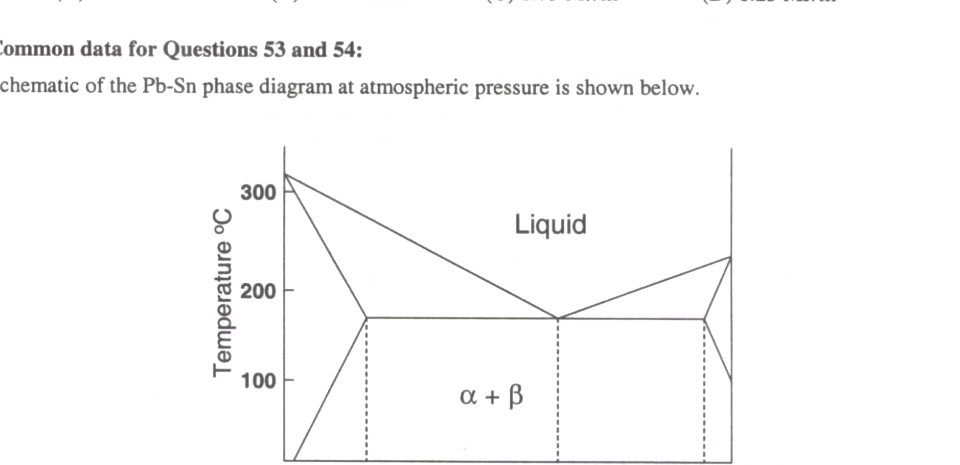
A Pb-Sn hypo-eutectic alloy is slowly cooled from the liquid state to room temperature. The composition of the alloy whose microstructure consists of 25 wt% lamellar constituent is

Question diagram

Open complete paper
18
2010 · Metallurgical Engineering · Physical Metallurgy · Phase Transformation
Metallurgical Engineering (MT) 2010

In heterogeneous nucleation, the radius of the critical nucleus does NOT depend on

Open complete paper
19
2010 · Metallurgical Engineering · Physical Metallurgy · Phase Transformation
Metallurgical Engineering (MT) 2010

Driving force for grain growth after completion of recrystallization is

Open complete paper
20
2010 · Metallurgical Engineering · Physical Metallurgy · Phase Transformation
Metallurgical Engineering (MT) 2010
A recrystallization process is 20% complete after 45 s and 85% complete after 75 s. Assuming Avrami kinetics, the value of Avrami exponent “n” is
Open complete paper

Showing 20 of 81 questions