My Cart
Your Cart 0

    Your cart is empty.

  • Total (Amount) ₹0.00
Previous year question hub

Materials Characterisation - Physical Metallurgy - Metallurgical Engineering Previous Year Questions

Practice Materials Characterisation - Physical Metallurgy - Metallurgical Engineering previous year questions organised from real papers, with year-wise coverage and clear topic navigation.

15Papers
15Years
18Questions
1Topics

Materials Characterisation question pattern

Every graph below is calculated only from this selection.

Questions by year

Year-wise coverage for Materials Characterisation. Each bar uses a separate theme-derived color.

Difficulty distribution

How the classified questions are distributed by difficulty.

Easy 10 55.6%
Medium 8 44.4%

Question type distribution

MCQ, numerical, multiple-select and other formats found in these papers.

MCQ 14 77.8%
MSQ 2 11.1%
Numerical Answer Type (NAT) 2 11.1%

Subject weightage

Top subjects by unique question coverage.

Metallurgical Engineering
18 Qs

Most asked topics

Top topics across the included previous year papers.

Physical Metallurgy
18 Qs

Subtopic coverage

Top subtopics inside this exact selection.

Materials Characterisation
18 Qs

Paper coverage

Question coverage for the most populated papers. Every active PYP paper remains listed below.

Metallurgical Engineering (MT) 2026
2 Qs
Metallurgical Engineering (MT) 2024
1 Qs
Metallurgical Engineering (MT) 2022
1 Qs
Metallurgical Engineering (MT) 2021
1 Qs
Metallurgical Engineering (MT) 2020
1 Qs
Metallurgical Engineering (MT) 2019
1 Qs
Metallurgical Engineering (MT) 2018
1 Qs
Metallurgical Engineering (MT) 2017
1 Qs
Metallurgical Engineering (MT) 2016
1 Qs
Metallurgical Engineering (MT) 2013
1 Qs
Metallurgical Engineering (MT) 2012
2 Qs
Metallurgical Engineering (MT) 2010
1 Qs
Metallurgical Engineering (MT) 2009
1 Qs
Metallurgical Engineering (MT) 2008
1 Qs
Metallurgical Engineering (MT) 2007
2 Qs

Included previous year papers

Newest papers appear first. Sort by year, question coverage or name.

PaperYear / sessionQuestions in this viewOpen
Metallurgical Engineering (MT) 202620262View paper
Metallurgical Engineering (MT) 202420241View paper
Metallurgical Engineering (MT) 202220221View paper
Metallurgical Engineering (MT) 202120211View paper
Metallurgical Engineering (MT) 202020201View paper
Metallurgical Engineering (MT) 201920191View paper
Metallurgical Engineering (MT) 201820181View paper
Metallurgical Engineering (MT) 201720171View paper
Metallurgical Engineering (MT) 201620161View paper
Metallurgical Engineering (MT) 201320131View paper
Metallurgical Engineering (MT) 201220122View paper
Metallurgical Engineering (MT) 201020101View paper
Metallurgical Engineering (MT) 200920091View paper
Metallurgical Engineering (MT) 200820081View paper
Metallurgical Engineering (MT) 200720072View paper

All Materials Characterisation previous year questions

Practice every matching question in batches of 20, with every available option.

1
2007 · Metallurgical Engineering · Physical Metallurgy · Materials Characterisation
Metallurgical Engineering (MT) 2007

The X-ray diffraction angle (2θ, in degrees) for the (110) set of planes is

Open complete paper
2
2007 · Metallurgical Engineering · Physical Metallurgy · Materials Characterisation
Metallurgical Engineering (MT) 2007
The zone axis is
Open complete paper
3
2008 · Metallurgical Engineering · Physical Metallurgy · Materials Characterisation
Metallurgical Engineering (MT) 2008

The Miller indices of the reflecting plane are

Open complete paper
4
2009 · Metallurgical Engineering · Physical Metallurgy · Materials Characterisation
Metallurgical Engineering (MT) 2009

In an X-ray diffraction experiment, radiation of wavelength 0.154 nm is used. Assuming the order of reflection to be 1, the Bragg angle for the (220) set of planes in copper will be

Open complete paper
5
2010 · Metallurgical Engineering · Physical Metallurgy · Materials Characterisation
Metallurgical Engineering (MT) 2010

The energy dispersive spectrometer (EDS) in an electron microscope does chemical analysis by analysing the energy of

Open complete paper
6
2012 · Metallurgical Engineering · Physical Metallurgy · Materials Characterisation
Metallurgical Engineering (MT) 2012
A peak in the X-ray diffraction pattern is observed at 2θ = 78°, corresponding to {311} planes of an fcc metal, when the incident beam has a wavelength of 0.154 nm. The lattice parameter of the metal is approximately
Open complete paper
7
2012 · Metallurgical Engineering · Physical Metallurgy · Materials Characterisation
Metallurgical Engineering (MT) 2012
Grain size of the material is approximately
Open complete paper
8
2013 · Metallurgical Engineering · Physical Metallurgy · Materials Characterisation
Metallurgical Engineering (MT) 2013

For an FCC metal, the ratio of interplanar spacing obtained from the first two peaks of the X-ray diffraction pattern is

Open complete paper
9
2016 · Metallurgical Engineering · Physical Metallurgy · Materials Characterisation
Metallurgical Engineering (MT) 2016

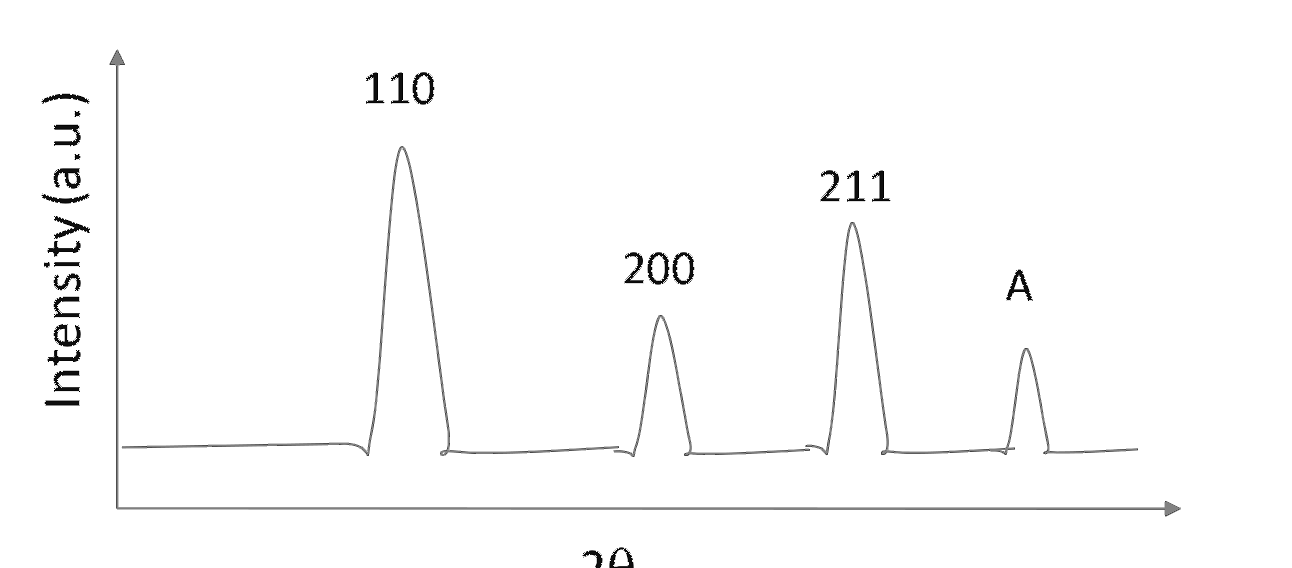
A schematic of X-ray diffraction pattern of a single phase cubic polycrystal is given below. The miller indices of peak A is

Open complete paper
10
2017 · Metallurgical Engineering · Physical Metallurgy · Materials Characterisation
Metallurgical Engineering (MT) 2017
The second peak in the powder X-ray diffraction pattern of a FCC metal occurs at a Bragg angle θ (in degrees) = __________ (answer up to two decimal places)
(Given: λCuKα = 0.154 nm; lattice parameter of the metal = 0.36 nm)
Open complete paper
11
2018 · Metallurgical Engineering · Physical Metallurgy · Materials Characterisation
Metallurgical Engineering (MT) 2018
What is the most-abundant anion in a \(2CaO.SiO_2\) melt?
Open complete paper
12
2019 · Metallurgical Engineering · Physical Metallurgy · Materials Characterisation
Metallurgical Engineering (MT) 2019
In a typical scanning electron microscope (SEM) image, information about topography and atomic contrast are obtained from __________.
Open complete paper
13
2020 · Metallurgical Engineering · Physical Metallurgy · Materials Characterisation
Metallurgical Engineering (MT) 2020
X-ray diffraction pattern from an elemental metal with a FCC crystal structure shows the first peak at a Bragg angle \( \theta = 24.65^\circ \). The lattice parameter of this metal is ________ nm.
Given, wavelength of the X-ray used is 0.1543 nm.
Open complete paper
14
2021 · Metallurgical Engineering · Physical Metallurgy · Materials Characterisation
Metallurgical Engineering (MT) 2021
In the X-ray diffraction pattern of a FCC crystal, the first reflection occurs at a Bragg angle (θ) of 30°. The Bragg angle (in degree) for the second reflection will be: ______ (round off to 1 decimal place).
Open complete paper
15
2022 · Metallurgical Engineering · Physical Metallurgy · Materials Characterisation
Metallurgical Engineering (MT) 2022
The sequence of peaks corresponding to the planes (in the order of increasing \(2\theta\)) observed in the X-ray diffractogram of a pure copper powder sample is ________
Open complete paper
16
2024 · Metallurgical Engineering · Physical Metallurgy · Materials Characterisation
Metallurgical Engineering (MT) 2024
Which of the following $(h\ k\ l)$ reflections is/are allowed in an X-ray diffraction pattern of a crystal with face centered cubic lattice?
Open complete paper
17
2026 · Metallurgical Engineering · Physical Metallurgy · Materials Characterisation
Metallurgical Engineering (MT) 2026
During metallography, Nital is the most commonly used for etching ______________.
Open complete paper
18
2026 · Metallurgical Engineering · Physical Metallurgy · Materials Characterisation
Metallurgical Engineering (MT) 2026
Residual stress present in a material can be determined by which one of the following techniques:
Open complete paper