My Cart
Your Cart 0

    Your cart is empty.

  • Total (Amount) ₹0.00
Previous year question hub

High Temperature deformation - Mechanical Behaviour of Materials - Metallurgical Engineering Previous Year Questions

Practice High Temperature deformation - Mechanical Behaviour of Materials - Metallurgical Engineering previous year questions organised from real papers, with year-wise coverage and clear topic navigation.

12Papers
12Years
13Questions
1Topics

High Temperature deformation question pattern

Every graph below is calculated only from this selection.

Questions by year

Year-wise coverage for High Temperature deformation. Each bar uses a separate theme-derived color.

Difficulty distribution

How the classified questions are distributed by difficulty.

Medium 8 61.5%
Easy 5 38.5%

Question type distribution

MCQ, numerical, multiple-select and other formats found in these papers.

MCQ 8 61.5%
MSQ 3 23.1%
Numerical Answer Type (NAT) 2 15.4%

Subject weightage

Top subjects by unique question coverage.

Metallurgical Engineering
13 Qs

Most asked topics

Top topics across the included previous year papers.

Mechanical Behaviour of Materials
13 Qs

Subtopic coverage

Top subtopics inside this exact selection.

High Temperature deformation
13 Qs

Paper coverage

Question coverage for the most populated papers. Every active PYP paper remains listed below.

Metallurgical Engineering (MT) 2026
1 Qs
Metallurgical Engineering (MT) 2025
1 Qs
Metallurgical Engineering (MT) 2024
1 Qs
Metallurgical Engineering (MT) 2023
1 Qs
Metallurgical Engineering (MT) 2022
1 Qs
Metallurgical Engineering (MT) 2021
1 Qs
Metallurgical Engineering (MT) 2020
2 Qs
Metallurgical Engineering (MT) 2019
1 Qs
Metallurgical Engineering (MT) 2018
1 Qs
Metallurgical Engineering (MT) 2016
1 Qs
Metallurgical Engineering (MT) 2014
1 Qs
Metallurgical Engineering (MT) 2008
1 Qs

Included previous year papers

Newest papers appear first. Sort by year, question coverage or name.

PaperYear / sessionQuestions in this viewOpen
Metallurgical Engineering (MT) 202620261View paper
Metallurgical Engineering (MT) 202520251View paper
Metallurgical Engineering (MT) 202420241View paper
Metallurgical Engineering (MT) 202320231View paper
Metallurgical Engineering (MT) 202220221View paper
Metallurgical Engineering (MT) 202120211View paper
Metallurgical Engineering (MT) 202020202View paper
Metallurgical Engineering (MT) 201920191View paper
Metallurgical Engineering (MT) 201820181View paper
Metallurgical Engineering (MT) 201620161View paper
Metallurgical Engineering (MT) 201420141View paper
Metallurgical Engineering (MT) 200820081View paper

All High Temperature deformation previous year questions

Practice every matching question in batches of 20, with every available option.

1
2008 · Metallurgical Engineering · Mechanical Behaviour of Materials · High Temperature deformation
Metallurgical Engineering (MT) 2008
Match the mechanical behaviour in Group 1 with the terms in Group 2
Open complete paper
2
2014 · Metallurgical Engineering · Mechanical Behaviour of Materials · High Temperature deformation
Metallurgical Engineering (MT) 2014

Which one of the following microstructures of a Ni-base superalloy imparts the highest creep resistance?

Open complete paper
3
2016 · Metallurgical Engineering · Mechanical Behaviour of Materials · High Temperature deformation
Metallurgical Engineering (MT) 2016

Creep resistance decreases due to

Open complete paper
4
2018 · Metallurgical Engineering · Mechanical Behaviour of Materials · High Temperature deformation
Metallurgical Engineering (MT) 2018
Determine the correctness (or otherwise) of the following Assertion [A] and the Reason [R]

Assertion [A]: For a material exhibiting Coble creep, a reduction in grain size results in a significant increase in creep rate
Reason [R]: Grain boundaries act as a barrier to motion of dislocations
Open complete paper
5
2019 · Metallurgical Engineering · Mechanical Behaviour of Materials · High Temperature deformation
Metallurgical Engineering (MT) 2019
In a tensile creep test of a metal, Nabarro-Herring mechanism is favored over Coble mechanism for ____________.
Open complete paper
6
2020 · Metallurgical Engineering · Mechanical Behaviour of Materials · High Temperature deformation
Metallurgical Engineering (MT) 2020
Determine the correctness or otherwise of the following Assertion [a] and the Reason [r]
Assertion [a]: Low-alloy steels used for medium-temperature creep resistance often have additions of strong carbide-forming elements.
Reason [r]: During creep deformation, the particles with higher misfit with the matrix, lose coherency.
Open complete paper
7
2020 · Metallurgical Engineering · Mechanical Behaviour of Materials · High Temperature deformation
Metallurgical Engineering (MT) 2020

The steady state creep rate of a material increases by a factor of 20 when the temperature is increased from 890 K to 980 K. The creep rate at a temperature of ______ K (round off to the nearest integer) will be 5 times the creep rate at 890 K.

Open complete paper
8
2021 · Metallurgical Engineering · Mechanical Behaviour of Materials · High Temperature deformation
Metallurgical Engineering (MT) 2021

Which one of the following is FALSE for creep deformation?

Open complete paper
9
2022 · Metallurgical Engineering · Mechanical Behaviour of Materials · High Temperature deformation
Metallurgical Engineering (MT) 2022
While designing a material for high temperature application, which of the following characteristic(s)/attribute(s) is(are) desirable for achieving better creep resistance?
Open complete paper
10
2023 · Metallurgical Engineering · Mechanical Behaviour of Materials · High Temperature deformation
Metallurgical Engineering (MT) 2023

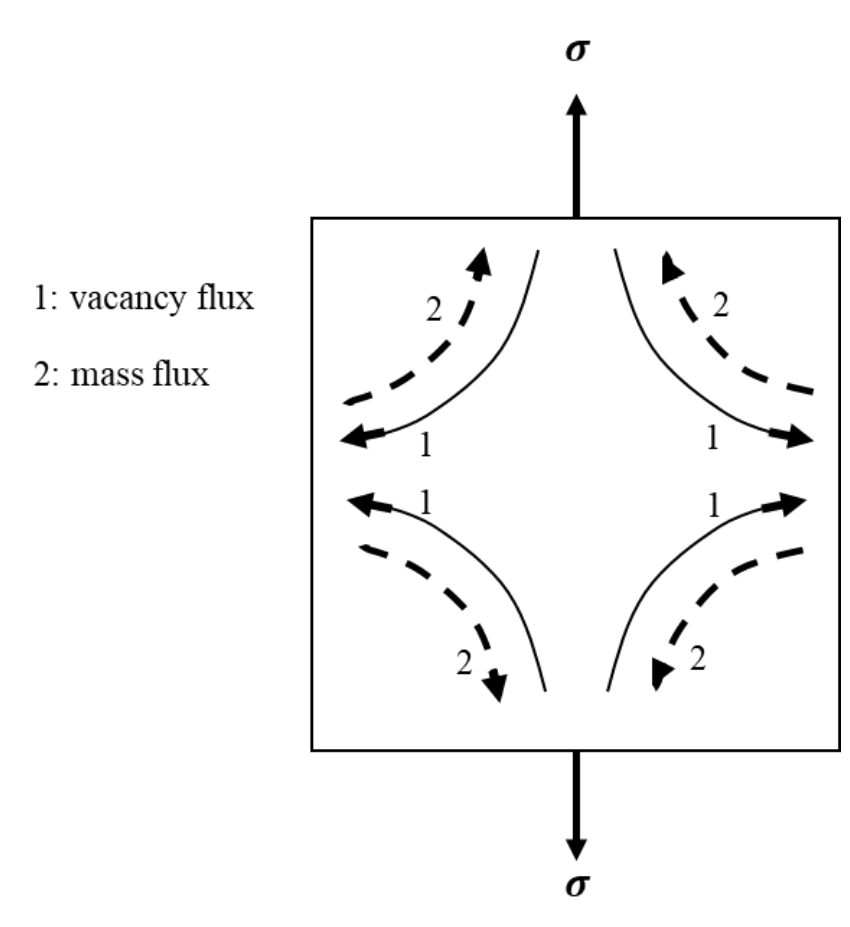
The mechanism of creep for a single crystal as depicted in the schematic is

Source question diagram

Open complete paper
11
2024 · Metallurgical Engineering · Mechanical Behaviour of Materials · High Temperature deformation
Metallurgical Engineering (MT) 2024

A creep test of a pure polycrystalline metal is performed in tension and the creep strain rate is observed to decrease during the primary stage. The creep mechanism is later determined to be dislocation-climb-controlled. The observed decrease in creep strain rate is/are due to

Open complete paper
12
2025 · Metallurgical Engineering · Mechanical Behaviour of Materials · High Temperature deformation
Metallurgical Engineering (MT) 2025
In polycrystalline Ni, Nabarro-Herring diffusion creep was found to be the rate controlling creep mechanism at a certain temperature.
At that temperature, if the steady state strain rate is 10-8 s-1 at a stress of 10 MPa, the steady state strain rate of 10-9 s-1 will be obtained at a stress value of ____ MPa (in integer).
Assume that the same creep mechanism is rate controlling during the creep deformation.
Open complete paper
13
2026 · Metallurgical Engineering · Mechanical Behaviour of Materials · High Temperature deformation
Metallurgical Engineering (MT) 2026
Deformation mechanism map of a given material is used for determining which one of the following properties?
Open complete paper