My Cart
Your Cart 0

    Your cart is empty.

  • Total (Amount) ₹0.00
Previous year question hub

Numerical Computation and Estimation - General Aptitude - General Aptitude (GA) Previous Year Questions

Practice Numerical Computation and Estimation - General Aptitude - General Aptitude (GA) previous year questions organised from real papers, with year-wise coverage and clear topic navigation.

5Papers
5Years
17Questions
1Topics

Numerical Computation and Estimation question pattern

Every graph below is calculated only from this selection.

Questions by year

Year-wise coverage for Numerical Computation and Estimation. Each bar uses a separate theme-derived color.

Difficulty distribution

How the classified questions are distributed by difficulty.

Easy 10 58.8%
Medium 7 41.2%

Question type distribution

MCQ, numerical, multiple-select and other formats found in these papers.

Numerical Answer Type (NAT) 10 58.8%
MCQ 7 41.2%

Subject weightage

Top subjects by unique question coverage.

General Aptitude (GA)
17 Qs

Most asked topics

Top topics across the included previous year papers.

General Aptitude
17 Qs

Subtopic coverage

Top subtopics inside this exact selection.

Numerical Computation and Estimation
17 Qs

Paper coverage

Question coverage for the most populated papers. Every active PYP paper remains listed below.

Metallurgical Engineering (MT) 2026
1 Qs
Metallurgical Engineering (MT) 2021
1 Qs
Metallurgical Engineering (MT) 2020
2 Qs
Metallurgical Engineering (MT) 2015
12 Qs
Metallurgical Engineering (MT) 2014
1 Qs

Included previous year papers

Newest papers appear first. Sort by year, question coverage or name.

PaperYear / sessionQuestions in this viewOpen
Metallurgical Engineering (MT) 202620261View paper
Metallurgical Engineering (MT) 202120211View paper
Metallurgical Engineering (MT) 202020202View paper
Metallurgical Engineering (MT) 2015201512View paper
Metallurgical Engineering (MT) 201420141View paper

All Numerical Computation and Estimation previous year questions

Practice every matching question in batches of 20, with every available option.

1
2014 · General Aptitude (GA) · General Aptitude · Numerical Computation and Estimation
Metallurgical Engineering (MT) 2014
A factory has a fixed daily cost of Rs 50,000 whenever it operates and a variable cost of Rs 800Q, where Q is the daily production in tonnes. What is the cost of production in Rs per tonne for a daily production of 100 tonnes?
Open complete paper
2
2015 · General Aptitude (GA) · General Aptitude · Numerical Computation and Estimation
Metallurgical Engineering (MT) 2015
\[\frac{y(x+h)-y(x)}{h} is a numerical approximation for\]

Question diagram

Open complete paper
3
2015 · General Aptitude (GA) · General Aptitude · Numerical Computation and Estimation
Metallurgical Engineering (MT) 2015
\(C(s) + CO_2(g) \rightleftharpoons 2CO(g)\) is an important reaction in iron making. Given \(\Delta H_{298}^0 = 172000\) joules per mole of \(CO_2\), which of the following conditions will favour the forward reaction?
Open complete paper
4
2015 · General Aptitude (GA) · General Aptitude · Numerical Computation and Estimation
Metallurgical Engineering (MT) 2015
Consider the reaction: \(Fe_3O_4 (solid, pure) + CO (gas, 1 atm) \rightarrow 3FeO (solid, pure) + CO_2 (gas, 1 atm)\). For this reaction, \(\Delta G_{1200}^0 = -8000\) joules per mole of CO and \(R = 8.314 J mol^{-1} K^{-1}\). The equilibrium ratio, \(p_{CO_2}/p_{CO}\), for the reaction at 1200 K and 1 atm is ______.
Open complete paper
5
2015 · General Aptitude (GA) · General Aptitude · Numerical Computation and Estimation
Metallurgical Engineering (MT) 2015
An iron blast furnace produces hot metal containing 95% Fe. The iron ore charged into the furnace contains 95% \(Fe_2O_3\) and the rest is gangue. Assume that all the iron in the ore goes to hot metal. The amount of iron ore (in kg) required for producing 1000 kg of hot metal is ______. (Atomic weight of Fe = 56 g mol^{-1} and that of \(Fe_2O_3 = 160 g mol^{-1}\))
Open complete paper
6
2015 · General Aptitude (GA) · General Aptitude · Numerical Computation and Estimation
Metallurgical Engineering (MT) 2015
In electrolytic refining of Ni, the anode is Cu-10 atom % Ni and the cathode is pure Ni. Assuming the Cu-Ni solution to be ideal, the ABSOLUTE value of the minimum voltage (in mV) required for refining is _____.
Given: Faraday constant = 96490 C mol⁻¹, Temperature = 300 K, R = 8.314 J mol⁻¹ K⁻¹.
Open complete paper
7
2015 · General Aptitude (GA) · General Aptitude · Numerical Computation and Estimation
Metallurgical Engineering (MT) 2015
Configurational entropy due to ideal mixing in a binary A-B system is expressed as:
\[ \Delta S_{mix} = -R (X_A \ln X_A + X_B \ln X_B) \]
where \(X_A\) and \(X_B\) are mole fractions of A and B respectively.
\Delta S_{mix} is maximum at \(X_A\) = _____
Open complete paper
8
2015 · General Aptitude (GA) · General Aptitude · Numerical Computation and Estimation
Metallurgical Engineering (MT) 2015
Melting point of α metal is 1356 K. When the liquid metal is undercooled to 1256 K, the free energy change for solidification, \(\Delta G^{S→L} = -1000 J mol⁻¹\). On the other hand, if the liquid metal is undercooled to 1200 K, the free energy change (in J mol⁻¹) for solidification is _____.
Open complete paper
9
2015 · General Aptitude (GA) · General Aptitude · Numerical Computation and Estimation
Metallurgical Engineering (MT) 2015
It takes 10 hours to homogenize an alloy at 1273 K. The time required (in hours) to achieve the same extent of homogenization at 1373 K is _____.
Given: Diffusivity, \(D_{1273 K} = 10^{-18} m² s⁻¹\) and \(D_{1373 K} = 10^{-19} m² s⁻¹\).
Open complete paper
10
2015 · General Aptitude (GA) · General Aptitude · Numerical Computation and Estimation
Metallurgical Engineering (MT) 2015
At the mould exit of a continuous caster, the metal consisting of a solidified shell with a liquid metal core exits at the rate of 35 kg s-1. Given that the latent heat of fusion is 3 × 10⁵ J kg-1 and the total rate of heat removal by the mould is 4.2 × 10⁶ W, the mass fraction of solid at the mould exit is _______.
Assume that both solid and liquid remain at the melting point while they are in the mould.
Open complete paper
11
2015 · General Aptitude (GA) · General Aptitude · Numerical Computation and Estimation
Metallurgical Engineering (MT) 2015
The driving force for sintering a compact consisting of spherical particles of radius R1 is ΔG1. If the particle size is reduced to R2 = 0.1 R1, the corresponding driving force ΔG2 = a ΔG1, where a is _______.
Open complete paper
12
2015 · General Aptitude (GA) · General Aptitude · Numerical Computation and Estimation
Metallurgical Engineering (MT) 2015
Which of the following techniques are NOT applicable for detecting internal flaws in a ceramic material?
1. Liquid penetration test
2. Radiography
3. Ultrasonic testing
4. Eddy current method
Open complete paper
13
2015 · General Aptitude (GA) · General Aptitude · Numerical Computation and Estimation
Metallurgical Engineering (MT) 2015
A brittle material is mechanically tested in medium P in which it has surface energy \(\gamma_s = 0.9\ J\ m^{-2}\). This material has a fracture strength of 300 MPa for a given flaw size. The same solid containing the same flaws is then tested in medium Q in which \(\gamma_s = 0.1\ J\ m^{-2}\). The fracture strength (in MPa) in medium Q based on Griffith's theory is _______.
Open complete paper
14
2020 · General Aptitude (GA) · General Aptitude · Numerical Computation and Estimation
Metallurgical Engineering (MT) 2020
Define \([x]\) as the greatest integer less than or equal to \(x\), for each \(x \in (-\infty, \infty)\). If \(y = [x]\), then area under \(y\) for \(x \in [1,4]\) is _____.
Open complete paper
15
2020 · General Aptitude (GA) · General Aptitude · Numerical Computation and Estimation
Metallurgical Engineering (MT) 2020
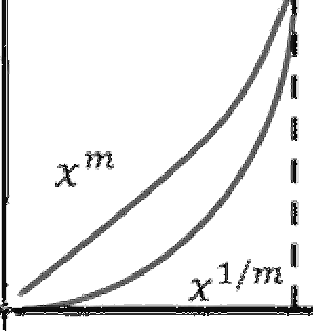
Select the graph that schematically represents BOTH \(y = x^m\) and \(y = x^{1/m}\) properly in the interval \(0 \le x \le 1\), for integer values of \(m\), where \(m > 1\).
Open complete paper
16
2021 · General Aptitude (GA) · General Aptitude · Numerical Computation and Estimation
Metallurgical Engineering (MT) 2021
A digital watch X beeps every 30 seconds while watch Y beeps every 32 seconds. They beeped together at 10 AM.
The immediate next time that they will beep together is ______
Open complete paper
17
2026 · General Aptitude (GA) · General Aptitude · Numerical Computation and Estimation
Metallurgical Engineering (MT) 2026
The table lists the unit selling price of five products P, Q, R, S, and T. On a particular day, 250 items were sold with the average selling price of Rs. 60. The following observations were made:
(i) The quantity of S sold was twice that of T.
(ii) The quantity of R sold was thrice that of T.
(iii) The quantity of Q sold was four times that of T.
ProductPQRST
Unit selling price (Rs.)10050406060

What is the quantity of product P sold on that day?

Question source image

Open complete paper