My Cart
Your Cart 0

    Your cart is empty.

  • Total (Amount) ₹0.00
Previous year question hub

Operations Research - Materials, Manufacturing and Industrial Engineering - Mechanical Engineering Previous Year Questions

Practice Operations Research - Materials, Manufacturing and Industrial Engineering - Mechanical Engineering previous year questions organised from real papers, with year-wise coverage and clear topic navigation.

18Papers
11Years
33Questions
1Topics

Operations Research question pattern

Every graph below is calculated only from this selection.

Questions by year

Year-wise coverage for Operations Research. Each bar uses a separate theme-derived color.

Difficulty distribution

How the classified questions are distributed by difficulty.

Medium 17 51.5%
Easy 16 48.5%

Question type distribution

MCQ, numerical, multiple-select and other formats found in these papers.

MCQ 23 69.7%
Numerical Answer Type (NAT) 10 30.3%

Subject weightage

Top subjects by unique question coverage.

Mechanical Engineering
33 Qs

Most asked topics

Top topics across the included previous year papers.

Materials, Manufacturing and Industrial Engineering
33 Qs

Subtopic coverage

Top subtopics inside this exact selection.

Operations Research
33 Qs

Paper coverage

Question coverage for the most populated papers. Every active PYP paper remains listed below.

Mechanical Engineering (ME) 2025
1 Qs
Mechanical Engineering (ME) 2024
2 Qs
Mechanical Engineering (ME) 2023
1 Qs
Mechanical Engineering (ME) 2021 [Session 1]
2 Qs
Mechanical Engineering (ME) 2016 [Session 1]
1 Qs
Mechanical Engineering (ME) 2016 [Session 3]
1 Qs
Mechanical Engineering (ME) 2014 [Session 4]
3 Qs
Mechanical Engineering (ME) 2014 [Session 1]
2 Qs
Mechanical Engineering (ME) 2014 [Session 2]
2 Qs
Mechanical Engineering (ME) 2014 [Session 3]
2 Qs
Mechanical Engineering (ME) 2013 [Session 2]
2 Qs
Mechanical Engineering (ME) 2013 [Session 1]
1 Qs
Mechanical Engineering (ME) 2013 [Session 3]
1 Qs
Mechanical Engineering (ME) 2013 [Session 4]
1 Qs
Mechanical Engineering (ME) 2011
3 Qs
Mechanical Engineering (ME) 2010
3 Qs
Mechanical Engineering (ME) 2009
1 Qs
Mechanical Engineering (ME) 2008
4 Qs

Included previous year papers

Newest papers appear first. Sort by year, question coverage or name.

PaperYear / sessionQuestions in this viewOpen
Mechanical Engineering (ME) 202520251View paper
Mechanical Engineering (ME) 202420242View paper
Mechanical Engineering (ME) 202320231View paper
Mechanical Engineering (ME) 2021 [Session 1]20212View paper
Mechanical Engineering (ME) 2016 [Session 1]20161View paper
Mechanical Engineering (ME) 2016 [Session 3]20161View paper
Mechanical Engineering (ME) 2014 [Session 1]20142View paper
Mechanical Engineering (ME) 2014 [Session 2]20142View paper
Mechanical Engineering (ME) 2014 [Session 3]20142View paper
Mechanical Engineering (ME) 2014 [Session 4]20143View paper
Mechanical Engineering (ME) 2013 [Session 1]20131View paper
Mechanical Engineering (ME) 2013 [Session 2]20132View paper
Mechanical Engineering (ME) 2013 [Session 3]20131View paper
Mechanical Engineering (ME) 2013 [Session 4]20131View paper
Mechanical Engineering (ME) 201120113View paper
Mechanical Engineering (ME) 201020103View paper
Mechanical Engineering (ME) 200920091View paper
Mechanical Engineering (ME) 200820084View paper

All Operations Research previous year questions

Practice every matching question in batches of 20, with every available option.

1
2008 · Mechanical Engineering · Materials, Manufacturing and Industrial Engineering · Operations Research
Mechanical Engineering (ME) 2008
In an M/M/1 queueing system, the number of arrivals in an interval of length \(T\) is a Poisson random variable (i.e. the probability of there being \(n\) arrivals in an interval of length \(T\) is \(\frac{e^{-\lambda T} (\lambda T)^n}{n!}\)). The probability density function \(f(t)\) of the inter-arrival time is given by
Open complete paper
2
2008 · Mechanical Engineering · Materials, Manufacturing and Industrial Engineering · Operations Research
Mechanical Engineering (ME) 2008
For the standard transportation linear programme with \( m \) sources and \( n \) destinations and total supply equaling total demand, an optimal solution (lowest cost) with the smallest number of non-zero \( x_{ij} \) values (amounts from source \( i \) to destination \( j \)) is desired. The best upper bound for this number is
Open complete paper
3
2008 · Mechanical Engineering · Materials, Manufacturing and Industrial Engineering · Operations Research
Mechanical Engineering (ME) 2008
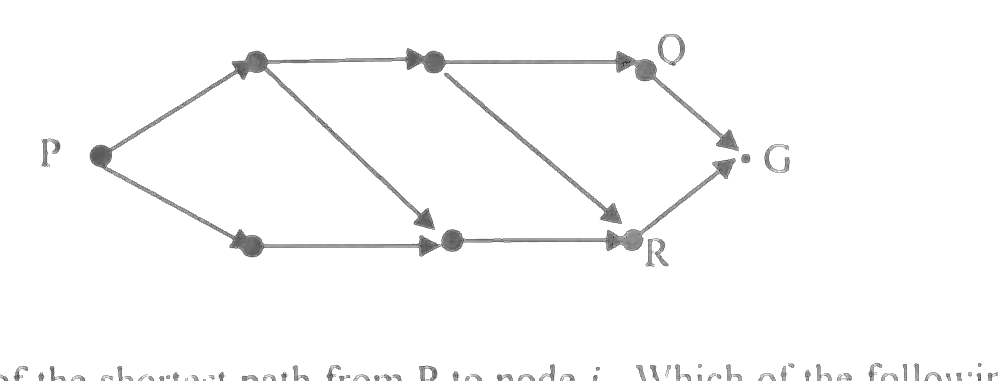
For the network below, the objective is to find the length of the shortest path from node P to node G. Let \( d_{ij} \) be the length of directed arc from node \( i \) to node \( j \). Let \( s_j \) be the length of the shortest path from P to node \( j \). Which of the following equations can be used to find \( s_G \)?
Open complete paper
4
2008 · Mechanical Engineering · Materials, Manufacturing and Industrial Engineering · Operations Research
Mechanical Engineering (ME) 2008
After introducing slack variables s and t, the initial basic feasible solution is represented by the tableau below (basic variables are s = 6 and t = 6, and the objective function value is 0).
After some simplex iterations, the following tableau is obtained
From this, one can conclude that

Question diagram

Open complete paper
5
2009 · Mechanical Engineering · Materials, Manufacturing and Industrial Engineering · Operations Research
Mechanical Engineering (ME) 2009
The critical path duration of the network (in days) is
Open complete paper
6
2010 · Mechanical Engineering · Materials, Manufacturing and Industrial Engineering · Operations Research
Mechanical Engineering (ME) 2010
Little's law is a relationship between
Open complete paper
7
2010 · Mechanical Engineering · Materials, Manufacturing and Industrial Engineering · Operations Research
Mechanical Engineering (ME) 2010

Simplex method of solving linear programming problem uses

Open complete paper
8
2010 · Mechanical Engineering · Materials, Manufacturing and Industrial Engineering · Operations Research
Mechanical Engineering (ME) 2010
The project activities, precedence relationships and durations are described in the table. The critical path of the project is
Open complete paper
9
2011 · Mechanical Engineering · Materials, Manufacturing and Industrial Engineering · Operations Research
Mechanical Engineering (ME) 2011

Cars arrive at a service station according to Poisson’s distribution with a mean rate of 5 per hour. The service time per car is exponential with a mean of 10 minutes. At steady state, the average waiting time in the queue is

Open complete paper
10
2011 · Mechanical Engineering · Materials, Manufacturing and Industrial Engineering · Operations Research
Mechanical Engineering (ME) 2011
The unit worth of resource R2, i.e. dual price of resource R2, in Rs. per kg is
Open complete paper
11
2011 · Mechanical Engineering · Materials, Manufacturing and Industrial Engineering · Operations Research
Mechanical Engineering (ME) 2011

The manufacturer can make a maximum profit of Rs.

Open complete paper
12
2013 · Mechanical Engineering · Materials, Manufacturing and Industrial Engineering · Operations Research
Mechanical Engineering (ME) 2013 [Session 1]

Customers arrive at a ticket counter at a rate of 50 per hr and tickets are issued in the order of their arrival. The average time taken for issuing a ticket is 1 min. Assuming that customer arrivals form a Poisson process and service times are exponentially distributed, the average waiting time in queue in min is

Open complete paper
13
2013 · Mechanical Engineering · Materials, Manufacturing and Industrial Engineering · Operations Research
Mechanical Engineering (ME) 2013 [Session 2]
A linear programming problem is shown below.
Maximize \( 3x + 7y \)
Subject to \( 3x + 7y \le 10 \)
\( 4x + 6y \le 8 \)
\( x, y \ge 0 \)
It has
Open complete paper
14
2014 · Mechanical Engineering · Materials, Manufacturing and Industrial Engineering · Operations Research
Mechanical Engineering (ME) 2014 [Session 1]
The jobs arrive at a facility, for service, in a random manner. The probability distribution of number of arrivals of jobs in a fixed time interval is
Open complete paper
15
2014 · Mechanical Engineering · Materials, Manufacturing and Industrial Engineering · Operations Research
Mechanical Engineering (ME) 2014 [Session 1]
Jobs arrive at a facility at an average rate of 5 in an 8 hour shift. The arrival of the jobs follows Poisson distribution. The average service time of a job on the facility is 40 minutes. The service time follows exponential distribution. Idle time (in hours) at the facility per shift will be
Open complete paper
16
2014 · Mechanical Engineering · Materials, Manufacturing and Industrial Engineering · Operations Research
Mechanical Engineering (ME) 2014 [Session 2]
If there are m sources and n destinations in a transportation matrix, the total number of basic variables in a basic feasible solution is
Open complete paper
17
2014 · Mechanical Engineering · Materials, Manufacturing and Industrial Engineering · Operations Research
Mechanical Engineering (ME) 2014 [Session 2]
Consider the following data with reference to elementary deterministic economic order quantity model
Annual demand of an item100000
Unit price of the item (in Rs.)10
Inventory carrying cost per unit per year (in Rs.)1.5
Unit order cost (in Rs.)30
The total number of economic orders per year to meet the annual demand is ______
Open complete paper
18
2014 · Mechanical Engineering · Materials, Manufacturing and Industrial Engineering · Operations Research
Mechanical Engineering (ME) 2014 [Session 3]
A minimal spanning tree in network flow models involves
Open complete paper
19
2014 · Mechanical Engineering · Materials, Manufacturing and Industrial Engineering · Operations Research
Mechanical Engineering (ME) 2014 [Session 3]
Consider an objective function \( Z(x_1, x_2) = 3x_1 + 9x_2 \) and the constraints \( x_1 + x_2 \leq 8 \), \( x_1 + 2x_2 \leq 4 \), \( x_1 \geq 0, x_2 \geq 0 \). The maximum value of the objective function is ______
Open complete paper
20
2014 · Mechanical Engineering · Materials, Manufacturing and Industrial Engineering · Operations Research
Mechanical Engineering (ME) 2014 [Session 4]
The total number of decision variables in the objective function of an assignment problem of size n × n (n jobs and n machines) is
Open complete paper

Showing 20 of 30 questions