My Cart
Your Cart 0

    Your cart is empty.

  • Total (Amount) ₹0.00
Previous year question hub

Heat Transfer - Fluid Mechanics and Thermal Sciences - Mechanical Engineering Previous Year Questions

Practice Heat Transfer - Fluid Mechanics and Thermal Sciences - Mechanical Engineering previous year questions organised from real papers, with year-wise coverage and clear topic navigation.

27Papers
16Years
115Questions
1Topics

Heat Transfer question pattern

Every graph below is calculated only from this selection.

Questions by year

Year-wise coverage for Heat Transfer. Each bar uses a separate theme-derived color.

Difficulty distribution

How the classified questions are distributed by difficulty.

Medium 67 58.3%
Easy 48 41.7%

Question type distribution

MCQ, numerical, multiple-select and other formats found in these papers.

MCQ 72 62.6%
Numerical Answer Type (NAT) 39 33.9%
MSQ 3 2.6%
Fill in the blanks 1 0.9%

Subject weightage

Top subjects by unique question coverage.

Mechanical Engineering
115 Qs

Most asked topics

Top topics across the included previous year papers.

Fluid Mechanics and Thermal Sciences
115 Qs

Subtopic coverage

Top subtopics inside this exact selection.

Heat Transfer
115 Qs

Paper coverage

Question coverage for the most populated papers. Every active PYP paper remains listed below.

Mechanical Engineering (ME) 2026
5 Qs
Mechanical Engineering (ME) 2025
3 Qs
Mechanical Engineering (ME) 2024
6 Qs
Mechanical Engineering (ME) 2023
5 Qs
Mechanical Engineering (ME) 2021 [Session 1]
4 Qs
Mechanical Engineering (ME) 2020 [Session 2]
3 Qs
Mechanical Engineering (ME) 2020 [Session 1]
2 Qs
Mechanical Engineering (ME) 2019 [Session 2]
5 Qs
Mechanical Engineering (ME) 2019 [Session 1]
4 Qs
Mechanical Engineering (ME) 2018 [Session 2]
3 Qs
Mechanical Engineering (ME) 2018 [Session 1]
1 Qs
Mechanical Engineering (ME) 2016 [Session 1]
4 Qs
Mechanical Engineering (ME) 2016 [Session 3]
4 Qs
Mechanical Engineering (ME) 2016 [Session 2]
2 Qs
Mechanical Engineering (ME) 2014 [Session 2]
5 Qs
Mechanical Engineering (ME) 2014 [Session 3]
5 Qs
Mechanical Engineering (ME) 2014 [Session 4]
5 Qs
Mechanical Engineering (ME) 2014 [Session 1]
4 Qs
Mechanical Engineering (ME) 2013 [Session 1]
6 Qs
Mechanical Engineering (ME) 2013 [Session 2]
6 Qs
Mechanical Engineering (ME) 2013 [Session 3]
6 Qs
Mechanical Engineering (ME) 2013 [Session 4]
6 Qs
Mechanical Engineering (ME) 2011
4 Qs
Mechanical Engineering (ME) 2010
1 Qs
Mechanical Engineering (ME) 2009
5 Qs
Mechanical Engineering (ME) 2008
5 Qs
Mechanical Engineering (ME) 2007
6 Qs

Included previous year papers

Newest papers appear first. Sort by year, question coverage or name.

PaperYear / sessionQuestions in this viewOpen
Mechanical Engineering (ME) 202620265View paper
Mechanical Engineering (ME) 202520253View paper
Mechanical Engineering (ME) 202420246View paper
Mechanical Engineering (ME) 202320235View paper
Mechanical Engineering (ME) 2021 [Session 1]20214View paper
Mechanical Engineering (ME) 2020 [Session 1]20202View paper
Mechanical Engineering (ME) 2020 [Session 2]20203View paper
Mechanical Engineering (ME) 2019 [Session 1]20194View paper
Mechanical Engineering (ME) 2019 [Session 2]20195View paper
Mechanical Engineering (ME) 2018 [Session 1]20181View paper
Mechanical Engineering (ME) 2018 [Session 2]20183View paper
Mechanical Engineering (ME) 2016 [Session 1]20164View paper
Mechanical Engineering (ME) 2016 [Session 2]20162View paper
Mechanical Engineering (ME) 2016 [Session 3]20164View paper
Mechanical Engineering (ME) 2014 [Session 1]20144View paper
Mechanical Engineering (ME) 2014 [Session 2]20145View paper
Mechanical Engineering (ME) 2014 [Session 3]20145View paper
Mechanical Engineering (ME) 2014 [Session 4]20145View paper
Mechanical Engineering (ME) 2013 [Session 1]20136View paper
Mechanical Engineering (ME) 2013 [Session 2]20136View paper
Mechanical Engineering (ME) 2013 [Session 3]20136View paper
Mechanical Engineering (ME) 2013 [Session 4]20136View paper
Mechanical Engineering (ME) 201120114View paper
Mechanical Engineering (ME) 201020101View paper
Mechanical Engineering (ME) 200920095View paper
Mechanical Engineering (ME) 200820085View paper
Mechanical Engineering (ME) 200720076View paper

All Heat Transfer previous year questions

Practice every matching question in batches of 20, with every available option.

1
2007 · Mechanical Engineering · Fluid Mechanics and Thermal Sciences · Heat Transfer
Mechanical Engineering (ME) 2007
The temperature distribution within the thermal boundary layer over a heated isothermal flat plate is given by \( \frac{T - T_w}{T_\infty - T_w} = \frac{3}{2} \left(\frac{y}{\delta_t}\right) - \frac{1}{2} \left(\frac{y}{\delta_t}\right)^3 \), where \( T_w \) and \( T_\infty \) are the temperatures of plate and free stream respectively, and \( y \) is the normal distance measured from the plate. The local Nusselt number based on the thermal boundary layer thickness \( \delta_t \) is given by
Open complete paper
2
2007 · Mechanical Engineering · Fluid Mechanics and Thermal Sciences · Heat Transfer
Mechanical Engineering (ME) 2007
In a counterflow heat exchanger, hot fluid enters at \( 60^\circ C \) and cold fluid leaves at \( 30^\circ C \). Mass flow rate of the hot fluid is 1 kg/s and that of the cold fluid is 2 kg/s. Specific heat of the hot fluid is 10 kJ/kgK and that of the cold fluid is 5 kJ/kgK. The Log Mean Temperature Difference (LMTD) for the heat exchanger in \( ^\circ C \) is
Open complete paper
3
2007 · Mechanical Engineering · Fluid Mechanics and Thermal Sciences · Heat Transfer
Mechanical Engineering (ME) 2007
The average heat transfer coefficient on a thin hot vertical plate suspended in still air can be determined from observations of the change in plate temperature with time as it cools. Assume the plate temperature to be uniform at any instant of time and radiation heat exchange with the surroundings negligible. The ambient temperature is \( 25^\circ C \), the plate has a total surface area of \( 0.1 \text{ m}^2 \) and a mass of 4 kg. The specific heat of the plate material is 2.5 kJ/kgK. The convective heat transfer coefficient in W/m²K, at the instant when the plate temperature is \( 225^\circ C \) and the change in plate temperature with time dT/dt = -0.02 K/s, is
Open complete paper
4
2007 · Mechanical Engineering · Fluid Mechanics and Thermal Sciences · Heat Transfer
Mechanical Engineering (ME) 2007
A building has to be maintained at \( 21^\circ C \) (dry bulb) and \( 14.5^\circ C \) (wet bulb). The dew point temperature under these conditions is \( 10.17^\circ C \). The outside temperature is \( -23^\circ C \) (dry bulb) and the internal and external surface heat transfer coefficients are \( 8 \text{ W/m}^2\text{K} \) and \( 23 \text{ W/m}^2\text{K} \) respectively. If the building wall has a thermal conductivity of \( 1.2 \text{ W/mK} \), the minimum thickness (in m) of the wall required to prevent condensation is
Open complete paper
5
2007 · Mechanical Engineering · Fluid Mechanics and Thermal Sciences · Heat Transfer
Mechanical Engineering (ME) 2007
The location of maximum temperature within the plate from its left face is
Open complete paper
6
2007 · Mechanical Engineering · Fluid Mechanics and Thermal Sciences · Heat Transfer
Mechanical Engineering (ME) 2007
The maximum temperature within the plate in \( ^\circ C \) is
Open complete paper
7
2008 · Mechanical Engineering · Fluid Mechanics and Thermal Sciences · Heat Transfer
Mechanical Engineering (ME) 2008

For flow of fluid over a heated plate, the following fluid properties are known: viscosity = 0.001 Pa.s; specific heat at constant pressure = 1 kJ/kg.K; thermal conductivity = 1 W/m.K. The hydrodynamic boundary layer thickness at a specified location on the plate is 1 mm. The thermal boundary layer thickness at the same location is

Open complete paper
8
2008 · Mechanical Engineering · Fluid Mechanics and Thermal Sciences · Heat Transfer
Mechanical Engineering (ME) 2008

The logarithmic mean temperature difference (LMTD) of a counterflow heat exchanger is 20°C. The cold fluid enters at 20°C and the hot fluid enters at 100°C. Mass flow rate of the cold fluid is twice that of the hot fluid. Specific heat at constant pressure of the hot fluid is twice that of the cold fluid. The exit temperature of the cold fluid

Open complete paper
9
2008 · Mechanical Engineering · Fluid Mechanics and Thermal Sciences · Heat Transfer
Mechanical Engineering (ME) 2008
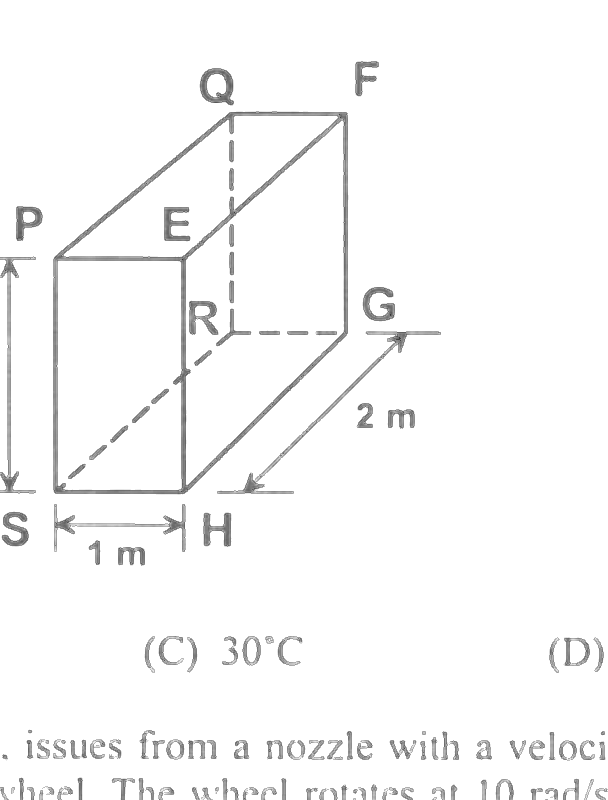
For the three-dimensional object shown in the figure below, five faces are insulated. The sixth face (PQRS), which is not insulated, interacts thermally with the ambient, with a convective heat transfer coefficient of 10 W/m²K. The ambient temperature is 30°C. Heat is uniformly generated inside the object at the rate of 100 W/m³. Assuming the face PQRS to be at uniform temperature, its steady state temperature is
Open complete paper
10
2008 · Mechanical Engineering · Fluid Mechanics and Thermal Sciences · Heat Transfer
Mechanical Engineering (ME) 2008

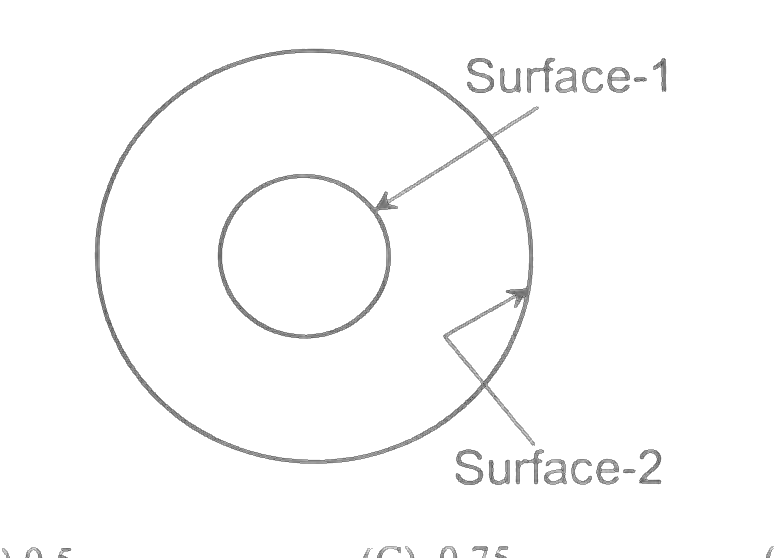
A hollow enclosure is formed between two infinitely long concentric cylinders of radii 1 m and 2 m, respectively. Radiative heat exchange takes place between the inner surface of the larger cylinder (surface-2) and the outer surface of the smaller cylinder (surface-1). The radiating surfaces are diffuse and the medium in the enclosure is non-participating. The fraction of the thermal radiation leaving the larger surface and striking itself is

Open complete paper
11
2008 · Mechanical Engineering · Fluid Mechanics and Thermal Sciences · Heat Transfer
Mechanical Engineering (ME) 2008

Steady two-dimensional heat conduction takes place in the body shown in the figure below. The normal temperature gradients over surfaces P and Q can be considered to be uniform. The temperature gradient ∂T/∂x at surface Q is equal to 10 K/m. Surfaces P and Q are maintained at constant temperatures as shown in the figure, while the remaining part of the boundary is insulated. The body has a constant thermal conductivity of 0.1 W/m.K. The values of ∂T/∂x and ∂T/∂y at surface P are

Open complete paper
12
2009 · Mechanical Engineering · Fluid Mechanics and Thermal Sciences · Heat Transfer
Mechanical Engineering (ME) 2009
A coolant fluid at 30 °C flows over a heated flat plate maintained at a constant temperature of 100 °C. The boundary layer temperature distribution at a given location on the plate may be approximated as \( T = 30 + 70\exp(-y) \) where \( y \) (in m) is the distance normal to the plate and \( T \) is in °C. If thermal conductivity of the fluid is 1.0 W/mK, the local convective heat transfer coefficient (in W/m²K) at that location will be
Open complete paper
13
2009 · Mechanical Engineering · Fluid Mechanics and Thermal Sciences · Heat Transfer
Mechanical Engineering (ME) 2009
In a parallel flow heat exchanger operating under steady state, the heat capacity rates (product of specific heat at constant pressure and mass flow rate) of the hot and cold fluid are equal. The hot fluid, flowing at 1 kg/s with \(C_p = 4\) kJ/kgK, enters the heat exchanger at 102 °C while the cold fluid has an inlet temperature of 15 °C. The overall heat transfer coefficient for the heat exchanger is estimated to be 1 kW/m²K and the corresponding heat transfer surface area is 5 m². Neglect heat transfer between the heat exchanger and the ambient. The heat exchanger is characterized by the following relation: \(2\epsilon = 1 - \exp(-2NTU)\). The exit temperature (in °C) for the cold fluid is
Open complete paper
14
2009 · Mechanical Engineering · Fluid Mechanics and Thermal Sciences · Heat Transfer
Mechanical Engineering (ME) 2009
Consider steady-state heat conduction across the thickness in a plane composite wall (as shown in the figure) exposed to convection conditions on both sides. Given: \(h_i = 20\) W/m²K; \(h_o = 50\) W/m²K; \(T_{\infty,i} = 20\) °C; \(T_{\infty,o} = -2\) °C; \(k_1 = 20\) W/mK; \(k_2 = 50\) W/mK; \(L_1 = 0.30\) m and \(L_2 = 0.15\) m. Assuming negligible contact resistance between the wall surfaces, the interface temperature, \(T\) (in °C), of the two walls will be
Open complete paper
15
2009 · Mechanical Engineering · Fluid Mechanics and Thermal Sciences · Heat Transfer
Mechanical Engineering (ME) 2009
The irradiation (in kW/m²) for the upper plate (plate 1) is
Open complete paper
16
2009 · Mechanical Engineering · Fluid Mechanics and Thermal Sciences · Heat Transfer
Mechanical Engineering (ME) 2009
If plate 1 is also a diffuse and gray surface with an emissivity value of 0.8, the net radiation heat exchange (in kW/m²) between plate 1 and plate 2 is
Open complete paper
17
2010 · Mechanical Engineering · Fluid Mechanics and Thermal Sciences · Heat Transfer
Mechanical Engineering (ME) 2010
A fin has 5 mm diameter and 100 mm length. The thermal conductivity of fin material is 400 Wm\(^{-1}\)K\(^{-1}\). One end of the fin is maintained at 130\(^\circ\)C and its remaining surface is exposed to ambient air at 30\(^\circ\)C. If the convective heat transfer coefficient is 40 Wm\(^{-2}\)K\(^{-1}\), the heat loss (in W) from the fin is
Open complete paper
18
2011 · Mechanical Engineering · Fluid Mechanics and Thermal Sciences · Heat Transfer
Mechanical Engineering (ME) 2011

In a condenser of a power plant, the steam condenses at a temperature of 60 °C. The cooling water enters at 30 °C and leaves at 45 °C. The logarithmic mean temperature difference (LMTD) of the condenser is

Open complete paper
19
2011 · Mechanical Engineering · Fluid Mechanics and Thermal Sciences · Heat Transfer
Mechanical Engineering (ME) 2011
A pipe of 25 mm outer diameter carries steam. The heat transfer coefficient between the cylinder and surroundings is 5 W/m²K. It is proposed to reduce the heat loss from the pipe by adding insulation having a thermal conductivity of 0.05 W/mK. Which one of the following statements is TRUE?
Open complete paper
20
2011 · Mechanical Engineering · Fluid Mechanics and Thermal Sciences · Heat Transfer
Mechanical Engineering (ME) 2011
The ratios of the laminar hydrodynamic boundary layer thickness to thermal boundary layer thickness of flows of two fluids P and Q on a flat plate are \( \frac{1}{2} \) and 2 respectively. The Reynolds number based on the plate length for both the flows is \( 10^4 \). The Prandtl and Nusselt numbers for P are \( \frac{1}{8} \) and 35 respectively. The Prandtl and Nusselt numbers for Q are respectively
Open complete paper

Showing 20 of 111 questions