My Cart
Your Cart 0

    Your cart is empty.

  • Total (Amount) ₹0.00
Previous year question hub

Reaction Rates and Rate Laws - Reaction Kinetics - Life Sciences Previous Year Questions

Practice Reaction Rates and Rate Laws - Reaction Kinetics - Life Sciences previous year questions organised from real papers, with year-wise coverage and clear topic navigation.

16Papers
16Years
22Questions
1Topics

Reaction Rates and Rate Laws question pattern

Every graph below is calculated only from this selection.

Questions by year

Year-wise coverage for Reaction Rates and Rate Laws. Each bar uses a separate theme-derived color.

Difficulty distribution

How the classified questions are distributed by difficulty.

Easy 14 63.6%
Medium 8 36.4%

Question type distribution

MCQ, numerical, multiple-select and other formats found in these papers.

MCQ 13 59.1%
Numerical Answer Type (NAT) 8 36.4%
Fill in the blanks 1 4.5%

Subject weightage

Top subjects by unique question coverage.

Life Sciences
22 Qs

Most asked topics

Top topics across the included previous year papers.

Reaction Kinetics
22 Qs

Subtopic coverage

Top subtopics inside this exact selection.

Reaction Rates and Rate Laws
22 Qs

Paper coverage

Question coverage for the most populated papers. Every active PYP paper remains listed below.

Life Sciences (XL) 2026
1 Qs
Life Sciences (XL) 2025
2 Qs
Life Sciences (XL) 2024
1 Qs
Life Sciences (XL) 2023
1 Qs
Life Sciences (XL) 2022
1 Qs
Life Sciences (XL) 2021
2 Qs
Life Sciences (XL) 2020
2 Qs
Life Sciences (XL) 2019
1 Qs
Life Sciences (XL) 2018
1 Qs
Life Sciences (XL) 2017
1 Qs
Life Sciences (XL) 2016
1 Qs
Life Sciences (XL) 2014
1 Qs
Life Sciences (XL) 2013
2 Qs
Life Sciences (XL) 2011
1 Qs
Life Sciences (XL) 2009
1 Qs
Life Sciences (XL) 2008
3 Qs

Included previous year papers

Newest papers appear first. Sort by year, question coverage or name.

PaperYear / sessionQuestions in this viewOpen
Life Sciences (XL) 202620261View paper
Life Sciences (XL) 202520252View paper
Life Sciences (XL) 202420241View paper
Life Sciences (XL) 202320231View paper
Life Sciences (XL) 202220221View paper
Life Sciences (XL) 202120212View paper
Life Sciences (XL) 202020202View paper
Life Sciences (XL) 201920191View paper
Life Sciences (XL) 201820181View paper
Life Sciences (XL) 201720171View paper
Life Sciences (XL) 201620161View paper
Life Sciences (XL) 201420141View paper
Life Sciences (XL) 201320132View paper
Life Sciences (XL) 201120111View paper
Life Sciences (XL) 200920091View paper
Life Sciences (XL) 200820083View paper

All Reaction Rates and Rate Laws previous year questions

Practice every matching question in batches of 20, with every available option.

1
2008 · Life Sciences · Reaction Kinetics · Reaction Rates and Rate Laws
Life Sciences (XL) 2008
The plot of concentration of A against time is a straight line with negative slope for the reaction:
\[A \rightarrow \text{products}\]
The order of the reaction is
Open complete paper
2
2008 · Life Sciences · Reaction Kinetics · Reaction Rates and Rate Laws
Life Sciences (XL) 2008
For a first order reaction at a particular temperature, the half-life was found to be \((100 \ln2)\) seconds. The specific rate constant of the reaction is
Open complete paper
3
2008 · Life Sciences · Reaction Kinetics · Reaction Rates and Rate Laws
Life Sciences (XL) 2008
The rate constant of the backward reaction (k_b) is
Open complete paper
4
2009 · Life Sciences · Reaction Kinetics · Reaction Rates and Rate Laws
Life Sciences (XL) 2009
For a second order reaction, \( R \xrightarrow{k} P \), the relation between half-life time ( \( t_{1/2} \) ) and the initial reactant concentration [\( R_0 \)] is
Open complete paper
5
2011 · Life Sciences · Reaction Kinetics · Reaction Rates and Rate Laws
Life Sciences (XL) 2011

If the concentration of KOH in the reaction mixture is doubled, the rate of the reaction will be

Open complete paper
6
2013 · Life Sciences · Reaction Kinetics · Reaction Rates and Rate Laws
Life Sciences (XL) 2013
Velocity of an object fired directly in upward direction is given by \( V = 80 – 32 t \), where \( t \) (time) is in seconds. When will the velocity be between 32 m/sec and 64 m/sec?
Open complete paper
7
2013 · Life Sciences · Reaction Kinetics · Reaction Rates and Rate Laws
Life Sciences (XL) 2013
The rate of a chemical reaction is tripled when the temperature of the reaction is increased from 298 K to 308 K. The activation energy (in kcal mol-1 K-1, up to one decimal place) for the reaction is (Given R = 1.987 cal mol-1 K-1) ________________
Open complete paper
8
2014 · Life Sciences · Reaction Kinetics · Reaction Rates and Rate Laws
Life Sciences (XL) 2014
For a first order reaction, the time required for 50% completion is 20 minutes. The time required for 99.9% completion of the reaction is _____ minutes.
Open complete paper
9
2016 · Life Sciences · Reaction Kinetics · Reaction Rates and Rate Laws
Life Sciences (XL) 2016

‘A harmful substance persists in the environment for a very long period of time’. The UNACCEPTABLE statement for this fact is

Open complete paper
10
2017 · Life Sciences · Reaction Kinetics · Reaction Rates and Rate Laws
Life Sciences (XL) 2017
For a reaction A + B → products, the following data was obtained.
[A]₀ (M)[B]₀ (M)Initial rate
0.10.1r
0.20.14r
0.10.22r
A₀ and B₀ are initial concentrations of A and B, respectively. The overall order of the reaction is

Question diagram

Open complete paper
11
2018 · Life Sciences · Reaction Kinetics · Reaction Rates and Rate Laws
Life Sciences (XL) 2018
The activation energy (Ea) values for two reactions carried out at 25 °C differ by 5.0 kJ mol⁻¹. If the pre-exponential factors (A₁ and A₂) for these two reactions are of the same magnitude, the ratio of rate constants (k₁/k₂) is ______ (up to two decimal places). (Given: Gas constant R = 8.314 J K⁻¹ mol⁻¹)
Open complete paper
12
2019 · Life Sciences · Reaction Kinetics · Reaction Rates and Rate Laws
Life Sciences (XL) 2019
For the reaction mechanism, 2X ⇌ Y (For this step, assume K_eq = [Y]/[X]^2) Y → P (k: rate constant for this step) the rate law is .
Open complete paper
13
2020 · Life Sciences · Reaction Kinetics · Reaction Rates and Rate Laws
Life Sciences (XL) 2020
A molecule in solution crystallizes into two different crystal forms with rate constants of 0.02 s⁻¹ and 0.13 s⁻¹. If the crystallization is assumed to be under kinetic control, then the half-life (in seconds, rounded off to one decimal place) of the molecule is ______.
Open complete paper
14
2020 · Life Sciences · Reaction Kinetics · Reaction Rates and Rate Laws
Life Sciences (XL) 2020
The activation energy ($E_a$) estimated for a reaction from the Arrhenius equation is 21 kJ mol⁻¹. If the frequency factor is assumed to be independent of temperature, then the ratio of the rate constants determined at 298 K and 260 K is ______ (rounded off to two decimal places). (Given: Gas constant, R = 8.315 J K⁻¹ mol⁻¹)
Open complete paper
15
2021 · Life Sciences · Reaction Kinetics · Reaction Rates and Rate Laws
Life Sciences (XL) 2021
The time taken by a first order reaction to reach 90% completion is 20 s.
The time taken for the reaction to reach 50% completion is ______ s
(rounded off to the closest integer).
Open complete paper
16
2021 · Life Sciences · Reaction Kinetics · Reaction Rates and Rate Laws
Life Sciences (XL) 2021
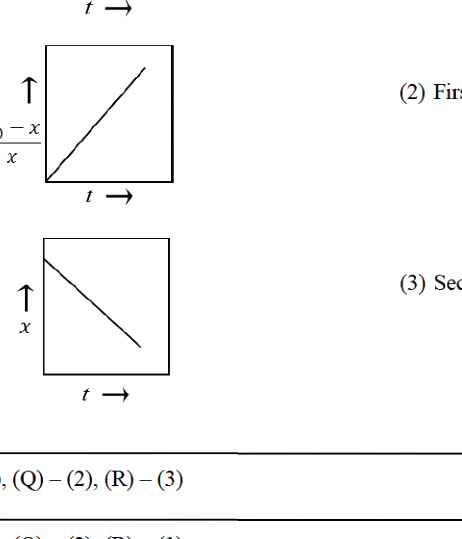
For a reaction, X → Products
Group I contains three plots of reactant concentrations as functions of time, where x = concentration of reactant X at time t, x0 = concentration of reactant X at initial time, t = 0. Group II gives a list of different orders of reaction. Match the plots with the order of the reaction.

Question diagram

Open complete paper
17
2022 · Life Sciences · Reaction Kinetics · Reaction Rates and Rate Laws
Life Sciences (XL) 2022
Consider a second order reaction, \(2A \longrightarrow Product\)
The concentration of A is represented as [A].
Which of the following is the CORRECT plot for determining the rate constant for the above reaction?
Open complete paper
18
2023 · Life Sciences · Reaction Kinetics · Reaction Rates and Rate Laws
Life Sciences (XL) 2023
Orange juice is packaged aseptically and stored under ambient conditions. The degradation of vitamin C in the juice occurs during storage and it follows first order reaction kinetics. The degradation rate constant is \(5.2\times10^{-3}\) day\(^{-1}\). The half-life of vitamin C in days is __________ (in integer).
Open complete paper
19
2024 · Life Sciences · Reaction Kinetics · Reaction Rates and Rate Laws
Life Sciences (XL) 2024

The initial rate of a reaction triples when the concentration of a reactant, A, is doubled. The order of the reaction with respect to A is ______ (rounded off to 2 decimal places).

Open complete paper
20
2025 · Life Sciences · Reaction Kinetics · Reaction Rates and Rate Laws
Life Sciences (XL) 2025
The temperature dependence of reaction rates is generally given by the Arrhenius equation. A plot of \( \ln k_r \) against \( 1/T \) is a straight line from which the pre-exponential factor ‘A’ and the activation energy ‘\( E_a \)’ can be determined.
The CORRECT option regarding this plot is
Open complete paper

Showing 20 of 22 questions