Difficulty distribution
How the classified questions are distributed by difficulty.
Your cart is empty.
Practice Plant Biomolecules, Secondary Metabolites and Hormones - Plant Physiology and Biochemistry - Life Sciences previous year questions organised from real papers, with year-wise coverage and clear topic navigation.
Every graph below is calculated only from this selection.
Year-wise coverage for Plant Biomolecules, Secondary Metabolites and Hormones. Each bar uses a separate theme-derived color.
How the classified questions are distributed by difficulty.
MCQ, numerical, multiple-select and other formats found in these papers.
Top subjects by unique question coverage.
Top topics across the included previous year papers.
Top subtopics inside this exact selection.
Question coverage for the most populated papers. Every active PYP paper remains listed below.
Newest papers appear first. Sort by year, question coverage or name.
| Paper | Year / session | Questions in this view | Open |
|---|---|---|---|
| Life Sciences (XL) 2026 | 2026 | 1 | View paper |
| Life Sciences (XL) 2024 | 2024 | 2 | View paper |
| Life Sciences (XL) 2021 | 2021 | 1 | View paper |
| Life Sciences (XL) 2020 | 2020 | 1 | View paper |
| Life Sciences (XL) 2019 | 2019 | 3 | View paper |
| Life Sciences (XL) 2018 | 2018 | 3 | View paper |
| Life Sciences (XL) 2017 | 2017 | 2 | View paper |
| Life Sciences (XL) 2016 | 2016 | 1 | View paper |
| Life Sciences (XL) 2015 | 2015 | 1 | View paper |
| Life Sciences (XL) 2014 | 2014 | 2 | View paper |
| Life Sciences (XL) 2013 | 2013 | 1 | View paper |
| Life Sciences (XL) 2012 | 2012 | 3 | View paper |
| Life Sciences (XL) 2011 | 2011 | 1 | View paper |
| Life Sciences (XL) 2010 | 2010 | 3 | View paper |
| Life Sciences (XL) 2008 | 2008 | 1 | View paper |
| Life Sciences (XL) 2007 | 2007 | 2 | View paper |
Practice every matching question in batches of 20, with every available option.
| Group I | Group II | Group III |
|---|---|---|
| P. Sorghum | 1. Gossypol | i. Protein |
| Q. Castor | 2. Strychnine | ii. Glycosidic conjugate |
| R. Mushroom | 3. Dhurrin | iii. Alkaloid |
| S. Cotton | 4. Bungarotoxin | iv. Polyphenol |
| 5. Ricin | v. Lipid | |
| 6. α-Amanitin | vi. Cyclic peptide |
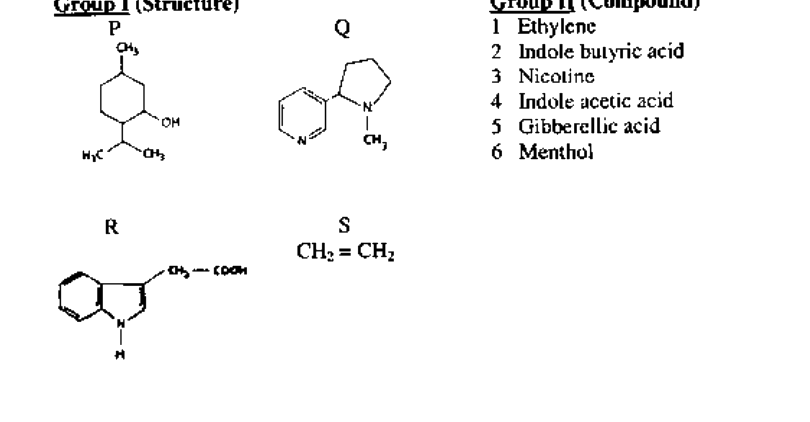
| Group I (Structure) | Group II (Compound) |
|---|---|
| P | 1. Ethylene |
| Q | 2. Indole butyric acid |
| R | 3. Nicotine |
| S | 4. Indole acetic acid |
| 5. Gibberellic acid | |
| 6. Menthol |

| Column I | Column II | Column III |
|---|---|---|
| P. Ubiquitin | 1. Chloroplast | i. Leaf |
| Q. Napin | 2. Nucleus | ii. Seed |
| R. RbcL | 3. Mitochondria | |
| S. RbcS |
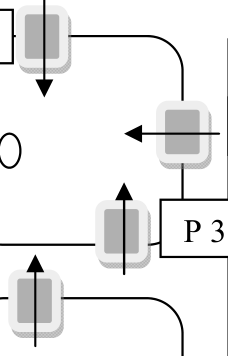
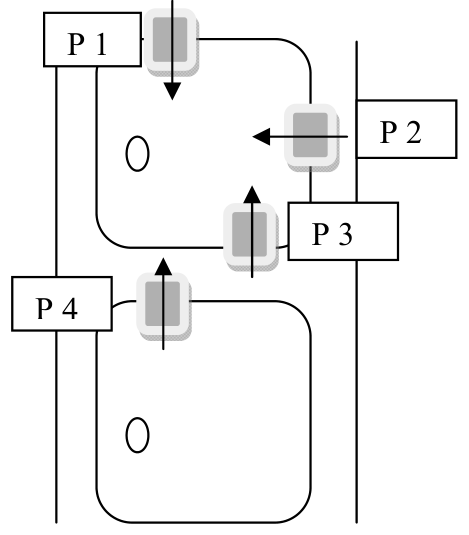
PIN proteins are plasma membrane-localized carrier proteins required for polar auxin transport in plants. Four different carrier proteins are shown in the diagram below labeled P1-P4. Arrow indicates the direction of auxin flow. Which among these is most likely to be a PIN protein?


Showing 20 of 28 questions