My Cart
Your Cart 0

    Your cart is empty.

  • Total (Amount) ₹0.00
Previous year question hub

Plant development; Cell and Tissue Morphogenesis - Life Sciences Previous Year Questions

Practice Plant development; Cell and Tissue Morphogenesis - Life Sciences previous year questions organised from real papers, with year-wise coverage and clear topic navigation.

7Papers
7Years
11Questions
1Topics

Plant development; Cell and Tissue Morphogenesis question pattern

Every graph below is calculated only from this selection.

Questions by year

Year-wise coverage for Plant development; Cell and Tissue Morphogenesis. Each bar uses a separate theme-derived color.

Difficulty distribution

How the classified questions are distributed by difficulty.

Medium 6 54.5%
Easy 5 45.5%

Question type distribution

MCQ, numerical, multiple-select and other formats found in these papers.

MCQ 10 90.9%
Numerical Answer Type (NAT) 1 9.1%

Subject weightage

Top subjects by unique question coverage.

Life Sciences
11 Qs

Most asked topics

Top topics across the included previous year papers.

Plant development; Cell and Tissue Morphogenesis
11 Qs

Subtopic coverage

Top subtopics inside this exact selection.

Tissue Patterning and Meristem Development
5 Qs
Gametophytes, Fertilization and Seed Development
3 Qs
Flowering, Light and Hormonal Regulation
3 Qs

Paper coverage

Question coverage for the most populated papers. Every active PYP paper remains listed below.

Life Sciences (XL) 2025
1 Qs
Life Sciences (XL) 2024
1 Qs
Life Sciences (XL) 2021
3 Qs
Life Sciences (XL) 2019
2 Qs
Life Sciences (XL) 2017
1 Qs
Life Sciences (XL) 2010
2 Qs
Life Sciences (XL) 2008
1 Qs

Browse by subtopics

Open a focused page built from the same verified paper data.

Included previous year papers

Newest papers appear first. Sort by year, question coverage or name.

PaperYear / sessionQuestions in this viewOpen
Life Sciences (XL) 202520251View paper
Life Sciences (XL) 202420241View paper
Life Sciences (XL) 202120213View paper
Life Sciences (XL) 201920192View paper
Life Sciences (XL) 201720171View paper
Life Sciences (XL) 201020102View paper
Life Sciences (XL) 200820081View paper

Sample previous year questions

A varied preview from the papers represented in this selection, with every available option.

1
2008 · Life Sciences · Plant development; Cell and Tissue Morphogenesis · Gametophytes, Fertilization and Seed Development
Life Sciences (XL) 2008

Parthenogenetic embryos in plants are those which are formed by

Open complete paper
2
2010 · Life Sciences · Plant development; Cell and Tissue Morphogenesis · Flowering, Light and Hormonal Regulation
Life Sciences (XL) 2010
Identify the CORRECT statements
In Arabidopsis, vernalization is associated with
P. Chromatin modification at the FLC (FLOWERING LOCUS C) locus
Q. Degradation of the FLC protein
R. Inactivating the FLC protein by post-translational modification
S. Down-regulation of FLC transcript
Open complete paper
3
2017 · Life Sciences · Plant development; Cell and Tissue Morphogenesis · Tissue Patterning and Meristem Development
Life Sciences (XL) 2017
A typical floral meristem differs from shoot apical meristem on the basis of
Open complete paper
4
2019 · Life Sciences · Plant development; Cell and Tissue Morphogenesis · Tissue Patterning and Meristem Development
Life Sciences (XL) 2019
The plant cells are considered totipotent. The phenomenon of a mature cell reverting to the meristematic state and forming undifferentiated callus tissue is called
Open complete paper
5
2021 · Life Sciences · Plant development; Cell and Tissue Morphogenesis · Tissue Patterning and Meristem Development
Life Sciences (XL) 2021
In spiral phyllotaxis, leaves are initiated sequentially on the meristem with two successive primordia being separated by golden angle. If a plant follows right-handed spiral phyllotaxis when looked down the meristem, then the angle between two successive leaves would be __________ degrees (with correct sign, round off to one decimal place).
Open complete paper
6
2024 · Life Sciences · Plant development; Cell and Tissue Morphogenesis · Flowering, Light and Hormonal Regulation
Life Sciences (XL) 2024
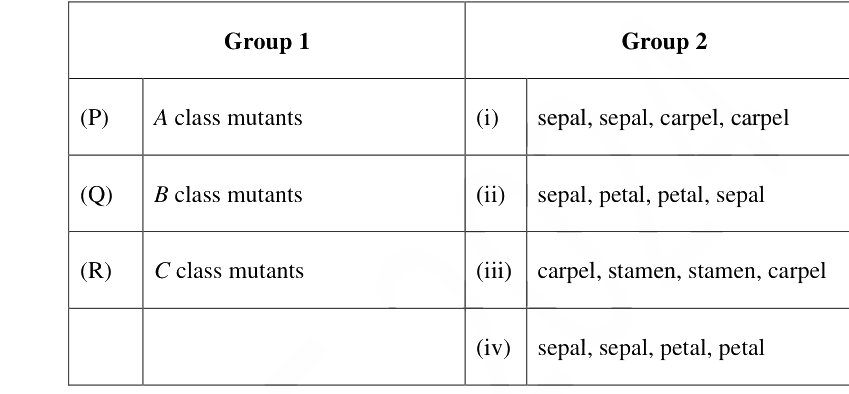
In wild-type Arabidopsis thaliana, the four types of floral organs (sepal, petal, stamen, carpel) are arranged in concentric whorls from outside to inside. With reference to the ABC model of floral organ patterning, match the homeotic mutants in Group 1 with their respective arrangements of organs in the four whorls given in Group 2.
Group 1Group 2
(P)A class mutants(i)sepal, sepal, carpel, carpel
(Q)B class mutants(ii)sepal, petal, petal, sepal
(R)C class mutants(iii)carpel, stamen, stamen, carpel
(iv)sepal, sepal, petal, petal

Question diagram

Open complete paper