My Cart
Your Cart 0

    Your cart is empty.

  • Total (Amount) ₹0.00
Previous year question hub

Plant Cells, Tissues and Organ Anatomy - Plant Anatomy - Life Sciences Previous Year Questions

Practice Plant Cells, Tissues and Organ Anatomy - Plant Anatomy - Life Sciences previous year questions organised from real papers, with year-wise coverage and clear topic navigation.

17Papers
17Years
30Questions
1Topics

Plant Cells, Tissues and Organ Anatomy question pattern

Every graph below is calculated only from this selection.

Questions by year

Year-wise coverage for Plant Cells, Tissues and Organ Anatomy. Each bar uses a separate theme-derived color.

Difficulty distribution

How the classified questions are distributed by difficulty.

Easy 20 66.7%
Medium 10 33.3%

Question type distribution

MCQ, numerical, multiple-select and other formats found in these papers.

MCQ 28 93.3%
Fill in the blanks 1 3.3%
MSQ 1 3.3%

Subject weightage

Top subjects by unique question coverage.

Life Sciences
30 Qs

Most asked topics

Top topics across the included previous year papers.

Plant Anatomy
30 Qs

Subtopic coverage

Top subtopics inside this exact selection.

Plant Cells, Tissues and Organ Anatomy
30 Qs

Paper coverage

Question coverage for the most populated papers. Every active PYP paper remains listed below.

Life Sciences (XL) 2025
2 Qs
Life Sciences (XL) 2024
1 Qs
Life Sciences (XL) 2023
2 Qs
Life Sciences (XL) 2021
2 Qs
Life Sciences (XL) 2019
3 Qs
Life Sciences (XL) 2018
1 Qs
Life Sciences (XL) 2017
1 Qs
Life Sciences (XL) 2016
2 Qs
Life Sciences (XL) 2015
1 Qs
Life Sciences (XL) 2014
1 Qs
Life Sciences (XL) 2013
1 Qs
Life Sciences (XL) 2012
2 Qs
Life Sciences (XL) 2011
2 Qs
Life Sciences (XL) 2010
1 Qs
Life Sciences (XL) 2009
2 Qs
Life Sciences (XL) 2008
3 Qs
Life Sciences (XL) 2007
3 Qs

Included previous year papers

Newest papers appear first. Sort by year, question coverage or name.

PaperYear / sessionQuestions in this viewOpen
Life Sciences (XL) 202520252View paper
Life Sciences (XL) 202420241View paper
Life Sciences (XL) 202320232View paper
Life Sciences (XL) 202120212View paper
Life Sciences (XL) 201920193View paper
Life Sciences (XL) 201820181View paper
Life Sciences (XL) 201720171View paper
Life Sciences (XL) 201620162View paper
Life Sciences (XL) 201520151View paper
Life Sciences (XL) 201420141View paper
Life Sciences (XL) 201320131View paper
Life Sciences (XL) 201220122View paper
Life Sciences (XL) 201120112View paper
Life Sciences (XL) 201020101View paper
Life Sciences (XL) 200920092View paper
Life Sciences (XL) 200820083View paper
Life Sciences (XL) 200720073View paper

All Plant Cells, Tissues and Organ Anatomy previous year questions

Practice every matching question in batches of 20, with every available option.

1
2007 · Life Sciences · Plant Anatomy · Plant Cells, Tissues and Organ Anatomy
Life Sciences (XL) 2007

Identify the mismatch tissue.

Open complete paper
2
2007 · Life Sciences · Plant Anatomy · Plant Cells, Tissues and Organ Anatomy
Life Sciences (XL) 2007
Group IGroup II
P. Funiculus1. Pea pod
Q. Seed coat dormancy2. Coconut
R. Reserve food stored in endosperm3. Rice seed
S. Vivipary germination4. Erycibe
5. Malvaceae
6. Rhizophora
Open complete paper
3
2007 · Life Sciences · Plant Anatomy · Plant Cells, Tissues and Organ Anatomy
Life Sciences (XL) 2007
Group IGroup II
(P) Epidermal cells with guard cells1. Amino acid
(Q) Cross section of a leaf showing bulliform cells2. Glucose
(R) Chemical structure of IAA3. IAA
(S) Chemical structure of an amino acid4. Bulliform cells
5. Tyloses
6. Kinetin
Open complete paper
4
2008 · Life Sciences · Plant Anatomy · Plant Cells, Tissues and Organ Anatomy
Life Sciences (XL) 2008
Identify the correct statements P Caryopsis, one-seeded dry indehiscent fruit of Gramineae Q Lithocyst, a cell containing starch R Aleurone layer contains protein granules and enzymes S Embryo development is not of a single cell origin
Open complete paper
5
2008 · Life Sciences · Plant Anatomy · Plant Cells, Tissues and Organ Anatomy
Life Sciences (XL) 2008
Group-I: P: Foliaceous bracts, Q: Spathe, R: Petaloid bracts, S: Involucre
Group-II: 1. A large and commonly boat shaped bract enclosing a cluster of flowers, 2. One or more whorls of bracteoles developing at the base of a calyx, 3. Green, flat and leaf like in appearance, 4. Brightly coloured bracts looking somewhat like petals, 5. Special bracts- small, dry and scaly, 6. One or more whorls of bracts, normally green in colour present around a cluster of flowers
Open complete paper
6
2008 · Life Sciences · Plant Anatomy · Plant Cells, Tissues and Organ Anatomy
Life Sciences (XL) 2008
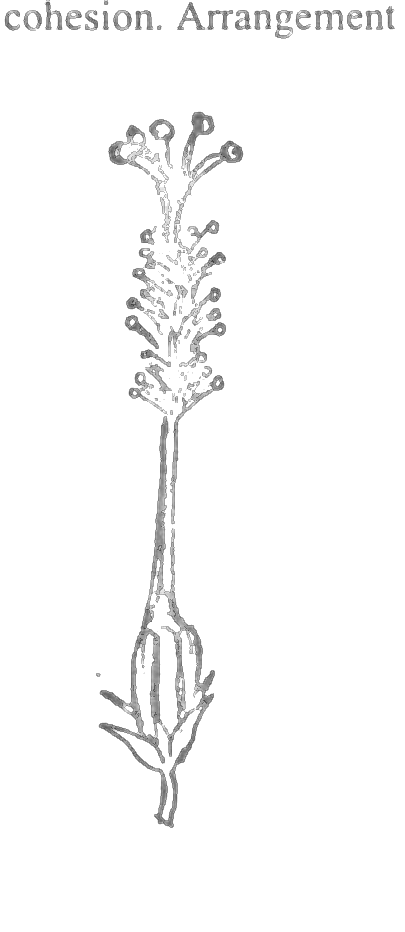
Identify the type of stamen
Open complete paper
7
2009 · Life Sciences · Plant Anatomy · Plant Cells, Tissues and Organ Anatomy
Life Sciences (XL) 2009

In hypogynous flower

Open complete paper
8
2009 · Life Sciences · Plant Anatomy · Plant Cells, Tissues and Organ Anatomy
Life Sciences (XL) 2009
Fill up the blanks with appropriate matches.
The main axis of the inflorescence is known as ______ and the stalk of the individual flower is called ______.
Open complete paper
9
2010 · Life Sciences · Plant Anatomy · Plant Cells, Tissues and Organ Anatomy
Life Sciences (XL) 2010
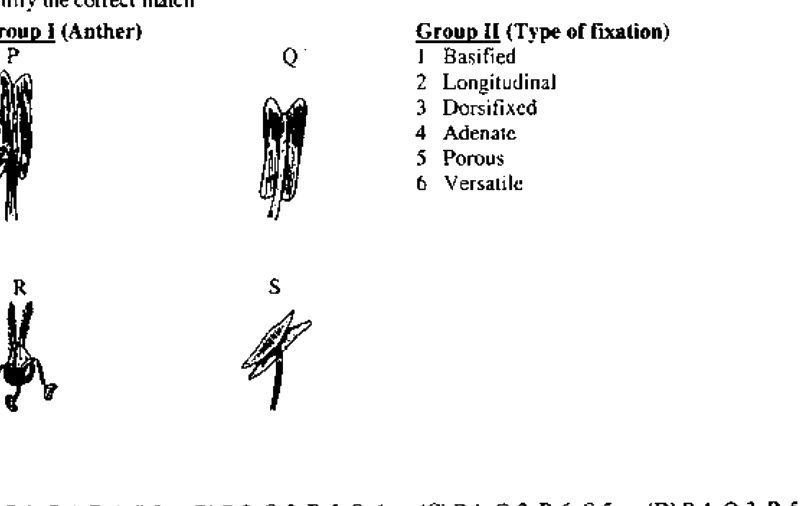
Identify the correct match
Group I (Anther)Group II (Type of fixation)
P1. Basifixed
Q2. Longitudinal
R3. Dorsifixed
S4. Adnate
5. Versatile

Question diagram

Open complete paper
10
2011 · Life Sciences · Plant Anatomy · Plant Cells, Tissues and Organ Anatomy
Life Sciences (XL) 2011
The stalk with which the ovule remains attached to the placenta is called
Open complete paper
11
2011 · Life Sciences · Plant Anatomy · Plant Cells, Tissues and Organ Anatomy
Life Sciences (XL) 2011
Identify the CORRECT statements.
P. Specialized parenchymatous cells with tannins and crystals of calcium oxalate are termed as sclereids
Q. The sieve elements of angiosperms are surrounded by companion cells and are essential component of phloem loading
R. The exudation of water by guttation occurs through trichomes
S. The bulliform cells control the unrolling and hygroscopic movement of grass leaves
Open complete paper
12
2012 · Life Sciences · Plant Anatomy · Plant Cells, Tissues and Organ Anatomy
Life Sciences (XL) 2012
The swollen base of a petiole is known as
Open complete paper
13
2012 · Life Sciences · Plant Anatomy · Plant Cells, Tissues and Organ Anatomy
Life Sciences (XL) 2012
Parenchyma cells associated with sieve tube members are called
Open complete paper
14
2013 · Life Sciences · Plant Anatomy · Plant Cells, Tissues and Organ Anatomy
Life Sciences (XL) 2013
Bast fibres are present in
Open complete paper
15
2014 · Life Sciences · Plant Anatomy · Plant Cells, Tissues and Organ Anatomy
Life Sciences (XL) 2014
Find the odd one out
Open complete paper
16
2015 · Life Sciences · Plant Anatomy · Plant Cells, Tissues and Organ Anatomy
Life Sciences (XL) 2015
An organized and differentiated cell having cytoplasm but no nucleus is found in
Open complete paper
17
2016 · Life Sciences · Plant Anatomy · Plant Cells, Tissues and Organ Anatomy
Life Sciences (XL) 2016
Which of the following is most abundant in the aleurone layer of wheat seeds?
Open complete paper
18
2016 · Life Sciences · Plant Anatomy · Plant Cells, Tissues and Organ Anatomy
Life Sciences (XL) 2016
4',6 diamidino 2-phenylindole (DAPI) is a fluorescent dye used to stain the nucleus. Which of the following plant cells, when mature, cannot be stained by DAPI?
Open complete paper
19
2017 · Life Sciences · Plant Anatomy · Plant Cells, Tissues and Organ Anatomy
Life Sciences (XL) 2017
A cavity, lysigenous in origin and possessing volatile oil is found in the pericarp of one of the following plants. Identify the CORRECT answer.
Open complete paper
20
2018 · Life Sciences · Plant Anatomy · Plant Cells, Tissues and Organ Anatomy
Life Sciences (XL) 2018
Which of the following stains is used to visualize callose under the microscope?
Open complete paper

Showing 20 of 30 questions