My Cart
Your Cart 0

    Your cart is empty.

  • Total (Amount) ₹0.00
Previous year question hub

Inheritance, Recombination and Genetic Mapping - Genetics and Genomics - Life Sciences Previous Year Questions

Practice Inheritance, Recombination and Genetic Mapping - Genetics and Genomics - Life Sciences previous year questions organised from real papers, with year-wise coverage and clear topic navigation.

5Papers
5Years
8Questions
1Topics

Inheritance, Recombination and Genetic Mapping question pattern

Every graph below is calculated only from this selection.

Questions by year

Year-wise coverage for Inheritance, Recombination and Genetic Mapping. Each bar uses a separate theme-derived color.

Difficulty distribution

How the classified questions are distributed by difficulty.

Medium 7 87.5%
Easy 1 12.5%

Question type distribution

MCQ, numerical, multiple-select and other formats found in these papers.

MCQ 5 62.5%
MSQ 2 25%
Numerical Answer Type (NAT) 1 12.5%

Subject weightage

Top subjects by unique question coverage.

Life Sciences
8 Qs

Most asked topics

Top topics across the included previous year papers.

Genetics and Genomics
8 Qs

Subtopic coverage

Top subtopics inside this exact selection.

Inheritance, Recombination and Genetic Mapping
8 Qs

Paper coverage

Question coverage for the most populated papers. Every active PYP paper remains listed below.

Life Sciences (XL) 2026
2 Qs
Life Sciences (XL) 2021
2 Qs
Life Sciences (XL) 2016
2 Qs
Life Sciences (XL) 2014
1 Qs
Life Sciences (XL) 2011
1 Qs

Included previous year papers

Newest papers appear first. Sort by year, question coverage or name.

PaperYear / sessionQuestions in this viewOpen
Life Sciences (XL) 202620262View paper
Life Sciences (XL) 202120212View paper
Life Sciences (XL) 201620162View paper
Life Sciences (XL) 201420141View paper
Life Sciences (XL) 201120111View paper

All Inheritance, Recombination and Genetic Mapping previous year questions

Practice every matching question in batches of 20, with every available option.

1
2011 · Life Sciences · Genetics and Genomics · Inheritance, Recombination and Genetic Mapping
Life Sciences (XL) 2011
Four Hfr strains of E. coli were generated from the same F⁺ strain. The Hfr strains donated markers in the following order
Strain1: DQWMT; Strain 2: AXPTM; Strain 3: BNCAX; Strain 4: BDQWM
The order of the markers in the original F⁺ strain is
Open complete paper
2
2014 · Life Sciences · Genetics and Genomics · Inheritance, Recombination and Genetic Mapping
Life Sciences (XL) 2014
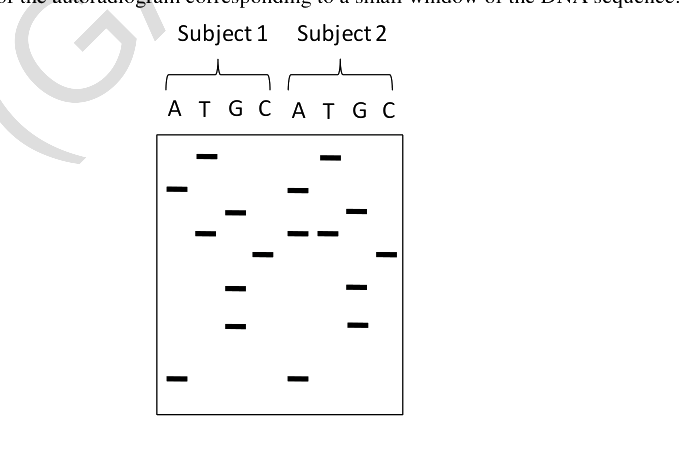
Using the Sanger’s dideoxy chain termination method, a particular exonic region of a protein coding gene was sequenced for two individuals referred to as Subject 1 and Subject 2. The figure below shows a segment of the autoradiogram corresponding to a small window of the DNA sequence.

Which one of the following interpretations is correct for the sequenced DNA fragments?

Question diagram

Open complete paper
3
2016 · Life Sciences · Genetics and Genomics · Inheritance, Recombination and Genetic Mapping
Life Sciences (XL) 2016

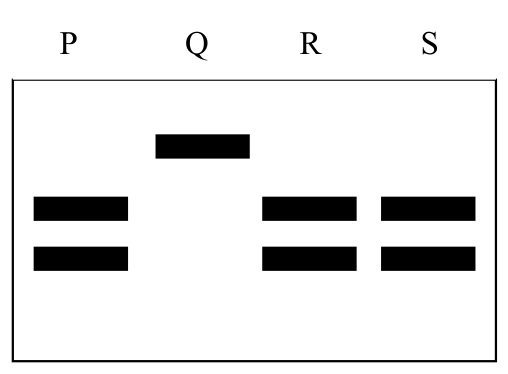
An RFLP marker shows sequence polymorphism in two ecotypes (X and Y) of a plant. In ecotype X, the marker contains one GAATTC site in its sequence, whereas in Y it has the sequence GAAATC at the same site. The rest of the sequence is identical in both ecotypes. In a genotyping experiment, the marker was PCR amplified from four different seedlings (P, Q, R, S), completely digested with EcoRI and the products were analyzed by electrophoresis. The diagram below shows the band patterns obtained. Based on the information provided, which of the following statements is correct?

Source question diagram

Open complete paper
4
2016 · Life Sciences · Genetics and Genomics · Inheritance, Recombination and Genetic Mapping
Life Sciences (XL) 2016

The nature of the polymorphic DNA fragment used for mapping is

Open complete paper
5
2021 · Life Sciences · Genetics and Genomics · Inheritance, Recombination and Genetic Mapping
Life Sciences (XL) 2021
To understand the mechanism of systemic acquired resistance (SAR), a team of researchers isolated a mutant with reduced SAR response. Sequencing of this mutant revealed homozygous mutations in two genes, X and Y. Which of the following experiment(s) would test whether the mutant phenotype is caused by mutation in either or both the genes?
Open complete paper
6
2021 · Life Sciences · Genetics and Genomics · Inheritance, Recombination and Genetic Mapping
Life Sciences (XL) 2021
The rate of appearance of recombinant E. coli strains containing different genes after a mating between Hfr and F strains is shown in the graph (left). The approximate location of different genes (p, q, r, s, t, x, and y) along the Hfr chromosome is also shown (right). Based on this information, identify the recombinants X, Y and Z.
Open complete paper
7
2026 · Life Sciences · Genetics and Genomics · Inheritance, Recombination and Genetic Mapping
Life Sciences (XL) 2026
In Escherichia coli, the minimum number of crossovers required between F⁻ genome and the linear DNA transmitted by Hfr to form a viable recombinant is ____. (Answer in integer)
Open complete paper
8
2026 · Life Sciences · Genetics and Genomics · Inheritance, Recombination and Genetic Mapping
Life Sciences (XL) 2026
In her exploration of the Western Ghats, Dora finds four new species of fungi. Below is the DNA sequence alignment for a single locus from these new species that she calls Yeti, Unicorn, Bigfoot and Godzilla. Using the principle of parsimony and the DNA sequence alignment information below, which one or more of the following tree topologies represent(s) the relationship between these species? Yeti: ATGC Unicorn: ATGT Bigfoot: ATGA Godzilla: ATGT (P) Unicorn, Godzilla, Bigfoot, Yeti (Q) Godzilla, Unicorn, Bigfoot, Yeti (R) Bigfoot, Yeti, Godzilla, Unicorn (S) Unicorn, Godzilla, Bigfoot, Yeti
Open complete paper