My Cart
Your Cart 0

    Your cart is empty.

  • Total (Amount) ₹0.00
Previous year question hub

Conductance and Electrochemical Cells - Electrochemistry - Life Sciences Previous Year Questions

Practice Conductance and Electrochemical Cells - Electrochemistry - Life Sciences previous year questions organised from real papers, with year-wise coverage and clear topic navigation.

15Papers
15Years
17Questions
1Topics

Conductance and Electrochemical Cells question pattern

Every graph below is calculated only from this selection.

Questions by year

Year-wise coverage for Conductance and Electrochemical Cells. Each bar uses a separate theme-derived color.

Difficulty distribution

How the classified questions are distributed by difficulty.

Medium 10 58.8%
Easy 7 41.2%

Question type distribution

MCQ, numerical, multiple-select and other formats found in these papers.

MCQ 11 64.7%
Numerical Answer Type (NAT) 6 35.3%

Subject weightage

Top subjects by unique question coverage.

Life Sciences
17 Qs

Most asked topics

Top topics across the included previous year papers.

Electrochemistry
17 Qs

Subtopic coverage

Top subtopics inside this exact selection.

Conductance and Electrochemical Cells
17 Qs

Paper coverage

Question coverage for the most populated papers. Every active PYP paper remains listed below.

Life Sciences (XL) 2025
1 Qs
Life Sciences (XL) 2023
1 Qs
Life Sciences (XL) 2022
1 Qs
Life Sciences (XL) 2021
1 Qs
Life Sciences (XL) 2020
1 Qs
Life Sciences (XL) 2019
1 Qs
Life Sciences (XL) 2018
1 Qs
Life Sciences (XL) 2017
1 Qs
Life Sciences (XL) 2016
1 Qs
Life Sciences (XL) 2013
2 Qs
Life Sciences (XL) 2012
1 Qs
Life Sciences (XL) 2010
1 Qs
Life Sciences (XL) 2009
1 Qs
Life Sciences (XL) 2008
2 Qs
Life Sciences (XL) 2007
1 Qs

Included previous year papers

Newest papers appear first. Sort by year, question coverage or name.

PaperYear / sessionQuestions in this viewOpen
Life Sciences (XL) 202520251View paper
Life Sciences (XL) 202320231View paper
Life Sciences (XL) 202220221View paper
Life Sciences (XL) 202120211View paper
Life Sciences (XL) 202020201View paper
Life Sciences (XL) 201920191View paper
Life Sciences (XL) 201820181View paper
Life Sciences (XL) 201720171View paper
Life Sciences (XL) 201620161View paper
Life Sciences (XL) 201320132View paper
Life Sciences (XL) 201220121View paper
Life Sciences (XL) 201020101View paper
Life Sciences (XL) 200920091View paper
Life Sciences (XL) 200820082View paper
Life Sciences (XL) 200720071View paper

All Conductance and Electrochemical Cells previous year questions

Practice every matching question in batches of 20, with every available option.

1
2007 · Life Sciences · Electrochemistry · Conductance and Electrochemical Cells
Life Sciences (XL) 2007
A fuel cell is based on the idea of the reaction H2(g) + ½ O2(g) → H2O(l) generating electricity. The standard free energy change (ΔG°) for this reaction at 298 K is –237.13 kJ/mol. The standard cell potential for the system at 298 K is (1 Faraday = 96500 coulombs)
Open complete paper
2
2008 · Life Sciences · Electrochemistry · Conductance and Electrochemical Cells
Life Sciences (XL) 2008
An electrochemical cell of the following representation was found to be a galvanic cell, where ‘A’ and ‘B’ represent different metals.
\[A(s) \mid A^{2+} (aq) \; 1 \; M \; \| \; B^{2+} (aq) \; 1M \mid B(s)\]
Which of the following statements with respect to the cell is correct?

Question diagram

Open complete paper
3
2008 · Life Sciences · Electrochemistry · Conductance and Electrochemical Cells
Life Sciences (XL) 2008
The limiting molar conductivities of some species are given in \((S \; cm^2 \; mol^{-1})\) units:
\[\Lambda_m^0(HCl) = 425.9; \; \Lambda_m^0(NaCl) = 126.4; \; \Lambda_m^0(H^+) = 349.6\]
Find the limiting molar conductivity of \(Na^+\) ion.
Open complete paper
4
2009 · Life Sciences · Electrochemistry · Conductance and Electrochemical Cells
Life Sciences (XL) 2009
Given the following standard electrode potentials at 25 °C: \( \frac{1}{2} Fe^{2+} + e^- = \frac{1}{2} Fe(s) ; E^0 = -0.440 \, V \) \( Fe^{3+} + e^- = Fe^{2+} ; E^0 = +0.771 \, V \) The standard electrode potential at 25 °C for \( Fe^{3+} + 3e^- = Fe(s) \) is
Open complete paper
5
2010 · Life Sciences · Electrochemistry · Conductance and Electrochemical Cells
Life Sciences (XL) 2010

A battery delivers a steady current of 1.25 A for 90 minutes. The total charge 'Q' (in Coulomb units) is

Open complete paper
6
2012 · Life Sciences · Electrochemistry · Conductance and Electrochemical Cells
Life Sciences (XL) 2012
The value of standard half cell potential of Cu2+, Cu couple (E°Cu2+, Cu) is 0.34 V. A wire of pure copper is immersed into a solution of copper nitrate. If the measured cell potential against standard hydrogen electrode at 298 K is 0.24 V, the molar concentration of copper nitrate is {Assume activity of Cu2+ = [Cu2+]}.
Open complete paper
7
2013 · Life Sciences · Electrochemistry · Conductance and Electrochemical Cells
Life Sciences (XL) 2013
The molar conductance at infinite dilution (in S m2 mol-1) of acetic acid is
Open complete paper
8
2013 · Life Sciences · Electrochemistry · Conductance and Electrochemical Cells
Life Sciences (XL) 2013
If the molar conductance of an acetic acid solution is \(15.2 \times 10^{-4}\) S m2 mol-1, then the percentage (%) dissociation of acetic acid in the solution will be
Open complete paper
9
2016 · Life Sciences · Electrochemistry · Conductance and Electrochemical Cells
Life Sciences (XL) 2016
For a weak acid at 298 K the molar conductivities (in ohm-1 m2 mol-1) at infinite dilution and 0.04 mol dm-3 are \( 4.3 \times 10^{-2} \) and \( 1.0 \times 10^{-2} \), respectively. The degree of dissociation of the acid (0.04 mol dm-3) at 298 K is ______________.
Open complete paper
10
2017 · Life Sciences · Electrochemistry · Conductance and Electrochemical Cells
Life Sciences (XL) 2017
The EMF for the following cell at 298.15 K is
Ag(s) | Ag⁺(aq., 0.01 M) || Ag⁺(aq., 1.0 M) | Ag(s)
(Standard reduction potential for Ag⁺ + e⁻ → Ag is -0.80 V)

Question diagram

Open complete paper
11
2018 · Life Sciences · Electrochemistry · Conductance and Electrochemical Cells
Life Sciences (XL) 2018
The standard reduction potential (E°) for the conversion of Cr₂O₇²⁻ to Cr³⁺ at 25 °C in an aqueous solution of pH 3.0 is 1.33 V. The concentrations of Cr₂O₇²⁻ and Cr³⁺ are 1.0 × 10⁻⁴ M and 1.0 × 10⁻³ M, respectively. Then the potential of this half-cell reaction is (Given: Faraday constant = 96500 C mol⁻¹, Gas constant R = 8.314 J K⁻¹ mol⁻¹)
Open complete paper
12
2019 · Life Sciences · Electrochemistry · Conductance and Electrochemical Cells
Life Sciences (XL) 2019
Given the standard reduction potentials, E°(Cu²⁺/Cu) = 0.34 V and E°(Ag⁺/Ag) = 0.80 V, the standard free energy change (ΔG°) for the reaction
Cu(s) + 2Ag⁺(aq) → Cu²⁺(aq) + 2Ag(s)
in kJ mol⁻¹ (rounded off to one decimal place; F= 96500 C mol⁻¹), is ____
Open complete paper
13
2020 · Life Sciences · Electrochemistry · Conductance and Electrochemical Cells
Life Sciences (XL) 2020
The standard potential ($E^0_{cell}$) for a cell reaction given below is +0.7 V. The standard reaction free energy ($\Delta_r G^0$) for this cell is ______ kJ mol⁻¹ (correct up to two decimal places). (Given: Faraday constant, F = 96500 C mol⁻¹) $\text{Au}^{3+} (aq) + 3 \text{Ag} (s) \longrightarrow \text{Au} (s) + 3 \text{Ag}^+ (aq)$

Question diagram

Open complete paper
14
2021 · Life Sciences · Electrochemistry · Conductance and Electrochemical Cells
Life Sciences (XL) 2021
Given the standard reduction potentials, $E^\circ_{Mg^{2+}/Mg} = -2.37 \text{ V}$ and $E^\circ_{Ag^+/Ag} = 0.80 \text{ V}$, the potential of the following cell
Ag⁺(aq., 1 mM) + Mg(s) ⇌ Ag(s) + Mg²⁺(aq., 0.2 M)
at 25 °C is ________ V (rounded off to two decimal places).
(Given: Faraday constant = 96500 C mol⁻¹, Gas constant R = 8.314 J K⁻¹ mol⁻¹)
Open complete paper
15
2022 · Life Sciences · Electrochemistry · Conductance and Electrochemical Cells
Life Sciences (XL) 2022
Molar conductance of monobromoacetic acid at infinite dilution is calculated to be \(x \times 10^{-4} \text{ S m}^2 \text{ mol}^{-1}\) at 25 °C. The value of \(x\) is (round off to the nearest integer)
Given:
Open complete paper
16
2023 · Life Sciences · Electrochemistry · Conductance and Electrochemical Cells
Life Sciences (XL) 2023
E° = 1.10 V for the following cell reaction:
\(\text{Zn(s)} + \text{Cu}^{2+}(\text{aq}) \rightleftharpoons \text{Zn}^{2+}(\text{aq}) + \text{Cu(s)}\)
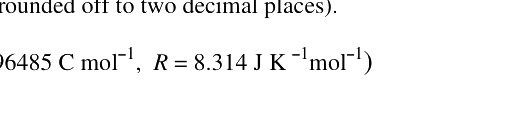
For this reaction, the equilibrium constant is \(y \times 10^{37}\) at 298 K. The value of \(y\) is _____ (rounded off to two decimal places).
(Given: \(F = 96485\ \text{C mol}^{-1}\), \(R = 8.314\ \text{J K}^{-1}\text{mol}^{-1}\))

Question diagram

Open complete paper
17
2025 · Life Sciences · Electrochemistry · Conductance and Electrochemical Cells
Life Sciences (XL) 2025
The standard potentials (\(E^0\)) for the Fe³⁺/Fe and Fe³⁺/Fe²⁺ couples are –0.04 V and +0.76 V, respectively.
Given: Faraday constant = 96500 C mol⁻¹.
The value for \(E^0(Fe^{2+}/Fe)\), in V, is __________. (rounded off to two decimal places)
Open complete paper