My Cart
Your Cart 0

    Your cart is empty.

  • Total (Amount) ₹0.00
Previous year question hub

Antimicrobial Mechanisms and Resistance - Control of Micro-organisms: Chemotherapy/Antibiotics - Life Sciences Previous Year Questions

Practice Antimicrobial Mechanisms and Resistance - Control of Micro-organisms: Chemotherapy/Antibiotics - Life Sciences previous year questions organised from real papers, with year-wise coverage and clear topic navigation.

17Papers
17Years
25Questions
1Topics

Antimicrobial Mechanisms and Resistance question pattern

Every graph below is calculated only from this selection.

Questions by year

Year-wise coverage for Antimicrobial Mechanisms and Resistance. Each bar uses a separate theme-derived color.

Difficulty distribution

How the classified questions are distributed by difficulty.

Easy 14 56%
Medium 11 44%

Question type distribution

MCQ, numerical, multiple-select and other formats found in these papers.

MCQ 21 84%
MSQ 3 12%
Numerical Answer Type (NAT) 1 4%

Subject weightage

Top subjects by unique question coverage.

Life Sciences
25 Qs

Most asked topics

Top topics across the included previous year papers.

Control of Micro-organisms: Chemotherapy/Antibiotics
25 Qs

Subtopic coverage

Top subtopics inside this exact selection.

Antimicrobial Mechanisms and Resistance
25 Qs

Paper coverage

Question coverage for the most populated papers. Every active PYP paper remains listed below.

Life Sciences (XL) 2026
1 Qs
Life Sciences (XL) 2025
1 Qs
Life Sciences (XL) 2024
1 Qs
Life Sciences (XL) 2023
2 Qs
Life Sciences (XL) 2021
1 Qs
Life Sciences (XL) 2020
2 Qs
Life Sciences (XL) 2019
2 Qs
Life Sciences (XL) 2018
1 Qs
Life Sciences (XL) 2017
4 Qs
Life Sciences (XL) 2016
1 Qs
Life Sciences (XL) 2014
1 Qs
Life Sciences (XL) 2013
1 Qs
Life Sciences (XL) 2012
2 Qs
Life Sciences (XL) 2011
1 Qs
Life Sciences (XL) 2010
1 Qs
Life Sciences (XL) 2009
1 Qs
Life Sciences (XL) 2007
2 Qs

Included previous year papers

Newest papers appear first. Sort by year, question coverage or name.

PaperYear / sessionQuestions in this viewOpen
Life Sciences (XL) 202620261View paper
Life Sciences (XL) 202520251View paper
Life Sciences (XL) 202420241View paper
Life Sciences (XL) 202320232View paper
Life Sciences (XL) 202120211View paper
Life Sciences (XL) 202020202View paper
Life Sciences (XL) 201920192View paper
Life Sciences (XL) 201820181View paper
Life Sciences (XL) 201720174View paper
Life Sciences (XL) 201620161View paper
Life Sciences (XL) 201420141View paper
Life Sciences (XL) 201320131View paper
Life Sciences (XL) 201220122View paper
Life Sciences (XL) 201120111View paper
Life Sciences (XL) 201020101View paper
Life Sciences (XL) 200920091View paper
Life Sciences (XL) 200720072View paper

All Antimicrobial Mechanisms and Resistance previous year questions

Practice every matching question in batches of 20, with every available option.

1
2007 · Life Sciences · Control of Micro-organisms: Chemotherapy/Antibiotics · Antimicrobial Mechanisms and Resistance
Life Sciences (XL) 2007

Bacterial cell wall biosynthesis is inhibited by the antibiotic

Open complete paper
2
2007 · Life Sciences · Control of Micro-organisms: Chemotherapy/Antibiotics · Antimicrobial Mechanisms and Resistance
Life Sciences (XL) 2007

The ineffectiveness of many antibiotics today is closely associated with

Open complete paper
3
2009 · Life Sciences · Control of Micro-organisms: Chemotherapy/Antibiotics · Antimicrobial Mechanisms and Resistance
Life Sciences (XL) 2009
Which one of the following antibiotics inhibits protein biosynthesis precisely by blocking the peptidyl transferase stage ?
Open complete paper
4
2010 · Life Sciences · Control of Micro-organisms: Chemotherapy/Antibiotics · Antimicrobial Mechanisms and Resistance
Life Sciences (XL) 2010
Match the resistance mechanism in Group I with the antibiotic in Group II
Group I
P. β-Lactamases
Q. Enhanced folate metabolism
R. Drug efflux
S. Phosphorylation of the drug
T. Mutant RNA polymerase
Group II
1. Aminoglycosides
2. Penicillins
3. Sulfa drugs
4. Tetracyclins
5. Nalidixic acid
6. Rifamycin
Open complete paper
5
2011 · Life Sciences · Control of Micro-organisms: Chemotherapy/Antibiotics · Antimicrobial Mechanisms and Resistance
Life Sciences (XL) 2011
Quinolones inhibit bacterial growth by targeting
Open complete paper
6
2012 · Life Sciences · Control of Micro-organisms: Chemotherapy/Antibiotics · Antimicrobial Mechanisms and Resistance
Life Sciences (XL) 2012
Match the antibiotics in Group I with their mechanism of action in Group II
Open complete paper
7
2012 · Life Sciences · Control of Micro-organisms: Chemotherapy/Antibiotics · Antimicrobial Mechanisms and Resistance
Life Sciences (XL) 2012
Nalidixic acid inhibits gyrase activity. Resistance to this antibiotic arises mainly due to
Open complete paper
8
2013 · Life Sciences · Control of Micro-organisms: Chemotherapy/Antibiotics · Antimicrobial Mechanisms and Resistance
Life Sciences (XL) 2013
To which one of the following groups, the antibiotics kanamycin, streptomycin and gentamicin belong
Open complete paper
9
2014 · Life Sciences · Control of Micro-organisms: Chemotherapy/Antibiotics · Antimicrobial Mechanisms and Resistance
Life Sciences (XL) 2014
Match compounds in Group I with inhibitory activities in Group II.

Group I
(P) Vancomycin
(Q) Rifampin
(R) Puromycin
(S) Ciprofloxacin

Group II
(i) Folate metabolism
(ii) DNA synthesis
(iii) Protein synthesis
(iv) RNA synthesis
(v) Cell wall synthesis
Open complete paper
10
2016 · Life Sciences · Control of Micro-organisms: Chemotherapy/Antibiotics · Antimicrobial Mechanisms and Resistance
Life Sciences (XL) 2016

Match the antibiotics given in Group I with appropriate targets from Group II.

Group IGroup II
(P) Nalidixic acid(I) RNA polymerase
(Q) Tetracycline(II) DNA gyrase
(R) Erythromycin(III) DNA polymerase
(S) Rifampin(IV) 50S ribosomal subunit
(V) Aminoacyl tRNA
Open complete paper
11
2017 · Life Sciences · Control of Micro-organisms: Chemotherapy/Antibiotics · Antimicrobial Mechanisms and Resistance
Life Sciences (XL) 2017
Which one of the following antibiotics is NOT produced by Streptomyces sp.?
Open complete paper
12
2017 · Life Sciences · Control of Micro-organisms: Chemotherapy/Antibiotics · Antimicrobial Mechanisms and Resistance
Life Sciences (XL) 2017
As an antiseptic, alcohol is effective against
Open complete paper
13
2017 · Life Sciences · Control of Micro-organisms: Chemotherapy/Antibiotics · Antimicrobial Mechanisms and Resistance
Life Sciences (XL) 2017
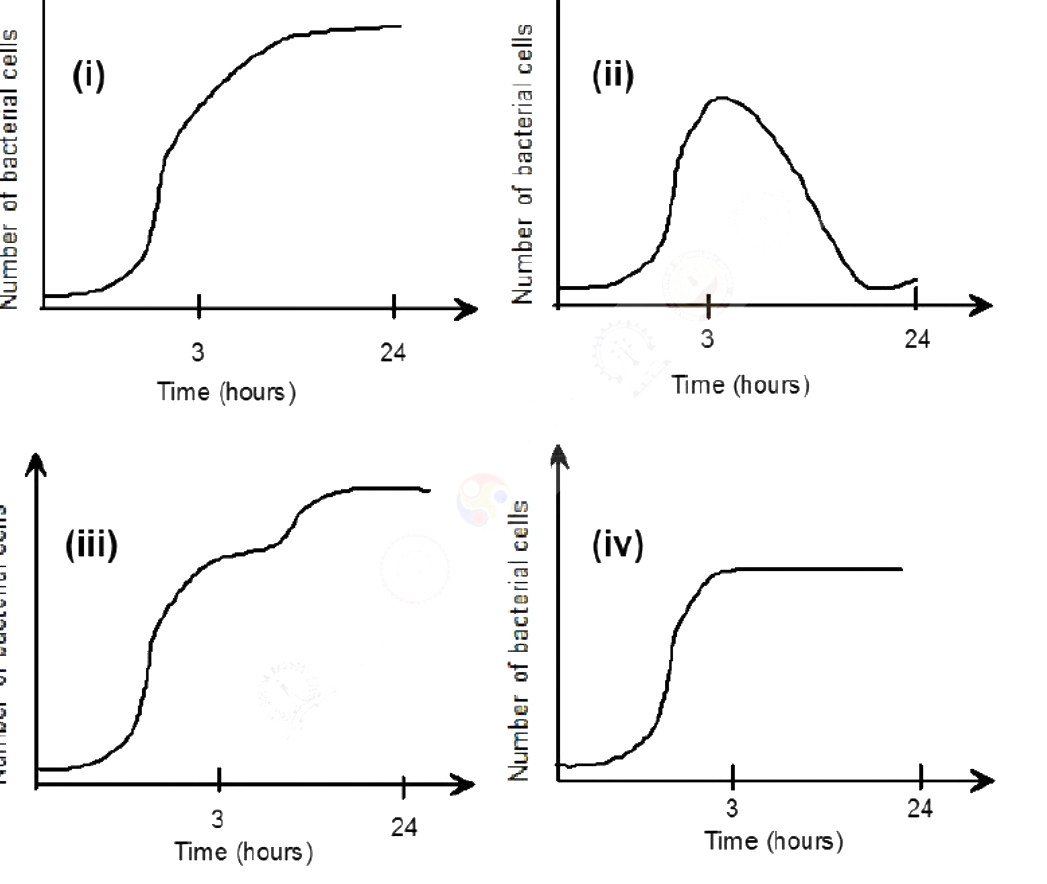
A bactericidal agent X is added after 3 hours of growth of a bacterial culture. Following the addition of X, the bacterial growth was measured using the standard plate count method till 24 hours. Which one of the following figures is the most accurate representation of the action of X?

Question diagram

Open complete paper
14
2017 · Life Sciences · Control of Micro-organisms: Chemotherapy/Antibiotics · Antimicrobial Mechanisms and Resistance
Life Sciences (XL) 2017
The minimal inhibitory concentration (MIC) of an antibiotic X against Clostridium tetani, Staphylococcus sp., Shigella sp., and Streptococcus sp. is 25, 15, 2 and 1 μg/ml, respectively. Assuming that the bioavailable concentration of X in an animal model is 20 μg/ml, which one of these bacteria may develop resistance against X in the animal model?
Open complete paper
15
2018 · Life Sciences · Control of Micro-organisms: Chemotherapy/Antibiotics · Antimicrobial Mechanisms and Resistance
Life Sciences (XL) 2018
Match the antimicrobial agents in group I with their category/mode of action in group II.

Question diagram

Open complete paper
16
2019 · Life Sciences · Control of Micro-organisms: Chemotherapy/Antibiotics · Antimicrobial Mechanisms and Resistance
Life Sciences (XL) 2019
Chloramphenicol and tetracycline are broad spectrum antibiotics which inhibit bacterial growth by targeting __________.
Open complete paper
17
2019 · Life Sciences · Control of Micro-organisms: Chemotherapy/Antibiotics · Antimicrobial Mechanisms and Resistance
Life Sciences (XL) 2019
Folic acid synthesis in bacteria is competitively inhibited by sulfonamides. Which of the following essential components is replaced by sulfonamides during the process of folic acid synthesis?
Open complete paper
18
2020 · Life Sciences · Control of Micro-organisms: Chemotherapy/Antibiotics · Antimicrobial Mechanisms and Resistance
Life Sciences (XL) 2020
The antibacterial trimethoprim is an inhibitor of
Open complete paper
19
2020 · Life Sciences · Control of Micro-organisms: Chemotherapy/Antibiotics · Antimicrobial Mechanisms and Resistance
Life Sciences (XL) 2020
Which one of the following statements about control of microbial growth is NOT correct?
Open complete paper
20
2021 · Life Sciences · Control of Micro-organisms: Chemotherapy/Antibiotics · Antimicrobial Mechanisms and Resistance
Life Sciences (XL) 2021
Which one of the following antibiotics can form an ion channel in the bacterial membrane?
Open complete paper

Showing 20 of 25 questions