My Cart
Your Cart 0

    Your cart is empty.

  • Total (Amount) ₹0.00
Previous year question hub

Biology - General Aptitude - General Aptitude (GA) Previous Year Questions

Practice Biology - General Aptitude - General Aptitude (GA) previous year questions organised from real papers, with year-wise coverage and clear topic navigation.

1Papers
1Years
16Questions
1Topics

Biology question pattern

Every graph below is calculated only from this selection.

Questions by year

Year-wise coverage for Biology. Each bar uses a separate theme-derived color.

Difficulty distribution

How the classified questions are distributed by difficulty.

Medium 9 56.3%
Easy 7 43.8%

Question type distribution

MCQ, numerical, multiple-select and other formats found in these papers.

MCQ 11 68.8%
MSQ 4 25%
Numerical Answer Type (NAT) 1 6.3%

Subject weightage

Top subjects by unique question coverage.

General Aptitude (GA)
16 Qs

Most asked topics

Top topics across the included previous year papers.

General Aptitude
16 Qs

Subtopic coverage

Top subtopics inside this exact selection.

Biology
16 Qs

Paper coverage

Question coverage for the most populated papers. Every active PYP paper remains listed below.

Life Sciences (XL) 2022
16 Qs

Included previous year papers

Newest papers appear first. Sort by year, question coverage or name.

PaperYear / sessionQuestions in this viewOpen
Life Sciences (XL) 2022202216View paper

All Biology previous year questions

Practice every matching question in batches of 20, with every available option.

1
2022 · General Aptitude (GA) · General Aptitude · Biology
Life Sciences (XL) 2022
In Angiosperms, normally ‘Exarch Xylem’ occurs in
Open complete paper
2
2022 · General Aptitude (GA) · General Aptitude · Biology
Life Sciences (XL) 2022

‘Quiescent Center’ is present in

Open complete paper
3
2022 · General Aptitude (GA) · General Aptitude · Biology
Life Sciences (XL) 2022

With reference to virulence (vir) region of nopaline type Ti plasmid of Agrobacterium tumefaciens, match Group-I (vir gene) and Group-II (coded protein) in CORRECT combination.

Group-IGroup-II
P. vir AI. Single strand T-DNA binding protein
Q. vir BII. Topoisomerase
R. vir EIII. Membrane protein, channel for T-DNA
S. vir DIV. Sensor protein, constitutive expression
Open complete paper
4
2022 · General Aptitude (GA) · General Aptitude · Biology
Life Sciences (XL) 2022

Anomalous secondary growth is observed in

Open complete paper
5
2022 · General Aptitude (GA) · General Aptitude · Biology
Life Sciences (XL) 2022

Which of the following plant diseases is/are caused by bacteria?

Open complete paper
6
2022 · General Aptitude (GA) · General Aptitude · Biology
Life Sciences (XL) 2022

Phylogenetic system of classification is/are proposed by

Open complete paper
7
2022 · General Aptitude (GA) · General Aptitude · Biology
Life Sciences (XL) 2022

Which of the following is/are part of marine ecosystem?

Open complete paper
8
2022 · General Aptitude (GA) · General Aptitude · Biology
Life Sciences (XL) 2022
In NADP+-malic enzyme type C4 photosynthesis cycle, n molecule(s) of ATP is/are required for the assimilation of one molecule of CO2. The value of n is ______ (in integer).
Open complete paper
9
2022 · General Aptitude (GA) · General Aptitude · Biology
Life Sciences (XL) 2022
An Arabidopsis thaliana mutant plant developed defective flowers with altered floral organ identity and patterning. In this mutant, the four floral whorls contain Sepal-Sepal-Carpel-Carpel, from the periphery to the center of the flower.
Based on the typical ABC model of floral organ patterning, which among the following are mutated in this plant?
Open complete paper
10
2022 · General Aptitude (GA) · General Aptitude · Biology
Life Sciences (XL) 2022

Match the secondary metabolites in Group-I with types of secondary metabolites in Group-II in CORRECT order.

Group-IGroup-II
P. MyrceneI. Sesquiterpene
Q. β-FarneseneII. Cyanogenic glycoside
R. AmygdalinIII. Flavone
S. NicotineIV. Alkaloid
T. LuteolinV. Monoterpene
Open complete paper
11
2022 · General Aptitude (GA) · General Aptitude · Biology
Life Sciences (XL) 2022
Match Group-I (enzyme), Group-II (reaction catalyzed by the enzyme), and Group-III (subcellular localization of the enzyme and the associated metabolic process) in CORRECT combination.
Group-IGroup-IIGroup-III
P. PEP CarboxylaseI. 2 Glycolate + 2 O2 = 2 Glyoxylate + 2 H2O2a. Cytosol – C4 cycle
Q. RubiscoII. Pyruvate + NAD+ + CoA = Acetyl-CoA + CO2 + NADHb. Peroxisome – C2 cycle
R. Glycolate oxidaseIII. Phosphoenolpyruvate + HCO3- = Oxaloacetate + Pic. Mitochondria – aerobic respiration
S. Pyruvate dehydrogenaseIV. 3 (Ribulose 1,5-bisphosphate) + 3 CO2 + 3 H2O = 6 (3-phosphoglycerate) + 6 H+d. Chloroplast – C3 cycle
Open complete paper
12
2022 · General Aptitude (GA) · General Aptitude · Biology
Life Sciences (XL) 2022

Match Group-I (selection agent) and Group-II (gene) in CORRECT combination.

Group-IGroup-II
P. KanamycinI. pmi
Q. HygromycinII. bar
R. PhosphinothricinIII. nptII
S. MannoseIV. ptxD
V. dhfr
VI. hpt
Open complete paper
13
2022 · General Aptitude (GA) · General Aptitude · Biology
Life Sciences (XL) 2022
Match Group I (plant natural product), Group II (class) and Group III (source plant) in CORRECT combination.
Group-IGroup-IIGroup-III
P. ReserpineI. Stilbenesa. Manihot esculenta
Q. ResveratrolII. Cyanogenic glycosideb. Crocus sativus
R. PicrocrocinIII. Alkaloidc. Vitis vinifera
S. LinamarinIV. Monoterpene glycosided. Rauwolfia serpentina
Open complete paper
14
2022 · General Aptitude (GA) · General Aptitude · Biology
Life Sciences (XL) 2022

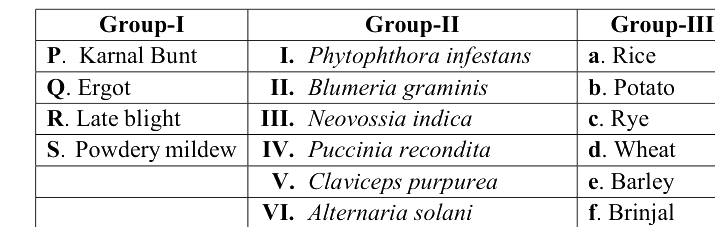
Match Group I (plant disease), Group II (causal organism) and Group III (affected plant) in CORRECT combination.

Group-IGroup-IIGroup-III
P. Karnal BuntI. Phytophthora infestansa. Rice
Q. ErgotII. Blumeria graminisb. Potato
R. Late blightIII. Neovossia indicac. Rye
S. Powdery mildewIV. Puccinia reconditad. Wheat
V. Claviceps purpureae. Barley
VI. Alternaria solanif. Brinjal

Question diagram

Open complete paper
15
2022 · General Aptitude (GA) · General Aptitude · Biology
Life Sciences (XL) 2022

Make CORRECT match between Group-I and Group-II, in relation to interaction between two species.

Group-IGroup-II
P. NeutralismI. neither can survive under natural condition without the other
Q. AllelopathyII. direct inhibition of one species by the other species using toxic compound
R. AmensalismIII. neither is affected by the association with the other
S. MutualismIV. one is inhibited and the other is not affected
Open complete paper
16
2022 · General Aptitude (GA) · General Aptitude · Biology
Life Sciences (XL) 2022

Which of the following matches is/are CORRECT?

Open complete paper