My Cart
Your Cart 0

    Your cart is empty.

  • Total (Amount) ₹0.00
Previous year question hub

Stability Analysis and Compensation - Control Systems - Instrumentation Engineering Previous Year Questions

Practice Stability Analysis and Compensation - Control Systems - Instrumentation Engineering previous year questions organised from real papers, with year-wise coverage and clear topic navigation.

20Papers
17Years
49Questions
1Topics

Stability Analysis and Compensation question pattern

Every graph below is calculated only from this selection.

Questions by year

Year-wise coverage for Stability Analysis and Compensation. Each bar uses a separate theme-derived color.

Difficulty distribution

How the classified questions are distributed by difficulty.

Medium 42 85.7%
Easy 5 10.2%
Hard 2 4.1%

Question type distribution

MCQ, numerical, multiple-select and other formats found in these papers.

MCQ 30 61.2%
Numerical Answer Type (NAT) 14 28.6%
Fill in the blanks 4 8.2%
MSQ 1 2%

Subject weightage

Top subjects by unique question coverage.

Instrumentation Engineering
49 Qs

Most asked topics

Top topics across the included previous year papers.

Control Systems
49 Qs

Subtopic coverage

Top subtopics inside this exact selection.

Stability Analysis and Compensation
49 Qs

Paper coverage

Question coverage for the most populated papers. Every active PYP paper remains listed below.

Instrumentation Engineering (IN) 2026
1 Qs
Instrumentation Engineering (IN) 2025
3 Qs
Instrumentation Engineering (IN) 2023
4 Qs
Instrumentation Engineering (IN) 2022
2 Qs
Instrumentation Engineering (IN) 2021
2 Qs
Instrumentation Engineering (IN) 2020
4 Qs
Instrumentation Engineering (IN) 2019
2 Qs
Instrumentation Engineering (IN) 2018
3 Qs
Instrumentation Engineering (IN) 2017
2 Qs
Instrumentation Engineering (IN) 2016
3 Qs
Instrumentation Engineering (IN) 2014
3 Qs
Instrumentation Engineering (IN) 2013 [Session 1]
1 Qs
Instrumentation Engineering (IN) 2013 [Session 2]
1 Qs
Instrumentation Engineering (IN) 2013 [Session 3]
1 Qs
Instrumentation Engineering (IN) 2013 [Session 4]
1 Qs
Instrumentation Engineering (IN) 2011
4 Qs
Instrumentation Engineering (IN) 2010
2 Qs
Instrumentation Engineering (IN) 2009
2 Qs
Instrumentation Engineering (IN) 2008
5 Qs
Instrumentation Engineering (IN) 2007
3 Qs

Included previous year papers

Newest papers appear first. Sort by year, question coverage or name.

PaperYear / sessionQuestions in this viewOpen
Instrumentation Engineering (IN) 202620261View paper
Instrumentation Engineering (IN) 202520253View paper
Instrumentation Engineering (IN) 202320234View paper
Instrumentation Engineering (IN) 202220222View paper
Instrumentation Engineering (IN) 202120212View paper
Instrumentation Engineering (IN) 202020204View paper
Instrumentation Engineering (IN) 201920192View paper
Instrumentation Engineering (IN) 201820183View paper
Instrumentation Engineering (IN) 201720172View paper
Instrumentation Engineering (IN) 201620163View paper
Instrumentation Engineering (IN) 201420143View paper
Instrumentation Engineering (IN) 2013 [Session 1]20131View paper
Instrumentation Engineering (IN) 2013 [Session 2]20131View paper
Instrumentation Engineering (IN) 2013 [Session 3]20131View paper
Instrumentation Engineering (IN) 2013 [Session 4]20131View paper
Instrumentation Engineering (IN) 201120114View paper
Instrumentation Engineering (IN) 201020102View paper
Instrumentation Engineering (IN) 200920092View paper
Instrumentation Engineering (IN) 200820085View paper
Instrumentation Engineering (IN) 200720073View paper

All Stability Analysis and Compensation previous year questions

Practice every matching question in batches of 20, with every available option.

1
2009 · Instrumentation Engineering · Control Systems · Stability Analysis and Compensation
Instrumentation Engineering (IN) 2009
A unity feedback control loop with an open loop transfer function of the form \(\frac{K}{s(s+a)}\) has a gain crossover frequency of 1 rad/s and a phase margin of \(60^{\circ}\). If an element having a transfer function \(\frac{s-\sqrt{3}}{s+\sqrt{3}}\) is inserted into the loop, the phase margin will become
Open complete paper
2
2009 · Instrumentation Engineering · Control Systems · Stability Analysis and Compensation
Instrumentation Engineering (IN) 2009
A unity feedback system has the transfer function \(\frac{K(s+b)}{s^2(s+20)}\). The value of \(b\) for which the loci of all the three roots of the closed loop characteristic equation meet at a single point is
Open complete paper
3
2010 · Instrumentation Engineering · Control Systems · Stability Analysis and Compensation
Instrumentation Engineering (IN) 2010
The open loop transfer function of a unity gain feedback system is given by \( G(s) = \frac{k(s+3)}{(s+1)(s+2)} \). The range of positive values of \( k \) for which the closed loop system will remain stable is:
Open complete paper
4
2010 · Instrumentation Engineering · Control Systems · Stability Analysis and Compensation
Instrumentation Engineering (IN) 2010

The asymptotic Bode magnitude plot of a lead network with its pole and zero on the left half of the s-plane is shown in the adjoining figure. The frequency at which the phase angle of the network is maximum (in rad/s) is

Open complete paper
5
2011 · Instrumentation Engineering · Control Systems · Stability Analysis and Compensation
Instrumentation Engineering (IN) 2011
The first two rows of Routh's table of a third-order characteristic equation are \(s^3 \ 3 \ 3\) and \(s^2 \ 4 \ 4\). It can be inferred that the system has
Open complete paper
6
2011 · Instrumentation Engineering · Control Systems · Stability Analysis and Compensation
Instrumentation Engineering (IN) 2011
Consider the second-order system with the characteristic equation \(s(s+3)+K(s+5)=0\). Based on the properties of the root loci, it can be shown that the complex portion of the root loci of the given system for \(0 < K < \infty\) is described by a circle, and the two breakaway points on the real axis are
Open complete paper
7
2011 · Instrumentation Engineering · Control Systems · Stability Analysis and Compensation
Instrumentation Engineering (IN) 2011
The value of K for the phase margin of the system to be 45° is
Open complete paper
8
2011 · Instrumentation Engineering · Control Systems · Stability Analysis and Compensation
Instrumentation Engineering (IN) 2011
The value of K for the damping ratio ζ to be 0.5, corresponding to the dominant closed-loop complex conjugate pole pair is
Open complete paper
9
2013 · Instrumentation Engineering · Control Systems · Stability Analysis and Compensation
Instrumentation Engineering (IN) 2013 [Session 1]
The values of Ku and Tu, respectively, are
Open complete paper
10
2013 · Instrumentation Engineering · Control Systems · Stability Analysis and Compensation
Instrumentation Engineering (IN) 2013 [Session 2]
The values of Ku and Tu , respectively, are
Open complete paper
11
2013 · Instrumentation Engineering · Control Systems · Stability Analysis and Compensation
Instrumentation Engineering (IN) 2013 [Session 4]
The values of \(K_u\) and \(T_u\), respectively, are
Open complete paper
12
2014 · Instrumentation Engineering · Control Systems · Stability Analysis and Compensation
Instrumentation Engineering (IN) 2014
A loop transfer function is given by : \[ G(s)H(s) = \frac{K(s + 2)}{s^2(s + 10)} \] The point of intersection of the asymptotes of \(G(s)H(s)\) on the real axis in the s-plane is at ______________.
Open complete paper
13
2014 · Instrumentation Engineering · Control Systems · Stability Analysis and Compensation
Instrumentation Engineering (IN) 2014
The loop transfer function of a feedback control system is given by \(G(s)H(s) = \frac{1}{s(s+1)(9s+1)}\). Its phase crossover frequency (in rad/s), approximated to two decimal places, is _________.
Open complete paper
14
2014 · Instrumentation Engineering · Control Systems · Stability Analysis and Compensation
Instrumentation Engineering (IN) 2014
Consider a transport lag process with a transfer function \(G_p(s) = e^{-s}\). The process is controlled by a purely integral controller with transfer function \(G_c(s) = \frac{K_I}{s}\) in a unity feedback configuration. The value of \(K_I\) for which the closed loop plant has a pole at \(s = -1\), is _________.
Open complete paper
15
2016 · Instrumentation Engineering · Control Systems · Stability Analysis and Compensation
Instrumentation Engineering (IN) 2016
The number of times the Nyquist plot of \(G(s) = \frac{s - 1}{s + 1}\) will encircle the origin clockwise is ______.
Open complete paper
16
2016 · Instrumentation Engineering · Control Systems · Stability Analysis and Compensation
Instrumentation Engineering (IN) 2016
The value of \(a_0\) which will ensure that the polynomial \(s^3 + 3s^2 + 2s + a_0\) has roots on the left half of the s-plane is
Open complete paper
17
2016 · Instrumentation Engineering · Control Systems · Stability Analysis and Compensation
Instrumentation Engineering (IN) 2016
For the feedback system given below, the transfer function \( G(s) = \frac{1}{(s+1)^2} \). The system CANNOT be stabilized with

Question diagram

Open complete paper
18
2025 · Instrumentation Engineering · Control Systems · Stability Analysis and Compensation
Instrumentation Engineering (IN) 2025
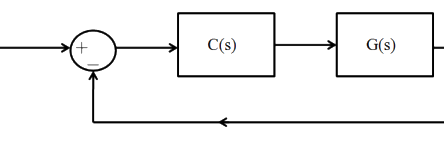
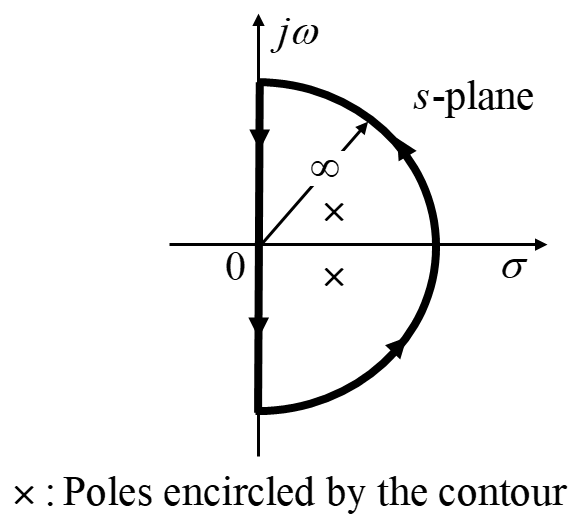
Consider the control system block diagram given in Figure (a). The loop transfer function \( G(s)H(s) \) does not have any pole on the \( j\omega \)-axis. The counterclockwise contour with infinite radius, as shown in Figure (b), encircles two poles of \( G(s)H(s) \). Choose the correct statement from the following options for closed loop stability of the system.
Open complete paper
19
2025 · Instrumentation Engineering · Control Systems · Stability Analysis and Compensation
Instrumentation Engineering (IN) 2025
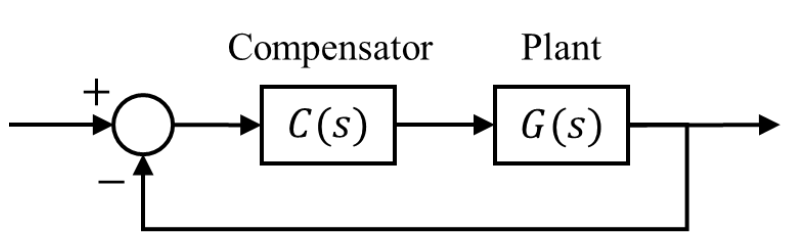
The figure shows a closed-loop system with a plant \(G(s) = \frac{1}{s^3}\) and a lead compensator \(C(s)\). The compensator is designed to place the dominant closed-loop poles at \(-1.5 \pm j\frac{\sqrt{27}}{2}\). From the following options, choose the phase lead that the compensator needs to contribute.

Source question diagram

Open complete paper
20
2025 · Instrumentation Engineering · Control Systems · Stability Analysis and Compensation
Instrumentation Engineering (IN) 2025
The plant in the feedback control system shown in the figure is \(P(s) = \frac{a}{s^2 - b^2}\), where \(a > 0\) and \(b > 0\). The type(s) of controller \(C(s)\) that CANNOT stabilize the plant is/are
Open complete paper

Showing 20 of 48 questions