My Cart
Your Cart 0

    Your cart is empty.

  • Total (Amount) ₹0.00
Previous year question hub

Impulse And Momentum - Mechanics - Physics Previous Year Questions

Practice Impulse And Momentum - Mechanics - Physics previous year questions organised from real papers, with year-wise coverage and clear topic navigation.

12Papers
10Years
16Questions
1Topics

Impulse And Momentum question pattern

Every graph below is calculated only from this selection.

Questions by year

Year-wise coverage for Impulse And Momentum. Each bar uses a separate theme-derived color.

Difficulty distribution

How the classified questions are distributed by difficulty.

Medium 10 62.5%
Hard 4 25%
Not classified 1 6.3%
Easy 1 6.3%

Question type distribution

MCQ, numerical, multiple-select and other formats found in these papers.

Multiple Choices 14 87.5%
Numerical Answer Type (NAT) 2 12.5%

Subject weightage

Top subjects by unique question coverage.

Physics
16 Qs

Most asked topics

Top topics across the included previous year papers.

Mechanics
16 Qs

Subtopic coverage

Top subtopics inside this exact selection.

Impulse And Momentum
16 Qs

Paper coverage

Question coverage for the most populated papers. Every active PYP paper remains listed below.

JEE ADVANCED 2025 PAPER 1 ONLINE
1 Qs
JEE ADVANCED 2024 PAPER 1 ONLINE
1 Qs
JEE ADVANCED 2023 PAPER 1 ONLINE
1 Qs
JEE ADVANCED 2021 PAPER 2 ONLINE
3 Qs
JEE ADVANCED 2021 PAPER 1 ONLINE
1 Qs
JEE ADVANCED 2013 PAPER 1 OFFLINE
1 Qs
JEE ADVANCED 2013 PAPER 2 OFFLINE
1 Qs
IIT JEE 2011 PAPER 2 OFFLINE
1 Qs
IIT JEE 2010 PAPER 1 OFFLINE
1 Qs
IIT JEE 2009 PAPER 1 OFFLINE
2 Qs
IIT JEE 2008 PAPER 1 OFFLINE
2 Qs
IIT JEE 2007 PAPER 1 OFFLINE
1 Qs

Included previous year papers

Newest papers appear first. Sort by year, question coverage or name.

PaperYear / sessionQuestions in this viewOpen
JEE ADVANCED 2025 PAPER 1 ONLINE20251View paper
JEE ADVANCED 2024 PAPER 1 ONLINE20241View paper
JEE ADVANCED 2023 PAPER 1 ONLINE20231View paper
JEE ADVANCED 2021 PAPER 1 ONLINE20211View paper
JEE ADVANCED 2021 PAPER 2 ONLINE20213View paper
JEE ADVANCED 2013 PAPER 1 OFFLINE20131View paper
JEE ADVANCED 2013 PAPER 2 OFFLINE20131View paper
IIT JEE 2011 PAPER 2 OFFLINE20111View paper
IIT JEE 2010 PAPER 1 OFFLINE20101View paper
IIT JEE 2009 PAPER 1 OFFLINE20092View paper
IIT JEE 2008 PAPER 1 OFFLINE20082View paper
IIT JEE 2007 PAPER 1 OFFLINE20071View paper

All Impulse And Momentum previous year questions

Practice every matching question in batches of 20, with every available option.

1
2007 · Physics · Mechanics · Impulse And Momentum
IIT JEE 2007 PAPER 1 OFFLINE

Statement 1 :

In an elastic collision between two bodies, the relative speed of the bodies after collision is equal to the relative speed before the collision.

Statement 2 :

In an elastic collision, the linear momentum of the system is conserved.

A
Statement 1 is True, Statement 2 is True, Statement 2 is a CORRECT explanation for Statement 1
B
Statement 1 is True, Statement 2 is True, Statement 2 is NOT a CORRECT explanation for Statement 1
C
Statement 1 is True, Statement 2 is False
D
Statement 1 is False, Statement 2 is True
Open complete paper
2
2008 · Physics · Mechanics · Impulse And Momentum
IIT JEE 2008 PAPER 1 OFFLINE

If collision between the block and the incline is completely elastic, then the vertical (upward) component of the velocity of the block at point B, immediately after it strikes the second incline is

A
\(\sqrt{30}\) m/s
B
\(\sqrt{15}\) m/s
C
0
D
\(-\sqrt{15}\) m/s
Open complete paper
3
2008 · Physics · Mechanics · Impulse And Momentum
IIT JEE 2008 PAPER 1 OFFLINE

Two balls, having linear momenta \({\overrightarrow p _1} = p\widehat i\) and \({\overrightarrow p _2} = - p\widehat i\), undergo a collision in free space. There is no external force acting on the balls. Let \({\overrightarrow {p'} _1}\) and \({\overrightarrow {p'} _2}\) be their final momenta. The following option(s) is (are) NOT ALLOWED for any non-zero value of \(p,{a_1},{a_2},{b_1},{b_2},{c_1}\) and \({c_2}\) :

A
\({\overrightarrow {p'} _1} = {a_1}\widehat i + {b_1}\widehat j + {c_1}\widehat k;{\overrightarrow {p'} _2} = {a_2}\widehat i + {b_2}\widehat j\)
B
\({\overrightarrow {p'} _1} = {c_1}\widehat k;{\overrightarrow {p'} _2} = {c_2}\widehat k\)
C
\({\overrightarrow {p'} _1} = {a_1}\widehat i + {b_1}\widehat j + {c_1}\widehat k;{\overrightarrow {p'} _2} = {a_2}\widehat i + {b_2}\widehat j - {c_1}\widehat k\)
D
\({\overrightarrow {p'} _1} = {a_1}\widehat i + {b_1}\widehat j;{\overrightarrow {p'} _2} = {a_2}\widehat i + {b_1}\widehat j\)
Open complete paper
4
2009 · Physics · Mechanics · Impulse And Momentum
IIT JEE 2009 PAPER 1 OFFLINE

Look at the drawing given in the figure below which has been drawn with ink of uniform line-thickness. The mass of ink used to draw each of the two inner circles, and each of the two line segments is \(m\). the mass of the ink used to draw the outer circle is \(6m\). The coordinates of the centres of the different parts are: outer circle (0, 0), left inner circle (\(-a,a\)), right inner circle (\(a,a\)), vertical line (0, 0) and horizontal line (\(0,-a\)). The y-coordinate of the centre of mass of the ink in this drawing is

IIT-JEE 2009 Paper 1 Offline Physics - Impulse & Momentum Question 7 English

A
\(\frac{a}{10}\)
B
\(\frac{a}{8}\)
C
\(\frac{a}{12}\)
D
\(\frac{a}{3}\)
Open complete paper
5
2009 · Physics · Mechanics · Impulse And Momentum
IIT JEE 2009 PAPER 1 OFFLINE

Two small particles of equal masses start moving in opposite directions from a point A in a horizontal circular orbit. Their tangential velocities are \(v\) and 2\(v\), respectively, as shown in the figure. Between collisions, the particles move with constant speeds. After making how many elastic collisions, other than that at A, these two particles will again reach the point A?

IIT-JEE 2009 Paper 1 Offline Physics - Impulse & Momentum Question 8 English

A
4
B
3
C
2
D
1
Open complete paper
6
2010 · Physics · Mechanics · Impulse And Momentum
IIT JEE 2010 PAPER 1 OFFLINE
A point mass of 1 kg collides elastically with a stationary point mass of 5 kg. After their collision, the 1 kg mass reverses its direction and moves with a speed of 2 ms−1. Which of the following statement(s) is (are) correct for the system of these two masses?
A
Total momentum of the system is 3 kg ms−1
B
Momentum of 5 kg mass after collision is 4 kg ms−1
C
Kinetic energy of the centre of mass is 0.75 J
D
Total kinetic energy of the system is 4 J
Open complete paper
7
2011 · Physics · Mechanics · Impulse And Momentum
IIT JEE 2011 PAPER 2 OFFLINE

A ball of mass 0.2 kg rests on a vertical post of height 5 m. A bullet of mass 0.01 kg, traveling with a velocity V m/s in a horizontal direction, hits the center of the ball. After the collision, the ball and bullet travel independently. The ball hits the ground at a distance of 20 m and the bullet at a distance of 100 m from the foot of the post. The velocity V of the bullet is

IIT-JEE 2011 Paper 2 Offline Physics - Impulse & Momentum Question 16 English

A
250 m/s
B
\(250\sqrt 2\) m/s
C
400 m/s
D
500 m/s
Open complete paper
8
2013 · Physics · Mechanics · Impulse And Momentum
JEE ADVANCED 2013 PAPER 1 OFFLINE
A particle of mass m is projected from the ground with an initial speed u0 at an angle \(\alpha\) with the horizontal. At the highest point of its trajectory, it makes a completely inelastic collision with another identical particle, which was thrown vertically upward from the ground with the same initial speed u0. The angle that the composite system makes with the horizontal immediately after the collision is
A
\({\pi \over 4}\)
B
\({\pi \over 4} + \alpha\)
C
\({\pi \over 2} - \alpha\)
D
\({\pi \over 2}\)
Open complete paper
9
2013 · Physics · Mechanics · Impulse And Momentum
JEE ADVANCED 2013 PAPER 2 OFFLINE
A particle of mass m is attached to one end of a mass-less spring of force constant k, lying on a frictionless horizontal plane. The other end of the spring is fixed. The particle starts moving horizontally from its equilibrium position at time t = 0 with an initial velocity u0. When the speed of the particle is 0.5 u0. It collides elastically with a rigid wall. After this collision,
A
the speed of the particle when it returns to its equilibrium position is u0.
B
the time at which the particle passes through the equilibrium position for the first time is \(t = \pi \sqrt {{m \over k}}\)
C
the time at which the maximum compression of the spring occurs is \(t = {{4\pi } \over 3}\sqrt {{m \over k}}\)
D
the time at which the particle passes through the equilibrium position for the second time is \(t = {{5\pi } \over 3}\sqrt {{m \over k}}\)
Open complete paper
10
2021 · Physics · Mechanics · Impulse And Momentum
JEE ADVANCED 2021 PAPER 1 ONLINE
A particle of mass M = 0.2 kg is initially at rest in the xy-plane at a point (x = \(-\)l, y = \(-\)h), where l = 10 m and h = 1 m. The particle is accelerated at time t = 0 with a constant acceleration a = 10 m/s2 along the positive x-direction. Its angular momentum and torque with respect to the origin, in SI units, are represented by \(\overrightarrow L\) and \(\overrightarrow \tau\) respectively. \(\widehat i\), \(\widehat j\) and \(\widehat k\) are unit vectors along the positive x, y and z-directions, respectively. If \(\widehat k\) = \(\widehat i\) \(\times\) \(\widehat j\) then which of the following statement(s) is(are) correct?
A
The particle arrives at the point (x = l, y = \(-\)h) at time t = 2 s
B
\(\overrightarrow \tau = 2\widehat k\) when the particle passes through the point (x = l, y = \(-\)h)
C
\(\overrightarrow L = 4\widehat k\) when the particle passes through the point (x = l, y = \(-\)h)
D
\(\overrightarrow \tau = \widehat k\) when the particle passes through the point (x = 0, y = \(-\)h)
Open complete paper
11
2021 · Physics · Mechanics · Impulse And Momentum
JEE ADVANCED 2021 PAPER 2 ONLINE
A pendulum consists of a bob of mass m = 0.1 kg and a massless inextensible string of length L = 1.0 m. It is suspended from a fixed point at height H = 0.9 m above a frictionless horizontal floor. Initially, the bob of the pendulum is lying on the floor at rest vertically below the point of suspension. A horizontal impulse P = 0.2 kg-m/s is imparted to the bob at some instant. After the bob slides for some distance, the string becomes taut and the bob lifts off the floor. The magnitude of the angular momentum of the pendulum about the point of suspension just before the bob lifts off is J kg-m2/s. The kinetic energy of the pendulum just after the lift-off is K Joules.

The value of J is ___________.
Enter a numerical response
Open complete paper
12
2021 · Physics · Mechanics · Impulse And Momentum
JEE ADVANCED 2021 PAPER 2 ONLINE
A pendulum consists of a bob of mass m = 0.1 kg and a massless inextensible string of length L = 1.0 m. It is suspended from a fixed point at height H = 0.9 m above a frictionless horizontal floor. Initially, the bob of the pendulum is lying on the floor at rest vertically below the point of suspension. A horizontal impulse P = 0.2 kg-m/s is imparted to the bob at some instant. After the bob slides for some distance, the string becomes taut and the bob lifts off the floor. The magnitude of the angular momentum of the pendulum about the point of suspension just before the bob lifts off is J kg-m2/s. The kinetic energy of the pendulum just after the lift-off is K Joules.

The value of K is ___________.
Enter a numerical response
Open complete paper
13
2021 · Physics · Mechanics · Impulse And Momentum
JEE ADVANCED 2021 PAPER 2 ONLINE
One end of a horizontal uniform beam of weight W and length L is hinged on a vertical wall at point O and its other end is supported by a light inextensible rope. The other end of the rope is fixed at point Q, at a height L above the hinge at point O. A block of weight \(\alpha\)W is attached at the point P of the beam, as shown in the figure (not to scale). The rope can sustain a maximum tension of (2\(\sqrt 2\))W. Which of the following statement(s) is(are) correct?

JEE Advanced 2021 Paper 2 Online Physics - Impulse & Momentum Question 10 English
A
The vertical component of reaction force at O does not depend on \(\alpha\)
B
The horizontal component of reaction force at O is equal to W for \(\alpha\) = 0.5
C
The tension in the rope is 2W for \(\alpha\) = 0.5
D
The rope breaks if \(\alpha\) > 1.5
Open complete paper
14
2023 · Physics · Mechanics · Impulse And Momentum
JEE ADVANCED 2023 PAPER 1 ONLINE
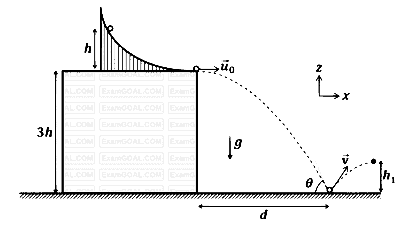
A slide with a frictionless curved surface, which becomes horizontal at its lower end, is fixed on the terrace of a building of height $3 h$ from the ground, as shown in the figure. A spherical ball of mass $m$ is released on the slide from rest at a height $h$ from the top of the terrace. The ball leaves the slide with a velocity $\vec{u}_0=u_0 \hat{x}$ and falls on the ground at a distance $d$ from the building making an angle $\theta$ with the horizontal. It bounces off with a velocity $\vec{v}$ and reaches a maximum height $h_1$. The acceleration due to gravity is $g$ and the coefficient of restitution of the ground is $1 / \sqrt{3}$. Which of the following statement(s) is(are) correct?

JEE Advanced 2023 Paper 1 Online Physics - Impulse & Momentum Question 3 English
A
$\overrightarrow{\mathrm{u}}_0=\sqrt{2 g h} \hat{x}$
B
$\vec{v}=\sqrt{2 g h}(\hat{x}-\hat{z})$
C
$\theta=60^{\circ}$
D
$d / h_1=2 \sqrt{3}$
Open complete paper
15
2024 · Physics · Mechanics · Impulse And Momentum
JEE ADVANCED 2024 PAPER 1 ONLINE

A block of mass $5 \mathrm{~kg}$ moves along the $x$-direction subject to the force $F=(-20 x+10) \mathrm{N}$, with the value of $x$ in metre. At time $t=0 \mathrm{~s}$, it is at rest at position $x=1 \mathrm{~m}$. The position and momentum of the block at $t={\pi \over 4} \mathrm{s}$ are

A
$-0.5 \mathrm{~m}, 5 \mathrm{~kg} \mathrm{~m} / \mathrm{s}$
B
$0.5 \mathrm{~m}, 0 \mathrm{~kg} \mathrm{~m} / \mathrm{s}$
C
$0.5 \mathrm{~m},-5 \mathrm{~kg} \mathrm{~m} / \mathrm{s}$
D
$-1 \mathrm{~m}, 5 \mathrm{~kg} \mathrm{~m} / \mathrm{s}$
Open complete paper
16
2025 · Physics · Mechanics · Impulse And Momentum
JEE ADVANCED 2025 PAPER 1 ONLINE

In a scattering experiment, a particle of mass 2m collides with another particle of mass m, which is initially at rest. Assuming the collision to be perfectly elastic, the maximum angular deviation θ of the heavier particle, as shown in the figure, in radians is:

JEE Advanced 2025 Paper 1 Online Physics - Impulse & Momentum Question 1 English
A

$\pi$

B

$\tan^{-1}\left(\frac{1}{2}\right)$

C

$\frac{\pi}{3}$

D

$\frac{\pi}{6}$

Open complete paper