Difficulty distribution
How the classified questions are distributed by difficulty.
Your cart is empty.
Practice Alternating Current - Electricity - Physics previous year questions organised from real papers, with year-wise coverage and clear topic navigation.
Every graph below is calculated only from this selection.
Year-wise coverage for Alternating Current. Each bar uses a separate theme-derived color.
How the classified questions are distributed by difficulty.
MCQ, numerical, multiple-select and other formats found in these papers.
Top subjects by unique question coverage.
Top topics across the included previous year papers.
Top subtopics inside this exact selection.
Question coverage for the most populated papers. Every active PYP paper remains listed below.
Newest papers appear first. Sort by year, question coverage or name.
| Paper | Year / session | Questions in this view | Open |
|---|---|---|---|
| JEE ADVANCED 2025 PAPER 1 ONLINE | 2025 | 1 | View paper |
| JEE ADVANCED 2024 PAPER 1 ONLINE | 2024 | 1 | View paper |
| JEE ADVANCED 2023 PAPER 1 ONLINE | 2023 | 1 | View paper |
| JEE ADVANCED 2021 PAPER 2 ONLINE | 2021 | 2 | View paper |
| JEE ADVANCED 2017 PAPER 1 OFFLINE | 2017 | 1 | View paper |
| JEE ADVANCED 2017 PAPER 2 OFFLINE | 2017 | 1 | View paper |
| JEE ADVANCED 2014 PAPER 1 OFFLINE | 2014 | 1 | View paper |
| JEE ADVANCED 2013 PAPER 2 OFFLINE | 2013 | 1 | View paper |
| IIT JEE 2012 PAPER 2 OFFLINE | 2012 | 1 | View paper |
| IIT JEE 2011 PAPER 2 OFFLINE | 2011 | 2 | View paper |
| IIT JEE 2010 PAPER 1 OFFLINE | 2010 | 1 | View paper |
| IIT JEE 2010 PAPER 2 OFFLINE | 2010 | 1 | View paper |
| IIT JEE 2007 PAPER 2 OFFLINE | 2007 | 1 | View paper |
| IIT JEE 2006 | 2006 | 4 | View paper |
Practice every matching question in batches of 20, with every available option.
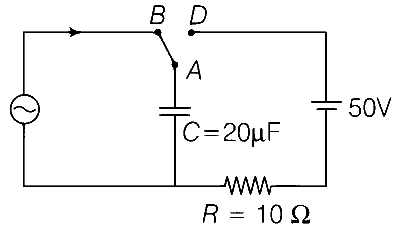
Initially, the capacitor was uncharged. Now, switch $S_1$ is closed and $S_2$ is kept open. If time constant of this circuit is $\tau$, then
After the capacitor gets fully charged, $\mathrm{S}_1$ is opened and $S_2$ is closed so that the inductor is connected in series with the capacitor. Then,
If the total charge stored in the LC circuit.is $\mathrm{Q}_0$, then for $t \geq 0$,
Match the following columns.
| Column I | Column II | ||
|---|---|---|---|
| (A) | Dielectric ring uniformly charged. | (P) | Time independent electrostatic field out of system. |
| (B) | Dielectric ring uniformly charged rotating with angular velocity \(\omega\). | (Q) | Magnetic field. |
| (C) | Constant current in ring \(io\) | (R) | Induced electric field. |
| (D) | $$i=i_0\cos\omega t$$ | (S) | Magnetic moment. |
STATEMENT 1
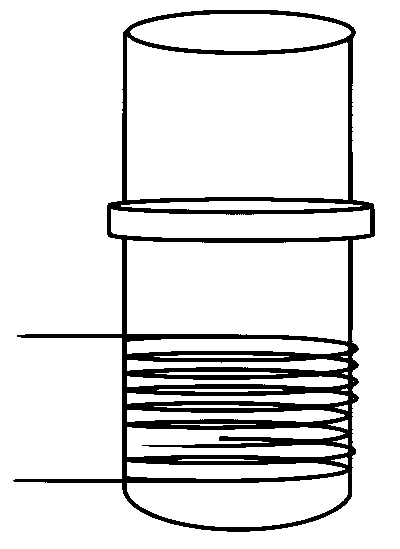
A vertical iron rod has a coil of wire wound over it at the bottom end. An alternating current flows in the coil. The rod goes through a conducting ring as shown in the figure. The ring can float at a certain height above the coil.

Because
STATEMENT 2
In the above situation, a current is induced in the ring which interacts with the horizontal component of the magnetic field to produce an average force in the upward direction.
An AC voltage source of variable angular frequency \(\omega\) and fixed amplitude V0 is connected in series with a capacitance C and an electric bulb of resistance R (inductance zero). When \(\omega\) is increased
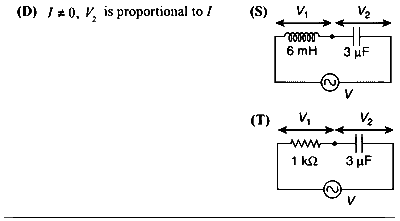
You are given many resistances, capacitors and inductors. These are connected to a variable DC voltage source (the first two circuits) or an AC voltage source of 50 Hz frequency (the next three circuits) in different ways as shown in Column II. When a current I (steady state for DC or rms for AC) flows through the circuit, the corresponding voltage $V_1$ and $V_2$ (indicated in circuits) are related as shown in Column I. Match the two :

A series RC combination is connected to an AC voltage of angular frequency \(\omega\) = 500 rad/s. If the impedance of the RC circuit is R\(\sqrt{1.25}\), the time constant (in millisecond) of the circuit is __________.
A series RC-current is connected to AC voltage source. Consider two cases : (A) When C is without a dielectric medium and (B) when C is filled with dielectric of constant 4. The current IR through the resistor and voltage VC across the capacitor are compared in the two cases. Which of the following is/are true?
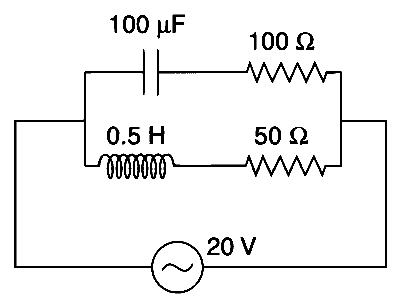
In the given circuit, the AC source has \(\omega\) = 100 rad/s. Considering the inductor and capacitor to be ideal, the correct choice(s) is(are)

In the method using the transformers, assume that the ratio of the number of turns in the primary to that in the secondary in the step-up transformer is 1 : 10. If the power of the consumers has to be supplied at 200 V, the ratio of the number of turns in the primary to that in the secondary in the step-down transformer is


| List - I | List - II |
|---|---|
| (P) $I_0$ in $\mathrm{mA}$ | (1) 44.4 |
| (Q) The quality factor of the circuit | (2) 18 |
| (R) The bandwidth of the circuit in $\mathrm{rad}~ \mathrm{s}^{-1}$ | (3) 400 |
| (S) The peak power dissipated at resonance in Watt | (4) 2250 |
| (5) 500 |
The circuit shown in the figure contains an inductor $L$, a capacitor $C_0$, a resistor $R_0$ and an ideal battery. The circuit also contains two keys $\mathrm{K}_1$ and $\mathrm{K}_2$. Initially, both the keys are open and there is no charge on the capacitor. At an instant, key $\mathrm{K}_1$ is closed and immediately after this the current in $R_0$ is found to be $I_1$. After a long time, the current attains a steady state value $I_2$. Thereafter, $\mathrm{K}_2$ is closed and simultaneously $\mathrm{K}_1$ is opened and the voltage across $C_0$ oscillates with amplitude $V_0$ and angular frequency $\omega_0$.
Match the quantities mentioned in List-I with their values in List-II and choose the correct option.
| List-I | List-II |
|---|---|
| (P) The value of $I_1$ in Ampere is | (1) $0$ |
| (Q) The value of $I_2$ in Ampere is | (2) $2$ |
| (R) The value of $\omega_0$ in kilo-radians/s is | (3) $4$ |
| (S) The value of $V_0$ in Volt is | (4) $20$ |
| (5) $200$ |
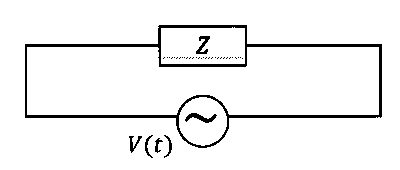
A circuit with an electrical load having impedance $Z$ is connected with an AC source as shown in the diagram. The source voltage varies in time as $V(t)=300 \sin (400 t) \mathrm{V}$, where $t$ is time in s . List-I shows various options for the load. The possible currents $i(t)$ in the circuit as a function of time are given in List-II.

Choose the option that describes the correct match between the entries in List-I to those in ListII.
| List–I | List–II |
|---|---|
(P) ![]() |
(1) ![]() |
(Q) ![]() |
(2) ![]() |
(R) ![]() |
(3) ![]() |
(S) ![]() |
(4) ![]() |
(5) ![]() |