Difficulty distribution
How the classified questions are distributed by difficulty.
Your cart is empty.
Practice Polymers - Organic Chemistry - Chemistry previous year questions organised from real papers, with year-wise coverage and clear topic navigation.
Every graph below is calculated only from this selection.
Year-wise coverage for Polymers. Each bar uses a separate theme-derived color.
How the classified questions are distributed by difficulty.
MCQ, numerical, multiple-select and other formats found in these papers.
Top subjects by unique question coverage.
Top topics across the included previous year papers.
Top subtopics inside this exact selection.
Question coverage for the most populated papers. Every active PYP paper remains listed below.
Newest papers appear first. Sort by year, question coverage or name.
| Paper | Year / session | Questions in this view | Open |
|---|---|---|---|
| JEE Advanced 2026 Paper 2 Online | 2026 | 1 | View paper |
| IIT JEE 2007 PAPER 1 OFFLINE | 2007 | 1 | View paper |
| IIT JEE 2005 MAINS | 2005 | 1 | View paper |
Practice every matching question in batches of 20, with every available option.
Monomer A of a polymer on ozonolysis yields two moles of HCHO and one mole of CH\(_3\)COCHO.
(A) Deduce the structure of A.
(B) Write the structure of "all \(cis\)" forms of polymer of compound A.
Match the chemical substances in Column I with type of polymers/type of bonds in Column II. Indicate your answer by darkening the appropriate bubbles of the 4 \(\times\) 4 matrix given in the ORS.
| Column I | Column II | ||
|---|---|---|---|
| (A) | cellulose | (P) | natural polymer |
| (B) | nylon-6, 6 | (Q) | synthetic polymer |
| (C) | protein | (R) | amide linkage |
| (D) | sucrose | (S) | glycoside linkage |
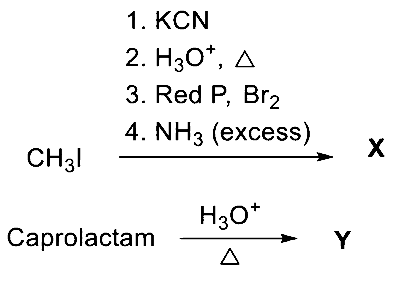
In the following reaction sequence, major products $\mathbf{X}$ and $\mathbf{Y}$ are acyclic monomers.

500 mol of $\mathbf{X}$ completely reacts with 500 mol of $\mathbf{Y}$ to give 1 mol of a single biodegradable acyclic copolymer $\mathbf{Z}$ as the only product. The amount of $\mathbf{Z}$ formed in grams is $\_\_\_\_$ .
Given :
Atomic mass (in amu): $\mathrm{H}: 1, \mathrm{C}: 12, \mathrm{~N}: 14, \mathrm{O}: 16, \mathrm{Br}: 80$