My Cart
Your Cart 0

    Your cart is empty.

  • Total (Amount) ₹0.00
Previous year question hub

Isolation Of Elements - Inorganic Chemistry - Chemistry Previous Year Questions

Practice Isolation Of Elements - Inorganic Chemistry - Chemistry previous year questions organised from real papers, with year-wise coverage and clear topic navigation.

19Papers
15Years
23Questions
1Topics

Isolation Of Elements question pattern

Every graph below is calculated only from this selection.

Questions by year

Year-wise coverage for Isolation Of Elements. Each bar uses a separate theme-derived color.

Difficulty distribution

How the classified questions are distributed by difficulty.

Easy 14 60.9%
Medium 7 30.4%
Not classified 1 4.3%
Hard 1 4.3%
Question type distribution

MCQ, numerical, multiple-select and other formats found in these papers.

Multiple Choices 21 91.3%
Subjective 1 4.3%
Numerical Answer Type (NAT) 1 4.3%

Subject weightage

Top subjects by unique question coverage.

Chemistry
23 Qs

Most asked topics

Top topics across the included previous year papers.

Inorganic Chemistry
23 Qs

Subtopic coverage

Top subtopics inside this exact selection.

Isolation Of Elements
23 Qs

Paper coverage

Question coverage for the most populated papers. Every active PYP paper remains listed below.

JEE ADVANCED 2023 PAPER 1 ONLINE
1 Qs
JEE ADVANCED 2022 PAPER 1 ONLINE
1 Qs
JEE ADVANCED 2022 PAPER 2 ONLINE
1 Qs
JEE ADVANCED 2021 PAPER 1 ONLINE
2 Qs
JEE ADVANCED 2020 PAPER 2 OFFLINE
1 Qs
JEE ADVANCED 2019 PAPER 1 OFFLINE
1 Qs
JEE ADVANCED 2019 PAPER 2 OFFLINE
1 Qs
JEE ADVANCED 2018 PAPER 2 OFFLINE
1 Qs
JEE ADVANCED 2016 PAPER 2 OFFLINE
1 Qs
JEE ADVANCED 2015 PAPER 1 OFFLINE
2 Qs
JEE ADVANCED 2013 PAPER 1 OFFLINE
1 Qs
JEE ADVANCED 2013 PAPER 2 OFFLINE
1 Qs
IIT JEE 2012 PAPER 2 OFFLINE
1 Qs
IIT JEE 2011 PAPER 1 OFFLINE
1 Qs
IIT JEE 2011 PAPER 2 OFFLINE
1 Qs
IIT JEE 2010 PAPER 1 OFFLINE
3 Qs
IIT JEE 2008 PAPER 1 OFFLINE
1 Qs
IIT JEE 2007 PAPER 1 OFFLINE
1 Qs
IIT JEE 1987
1 Qs

Included previous year papers

Newest papers appear first. Sort by year, question coverage or name.

PaperYear / sessionQuestions in this viewOpen
JEE ADVANCED 2023 PAPER 1 ONLINE20231View paper
JEE ADVANCED 2022 PAPER 1 ONLINE20221View paper
JEE ADVANCED 2022 PAPER 2 ONLINE20221View paper
JEE ADVANCED 2021 PAPER 1 ONLINE20212View paper
JEE ADVANCED 2020 PAPER 2 OFFLINE20201View paper
JEE ADVANCED 2019 PAPER 1 OFFLINE20191View paper
JEE ADVANCED 2019 PAPER 2 OFFLINE20191View paper
JEE ADVANCED 2018 PAPER 2 OFFLINE20181View paper
JEE ADVANCED 2016 PAPER 2 OFFLINE20161View paper
JEE ADVANCED 2015 PAPER 1 OFFLINE20152View paper
JEE ADVANCED 2013 PAPER 1 OFFLINE20131View paper
JEE ADVANCED 2013 PAPER 2 OFFLINE20131View paper
IIT JEE 2012 PAPER 2 OFFLINE20121View paper
IIT JEE 2011 PAPER 1 OFFLINE20111View paper
IIT JEE 2011 PAPER 2 OFFLINE20111View paper
IIT JEE 2010 PAPER 1 OFFLINE20103View paper
IIT JEE 2008 PAPER 1 OFFLINE20081View paper
IIT JEE 2007 PAPER 1 OFFLINE20071View paper
IIT JEE 198719871View paper

All Isolation Of Elements previous year questions

Practice every matching question in batches of 20, with every available option.

1
1987 · Chemistry · Inorganic Chemistry · Isolation Of Elements
IIT JEE 1987
Give reasons of the following:
Why is sodium chloride added during electrolysis of fused anhydrous magnesium chloride?
Write your response
Open complete paper
2
2007 · Chemistry · Inorganic Chemistry · Isolation Of Elements
IIT JEE 2007 PAPER 1 OFFLINE

Extraction of zinc from zinc blende is achieved by

A
electrolytic reduction
B
roasting followed by reduction with carbon
C
roasting followed by reduction with another metal
D
roasting followed by self-reduction
Open complete paper
3
2008 · Chemistry · Inorganic Chemistry · Isolation Of Elements
IIT JEE 2008 PAPER 1 OFFLINE

Native silver metal forms a water soluble complex with a dilute aqueous solution of NaCN in the presence of:

A
nitrogen
B
oxygen
C
carbon dioxide
D
argon
Open complete paper
4
2010 · Chemistry · Inorganic Chemistry · Isolation Of Elements
IIT JEE 2010 PAPER 1 OFFLINE

Partial roasting of chalcopyrite produces

A
Cu\(_2\)S and FeO
B
Cu\(_2\)O and FeO
C
CuS and Fe\(_2\)O\(_3\)
D
Cu\(_2\)O and Fe\(_2\)O\(_3\)
Open complete paper
5
2010 · Chemistry · Inorganic Chemistry · Isolation Of Elements
IIT JEE 2010 PAPER 1 OFFLINE

Iron is removed from chalcopyrite as

A
FeO
B
FeS
C
Fe\(_2\)O\(_3\)
D
FeSiO\(_3\)
Open complete paper
6
2010 · Chemistry · Inorganic Chemistry · Isolation Of Elements
IIT JEE 2010 PAPER 1 OFFLINE

In self-reduction, the reducing species is

A
S
B
O\(^{2-}\)
C
S\(^{2-}\)
D
SO\(_2\)
Open complete paper
7
2011 · Chemistry · Inorganic Chemistry · Isolation Of Elements
IIT JEE 2011 PAPER 1 OFFLINE
Extraction of metal from the ore cassiterite involves
A
carbon reduction of an oxide ore
B
self-reduction of a sulphide ore
C
removal of copper impurity
D
removal of iron impurity
Open complete paper
8
2011 · Chemistry · Inorganic Chemistry · Isolation Of Elements
IIT JEE 2011 PAPER 2 OFFLINE
Oxidation states of the metal in the minerals haematite and magnetite, respectively are
A
II, III in haematite and III in magnetite
B
II, III in haematite and II in magnetite
C
II in haematite and II, III in magnetite
D
III in haematite and II, III in magnetite
Open complete paper
9
2012 · Chemistry · Inorganic Chemistry · Isolation Of Elements
IIT JEE 2012 PAPER 2 OFFLINE
In the cyanide extraction process of silver from argentite ore, the oxidising and reducing agents used are
A
O2 and CO respectively
B
O2 and Zn dust respectively
C
HNO3 and Zn dust respectively
D
HNO3 and CO respectively
Open complete paper
10
2013 · Chemistry · Inorganic Chemistry · Isolation Of Elements
JEE ADVANCED 2013 PAPER 1 OFFLINE
Sulphide ores are common for the metals
A
Ag, Cu and Pb
B
Ag, Mg and Pb
C
Ag, Cu and Sn
D
Al, Cu and Pb
Open complete paper
11
2013 · Chemistry · Inorganic Chemistry · Isolation Of Elements
JEE ADVANCED 2013 PAPER 2 OFFLINE
The carbon–based reduction method is NOT used for the extraction of
A
tin from SnO2
B
iron from Fe2O3
C
aluminium from Al2O3
D
magnesium from MgCO3.CaCO3
Open complete paper
12
2015 · Chemistry · Inorganic Chemistry · Isolation Of Elements
JEE ADVANCED 2015 PAPER 1 OFFLINE
Copper is purified by electrolytic refining of blister copper. The correct statement(s) about this process is(are)
A
Impure Cu strip is used as cathode
B
Acidified aqueous CuSO4 is used as electrolyte
C
Pure Cu deposits at cathode
D
Impurities settle as anode – mud
Open complete paper
13
2015 · Chemistry · Inorganic Chemistry · Isolation Of Elements
JEE ADVANCED 2015 PAPER 1 OFFLINE
Match the anionic species given in Column-I that are present in the ore(s) given in Column-II
Column - I Column - II
(A) Carbonate (p) Siderite
(B) Sulphide (q) Malachite
(C) Hydroxide (r) Bauxite
(D) Oxide (s) Calamine
(t) Argentite
A
(A) \(\to\) p,q,s; (B) \(\to\) t; (C) \(\to\) q,r; (D) \(\to\) r
B
(A) \(\to\) s; (B) \(\to\) s,t; (C) \(\to\) r; (D) \(\to\) r,s
C
(A) \(\to\) p,s; (B) \(\to\) s,t; (C) \(\to\) r; (D) \(\to\) s
D
(A) \(\to\) p,q,s; (B) \(\to\) s,t; (C) \(\to\) p,r; (D) \(\to\) t
Open complete paper
14
2016 · Chemistry · Inorganic Chemistry · Isolation Of Elements
JEE ADVANCED 2016 PAPER 2 OFFLINE
Extraction of copper from copper pyrite (CuFeS2) involves
A
crushing followed by concentration of the ore by froth flotation
B
removal of iron as slag
C
self-reduction step to produce ‘blister copper’ following evolution of SO2
D
refining of ‘blister copper’ by carbon reduction
Open complete paper
15
2018 · Chemistry · Inorganic Chemistry · Isolation Of Elements
JEE ADVANCED 2018 PAPER 2 OFFLINE
Galena (an ore) is partially oxidized by passing air through it at high temperature. After some time, the passage of air is stopped, but the heating is continued in a closed furnace such that the contents undergo self-reduction. The weight (in kg) of \(Pb\) produced per kg of \({O_2}\) consumed is ___________.

(Atomic weights in \(g\,mo{l^{ - 1}}:O = 16,S = 32,Pb = 207\))
Enter a numerical response
Open complete paper
16
2019 · Chemistry · Inorganic Chemistry · Isolation Of Elements
JEE ADVANCED 2019 PAPER 1 OFFLINE
Calamine, malachite, magnetic and cryolite, respectively, are
A
ZnCO3, CuCO3, Fe2O3, Na3AlF6
B
ZnSO4, CuCO3, Fe2O3, AlF3
C
ZnSO4, Cu(OH)2, Fe3O4, Na3AlF6
D
ZnCO3, CuCO3.Cu(OH)2, Fe3O4, Na3AlF6
Open complete paper
17
2019 · Chemistry · Inorganic Chemistry · Isolation Of Elements
JEE ADVANCED 2019 PAPER 2 OFFLINE
The cyanide process of gold extraction involves leaching out gold from its ore with CN\(-\) in the presence of Q in water to form R. Subsequently, R is treated with T to obtain Au and Z. Choose the correct option(s).
A
Q is O2
B
Z is [Zn(CN)4]2\(-\)
C
T is Zn
D
R is [Au(CN)4]\(-\)
Open complete paper
18
2020 · Chemistry · Inorganic Chemistry · Isolation Of Elements
JEE ADVANCED 2020 PAPER 2 OFFLINE
Which among the following statement(s) is/are true for the extraction of aluminium from bauxite?
A
Hydrated Al2O3 precipitates, when CO2 is bubbled through a solution of sodium aluminate.
B
Addition of Na3AlF6 lowers the melting point of alumina.
C
CO2 is evolved at the anode during electrolysis.
D
The cathode is a steel vessel with a lining or carbon.
Open complete paper
19
2021 · Chemistry · Inorganic Chemistry · Isolation Of Elements
JEE ADVANCED 2021 PAPER 1 ONLINE
The correct statement(s) related to the metal extraction processes is (are) :
A
A mixture of PbS and PbO undergoes self-reduction to produce Pb and SO2
B
In the extraction process of copper from copper pyrites, silica is added to produce copper silicate.
C
Partial oxidation of sulphide ore of copper by roasting, followed by self-reduction produces blister copper.
D
In cyanide process, zinc powder is utilized to precipitate gold from Na[Au(CN)2]
Open complete paper
20
2021 · Chemistry · Inorganic Chemistry · Isolation Of Elements
JEE ADVANCED 2021 PAPER 1 ONLINE
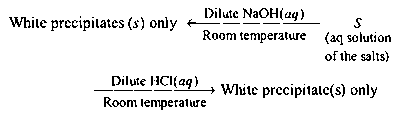
A mixture of two salts is used to prepare a solution S, which gives the following results :

JEE Advanced 2021 Paper 1 Online Chemistry - Isolation of Elements Question 12 English
The correct option(s) for the salt mixture is (are)
A
Pb(NO3)2 and Zn(NO3)2
B
Pb(NO3)2 and Bi(NO3)3
C
AgNO3 and Bi(NO3)3
D
Pb(NO3)2 and Hg(NO3)2
Open complete paper

Showing 20 of 23 questions