Difficulty distribution
How the classified questions are distributed by difficulty.
Your cart is empty.
Practice Word Formation - Levels of Grammatical Analysis (The primary components of grammar) - Linguistics previous year questions organised from real papers, with year-wise coverage and clear topic navigation.
Every graph below is calculated only from this selection.
Year-wise coverage for Word Formation. Each bar uses a separate theme-derived color.
How the classified questions are distributed by difficulty.
MCQ, numerical, multiple-select and other formats found in these papers.
Top subjects by unique question coverage.
Top topics across the included previous year papers.
Top subtopics inside this exact selection.
Question coverage for the most populated papers. Every active PYP paper remains listed below.
Newest papers appear first. Sort by year, question coverage or name.
| Paper | Year / session | Questions in this view | Open |
|---|---|---|---|
| Humanities & Social Sciences - Linguistics (XH-C3) 2026 | 2026 | 4 | View paper |
| Humanities & Social Sciences-Linguistics (XH-C3) 2025 | 2025 | 3 | View paper |
| Humanities & Social Sciences-Linguistics (XH-C3) 2024 | 2024 | 1 | View paper |
| Humanities & Social Sciences-Linguistics (XH-C3) 2023 | 2023 | 5 | View paper |
| Humanities & Social Sciences-Linguistics (XH-C3) 2022 | 2022 | 4 | View paper |
Practice every matching question in batches of 20, with every available option.
A second language speaker uses the word [phonetic] as a singular noun because she interprets the word [phonetics] as a plural noun. In doing so, she is deducing a new word by the process of __________.
Choose the option that correctly matches the compound words (P – S) in column X with their types (i – iv) in column Y.
| X | Y |
|---|---|
| P. Scarecrow | i. Copulative |
| Q. Shoerack | ii. Appositional |
| R. Sleepwalk | iii. Exocentric |
| S. Maidservant | iv. Endocentric |
Choose the option/s that lead/s to the ungrammaticality of the English word *grammarismian.
Examine the following statements (S1 and S2) and choose the CORRECT option.
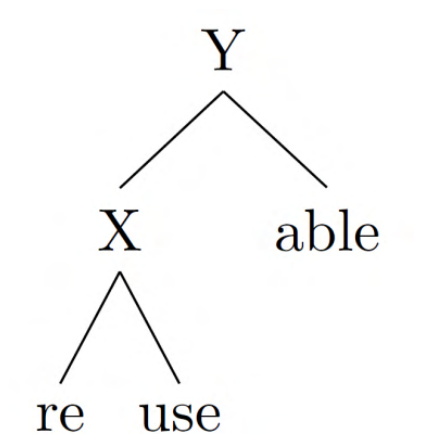
S1: In English, the attachment of suffix -able to intransitive verbs is productive.
S2: In English words, inflectional suffixes follow derivational suffixes.
| 1. | adam 'man' | adamlar 'men' |
| 2. | top 'gun' | toplar 'guns' |
| 3. | ders 'lesson' | dersler 'lessons' |
| 4. | yer 'place' | yerler 'places' |
| 5. | yol 'road' | yollar 'roads' |
| 6. | kilit 'lock' | kilitler 'locks' |
| 7. | ok 'arrow' | ______ 'arrows' |
| 8. | el 'hand' | ______ 'hands' |
| 9. | zil 'bell' | ______ 'bells' |
| 10. | elma 'apple' | ______ 'apples' |
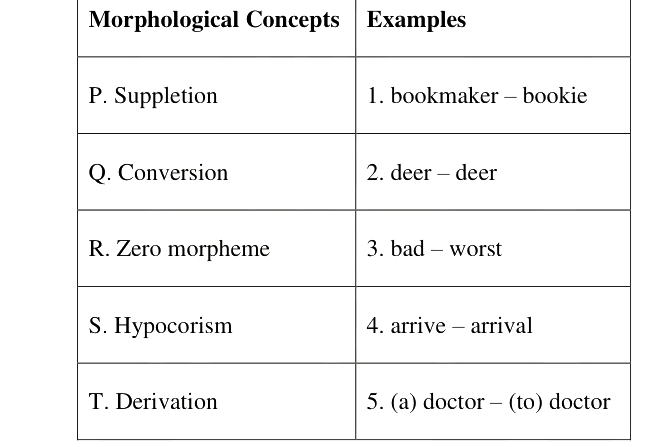
| Column X: Morphological Concepts | Column Y: Examples |
|---|---|
| P. Suppletion | 1. bookmaker – bookie |
| Q. Conversion | 2. deer – deer |
| R. Zero morpheme | 3. bad – worst |
| S. Hypocorism | 4. arrive – arrival |
| T. Derivation | 5. (a) doctor – (to) doctor |