My Cart
Your Cart 0

    Your cart is empty.

  • Total (Amount) ₹0.00
Previous year question hub

Regression and Simultaneous Equations - Statistics, Econometrics and Mathematical Economics - Economics Previous Year Questions

Practice Regression and Simultaneous Equations - Statistics, Econometrics and Mathematical Economics - Economics previous year questions organised from real papers, with year-wise coverage and clear topic navigation.

6Papers
6Years
21Questions
1Topics

Regression and Simultaneous Equations question pattern

Every graph below is calculated only from this selection.

Questions by year

Year-wise coverage for Regression and Simultaneous Equations. Each bar uses a separate theme-derived color.

Difficulty distribution

How the classified questions are distributed by difficulty.

Medium 12 57.1%
Easy 9 42.9%

Question type distribution

MCQ, numerical, multiple-select and other formats found in these papers.

MCQ 13 61.9%
Numerical Answer Type (NAT) 6 28.6%
MSQ 2 9.5%

Subject weightage

Top subjects by unique question coverage.

Economics
21 Qs

Most asked topics

Top topics across the included previous year papers.

Statistics, Econometrics and Mathematical Economics
21 Qs

Subtopic coverage

Top subtopics inside this exact selection.

Regression and Simultaneous Equations
21 Qs

Paper coverage

Question coverage for the most populated papers. Every active PYP paper remains listed below.

Humanities & Social Sciences - Economics (XH-C1) 2026
3 Qs
Humanities & Social Sciences-Economics (XH-C1) 2025
1 Qs
Humanities & Social Sciences-Economics (XH-C1) 2024
4 Qs
Humanities & Social Sciences-Economics (XH-C1) 2023
4 Qs
Humanities & Social Sciences-Economics (XH-C1) 2022
4 Qs
Humanities & Social Sciences-Economics (XH-C1) 2021
5 Qs

Included previous year papers

Newest papers appear first. Sort by year, question coverage or name.

PaperYear / sessionQuestions in this viewOpen
Humanities & Social Sciences - Economics (XH-C1) 202620263View paper
Humanities & Social Sciences-Economics (XH-C1) 202520251View paper
Humanities & Social Sciences-Economics (XH-C1) 202420244View paper
Humanities & Social Sciences-Economics (XH-C1) 202320234View paper
Humanities & Social Sciences-Economics (XH-C1) 202220224View paper
Humanities & Social Sciences-Economics (XH-C1) 202120215View paper

All Regression and Simultaneous Equations previous year questions

Practice every matching question in batches of 20, with every available option.

1
2021 · Economics · Statistics, Econometrics and Mathematical Economics · Regression and Simultaneous Equations
Humanities & Social Sciences-Economics (XH-C1) 2021
What would be the consequences for the OLS estimator if heteroscedasticity is present in a regression model but ignored? Assume that all the other classical assumptions are valid.
Open complete paper
2
2021 · Economics · Statistics, Econometrics and Mathematical Economics · Regression and Simultaneous Equations
Humanities & Social Sciences-Economics (XH-C1) 2021
To determine the relationship between \( y \) and \( x_1 \), Rohit estimated two different OLS models. In the first model, Rohit regressed \( y \) on \( x_1 \) and \( x_2 \) as given below
\( y = \beta_0 + \beta_1 x_1 + \beta_2 x_2 + u \) (1)
In the second model, Rohit regressed \( y \) only on \( x_1 \) as given below
\( y = \delta_0 + \delta_1 x_1 + v \) (2)
The estimated coefficients of \( x_1 \) in the above two models are exactly same. From this observation we can state conclusively that
(i) \( Cov(x_1, y) = 0 \)
(ii) \( \hat{\beta}_2 = 0 \)
(iii) \( Cov(x_2, x_1) = 0 \)
where \( \hat{\beta}_2 \) is the estimated coefficient of \( x_2 \) in the equation (1)
Open complete paper
3
2021 · Economics · Statistics, Econometrics and Mathematical Economics · Regression and Simultaneous Equations
Humanities & Social Sciences-Economics (XH-C1) 2021
In a demand function estimation of a good \( X \), a researcher collected data on various households’ consumption of good \( X \) (\( Q_x \)) for various price levels. The researcher also collected data on household income (\( M \)) and household size (\( S \)). The estimated regression result is
\( \log Q_x = -0.345(0.111) - 1.543(2.345) \log P_x + 1.123(0.012) \log M + 0.234(0.123) \log S \)
where \( P_x \) is price per unit of \( X \). The values in the parentheses are the standard errors of the estimated coefficients. From the estimation one can conclude that
Open complete paper
4
2021 · Economics · Statistics, Econometrics and Mathematical Economics · Regression and Simultaneous Equations
Humanities & Social Sciences-Economics (XH-C1) 2021
Consider a regression model \( y = \beta_0 + \beta x + u \) where the continuous variable y is regressed on a dummy variable x, which takes the value either 1 or 0.
However, the model was estimated using the instrumental variable (IV) estimation method, wherein the indicator variable z is used as an instrument of x.
Let
\( \bar{y}_1 \) and \( \bar{y}_0 \) be the sample averages of y when z takes the value 1 and 0, respectively
\( \bar{x}_1 \) and \( \bar{x}_0 \) be the sample averages of x when z takes the value 1 and 0, respectively
\( \bar{y}^1 \) and \( \bar{y}^0 \) be the sample averages of y when x takes the value 1 and 0, respectively
\( \bar{z}^1 \) and \( \bar{z}^0 \) be the sample averages of z when x takes the value 1 and 0, respectively
Then the estimated coefficient of \( \beta_{IV} \) is
Open complete paper
5
2021 · Economics · Statistics, Econometrics and Mathematical Economics · Regression and Simultaneous Equations
Humanities & Social Sciences-Economics (XH-C1) 2021
Consider two regression models estimated on a sample of 350 observations.
\(y = \beta_0 + \beta_1 x_1 + \beta_2 x_2 + \beta_3 x_3 + \beta_4 x_4 + \beta_5 x_5 + u\) ---------(1)
\(y = \alpha_0 + \alpha_1 x_1 + \alpha_2 x_2 + v\) ---------(2)
The \(R^2\) in model (1) is \(R_1^2 = 0.3521\) and in model (2) is \(R_2^2 = 0.2314\). The value of the test statistic to test the \(H_0: \beta_3 = \beta_4 = \beta_5 = 0\) is ______________ (round off to three decimal places).
Open complete paper
6
2022 · Economics · Statistics, Econometrics and Mathematical Economics · Regression and Simultaneous Equations
Humanities & Social Sciences-Economics (XH-C1) 2022
Suppose we estimate the following regression equation:
\( ln(x_t) = a_0 + a_1 ln(y_t) + \epsilon_t , \quad a_0, a_1 > 0 \)
where \( x_t \) and \( y_t \) are some variables. \( a_0 \) and \( a_1 \) are the intercept and the slope, respectively. \( \epsilon_t \) is the residual term. What is the interpretation of the coefficient \( a_1 \)?
Open complete paper
7
2022 · Economics · Statistics, Econometrics and Mathematical Economics · Regression and Simultaneous Equations
Humanities & Social Sciences-Economics (XH-C1) 2022
Which one of the following is a test of heteroscedastity?
Open complete paper
8
2022 · Economics · Statistics, Econometrics and Mathematical Economics · Regression and Simultaneous Equations
Humanities & Social Sciences-Economics (XH-C1) 2022
Suppose an econometrician had specified the following regression:
\( y_t = \beta_1 + \beta_2 z_{2t} + \beta_3 z_{3t} + \beta_4 z_{4t} + \varepsilon_t \)
but a researcher estimated the following regression:
\( y_t = \beta_1 + \beta_2 z_{2t} + \beta_3 z_{3t} + \beta_4 z_{4t} + \beta_5 z_{5t} + \varepsilon_t \)
What will be the consequence of including the irrelevant variable on the estimated coefficients?
Open complete paper
9
2022 · Economics · Statistics, Econometrics and Mathematical Economics · Regression and Simultaneous Equations
Humanities & Social Sciences-Economics (XH-C1) 2022
Suppose an investigator has specified the following simultaneous equation model:
\(y_{1,t} = \alpha_{1,0} + \alpha_{1,2}y_{2,t} + \alpha_2M_t + \alpha_3K_t + u_t\) (1)
\(y_{2,t} = \alpha_{3,0} + \alpha_{3,1}y_{1,t} + \alpha_3I_t + v_t\) (2)
where \(y_{1,t}\) and \(y_{2,t}\) are endogenous variables. \(M_t\), \(K_t\) and \(I_t\) are predetermined variables. \(u_t\) and \(v_t\) are residual terms. Based on the order condition of identification, which one of the following statements are correct?
Open complete paper
10
2023 · Economics · Statistics, Econometrics and Mathematical Economics · Regression and Simultaneous Equations
Humanities & Social Sciences-Economics (XH-C1) 2023
An analyst regressed \( Y \) on \( X_1 \) and \( X_2 \). If she later noticed that \( X_1 = 5X_2 \), then which of the following assumptions of the classical linear regression model was violated?
Open complete paper
11
2023 · Economics · Statistics, Econometrics and Mathematical Economics · Regression and Simultaneous Equations
Humanities & Social Sciences-Economics (XH-C1) 2023
Consider the following simultaneous equations model:
\[ Y_t = \beta_1 + \beta_2 X_t + \beta_3 X_{t-1} + \beta_4 Z_t + \mu_{1t} \quad (1) \]
\[ Z_t = \delta_1 + \delta_2 Y_t + \delta_3 W_t + \mu_{2t} \quad (2) \]
Before estimating the above model, a researcher performed the test of identification using order and rank conditions, and found that equation (2) is overidentified. Then, which of the following methods is appropriate to estimate equation (2)?
Open complete paper
12
2023 · Economics · Statistics, Econometrics and Mathematical Economics · Regression and Simultaneous Equations
Humanities & Social Sciences-Economics (XH-C1) 2023
Using the Ordinary Least Squares (OLS) method, a researcher estimated the relationship between initial salary (\( S \)) of MBA graduates and their cumulative grade point average (\( CGPA \)) as \[ \hat{S}_i = \hat{\beta}_0 + \hat{\beta}_1 CGPA_i \quad ; \quad i = 1,2,...,100 \] where \( \hat{\beta}_0 = 4543 \) and \( \hat{\beta}_1 = 645.08 \). The standard errors of \( \hat{\beta}_0 \) and \( \hat{\beta}_1 \) are 921.79 and 70.01, respectively.
The t-statistic for testing the null hypothesis \( \beta_1 = 0 \) is ______ (round off to two decimal places).
Open complete paper
13
2023 · Economics · Statistics, Econometrics and Mathematical Economics · Regression and Simultaneous Equations
Humanities & Social Sciences-Economics (XH-C1) 2023
Suppose from the estimation of a linear regression model \[ Y_i = \beta_0 + \beta_1 X_i + e_i \] the residual sum of squares and the total sum of squares are obtained as 44 and 80, respectively. The value of coefficient of determination is ________ (round off to two decimal places).
Open complete paper
14
2024 · Economics · Statistics, Econometrics and Mathematical Economics · Regression and Simultaneous Equations
Humanities & Social Sciences-Economics (XH-C1) 2024
Consider a simple pooled regression model: \(y_{it} = \beta_0 + \beta_1 x_{it} + v_{it}\) where \(v_{it} = \mu_i + \epsilon_{it}\) and \(Cov(x_{it}, \mu_i) \neq 0\). Here, \(\mu_i\) captures the unknown individual specific effects and \(\epsilon_{it}\) is the idiosyncratic error uncorrelated with both \(x_{it}\) and \(\mu_i\). If the parameters of this model are estimated using the ordinary least squares (OLS) method, then the estimated slope coefficient will be
Open complete paper
15
2024 · Economics · Statistics, Econometrics and Mathematical Economics · Regression and Simultaneous Equations
Humanities & Social Sciences-Economics (XH-C1) 2024
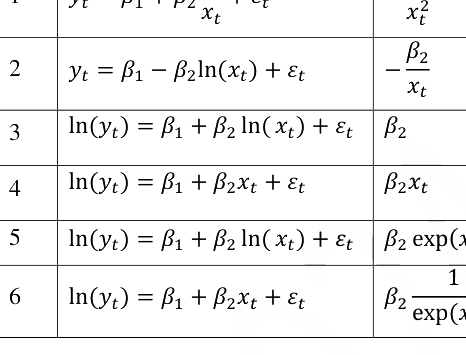
The following table provides different statistical model specifications along with the elasticity of \(y_t\) with respect to \(x_t\). Which one of the following options is correct?

Question diagram

Open complete paper
16
2024 · Economics · Statistics, Econometrics and Mathematical Economics · Regression and Simultaneous Equations
Humanities & Social Sciences-Economics (XH-C1) 2024
Let \(x\) and \(y\) be two dummy variables that take the values of either 0 or 1, and follow the bivariate frequency distribution as given below. If a logit regression is estimated with \(y\) as the dependent variable and \(x\) as the independent variable, then the estimated coefficient of \(x\) is ______ (rounded off to two decimal places).

Question diagram

Open complete paper
17
2024 · Economics · Statistics, Econometrics and Mathematical Economics · Regression and Simultaneous Equations
Humanities & Social Sciences-Economics (XH-C1) 2024
The estimated results of a Probit model is given in the table below, where \(Y\) is a binary variable taking the value either 0 or 1, and \(X\) is an integer. The probability that \(Y = 1\) when \(X = 30\) is ______ (rounded off to two decimal places).

Question diagram

Open complete paper
18
2025 · Economics · Statistics, Econometrics and Mathematical Economics · Regression and Simultaneous Equations
Humanities & Social Sciences-Economics (XH-C1) 2025
Consider a two-variables \((x, y)\) linear regression model
\[ y = \alpha + \beta x + \epsilon \]
where \(\alpha\) and \(\beta\) are the parameters, and \(\epsilon\) is the error term.
The parameters are estimated using the Ordinary Least Squares (OLS) method. Let \(b\) denote the estimated value of \(\beta\). If \(b = 0\), then which one of the following statements is CORRECT?
Open complete paper
19
2026 · Economics · Statistics, Econometrics and Mathematical Economics · Regression and Simultaneous Equations
Humanities & Social Sciences - Economics (XH-C1) 2026
Consider a two-variable \((x, y)\) linear regression model given in Equations (1) and (2) below. The error term, \(u_t\), of Equation (1) is serially correlated as given in Equation (2). The error term, \(\epsilon_t\), of Equation (2) is white noise. All other assumptions of the Classical Linear Regression Model (CLRM) hold. Then, which of the following options is/are FALSE?
\[ y_t = \alpha + \beta x_t + u_t \quad (1) \]
\[ u_t = \rho u_{t-1} + \epsilon_t; \ 0 < \rho < 1 \quad (2) \]
Open complete paper
20
2026 · Economics · Statistics, Econometrics and Mathematical Economics · Regression and Simultaneous Equations
Humanities & Social Sciences - Economics (XH-C1) 2026
The estimated energy demand is given in the Equation below, where, \(\hat{y}_t\) is the estimated value of the log of energy demand at time \(t\). The numbers in the parentheses are the values of the \(t\)-statistic of the corresponding coefficients.
\(\hat{y}_t = 1.24 + 0.56 \ln(GDP_t) - 0.03 \ln(energyprice_t)\)
(10.73) (7.28) (5.28)
Which one of the following statements is CORRECT?
Open complete paper

Showing 20 of 21 questions