My Cart
Your Cart 0

    Your cart is empty.

  • Total (Amount) ₹0.00
Previous year question hub

Uncertainty, Information and Game Theory - Microeconomics - Economics Previous Year Questions

Practice Uncertainty, Information and Game Theory - Microeconomics - Economics previous year questions organised from real papers, with year-wise coverage and clear topic navigation.

5Papers
5Years
15Questions
1Topics

Uncertainty, Information and Game Theory question pattern

Every graph below is calculated only from this selection.

Questions by year

Year-wise coverage for Uncertainty, Information and Game Theory. Each bar uses a separate theme-derived color.

Difficulty distribution

How the classified questions are distributed by difficulty.

Easy 6 40%
Medium 6 40%
Hard 3 20%

Question type distribution

MCQ, numerical, multiple-select and other formats found in these papers.

Numerical Answer Type (NAT) 8 53.3%
MCQ 6 40%
MSQ 1 6.7%

Subject weightage

Top subjects by unique question coverage.

Economics
15 Qs

Most asked topics

Top topics across the included previous year papers.

Microeconomics
15 Qs

Subtopic coverage

Top subtopics inside this exact selection.

Uncertainty, Information and Game Theory
15 Qs

Paper coverage

Question coverage for the most populated papers. Every active PYP paper remains listed below.

Humanities & Social Sciences - Economics (XH-C1) 2026
4 Qs
Humanities & Social Sciences-Economics (XH-C1) 2025
3 Qs
Humanities & Social Sciences-Economics (XH-C1) 2024
2 Qs
Humanities & Social Sciences-Economics (XH-C1) 2022
1 Qs
Humanities & Social Sciences-Economics (XH-C1) 2021
5 Qs

Included previous year papers

Newest papers appear first. Sort by year, question coverage or name.

PaperYear / sessionQuestions in this viewOpen
Humanities & Social Sciences - Economics (XH-C1) 202620264View paper
Humanities & Social Sciences-Economics (XH-C1) 202520253View paper
Humanities & Social Sciences-Economics (XH-C1) 202420242View paper
Humanities & Social Sciences-Economics (XH-C1) 202220221View paper
Humanities & Social Sciences-Economics (XH-C1) 202120215View paper

All Uncertainty, Information and Game Theory previous year questions

Practice every matching question in batches of 20, with every available option.

1
2021 · Economics · Microeconomics · Uncertainty, Information and Game Theory
Humanities & Social Sciences-Economics (XH-C1) 2021
Piku faces a lottery with outcomes of ₹24, ₹12, ₹48 and ₹6 given by the following probability distribution
Lottery Outcome₹24₹12₹48₹6
Probability of Outcome2/63/61/60

She is indifferent between the lottery and receiving ₹28 with certainty. Given the information we can conclude that Piku is a
Open complete paper
2
2021 · Economics · Microeconomics · Uncertainty, Information and Game Theory
Humanities & Social Sciences-Economics (XH-C1) 2021

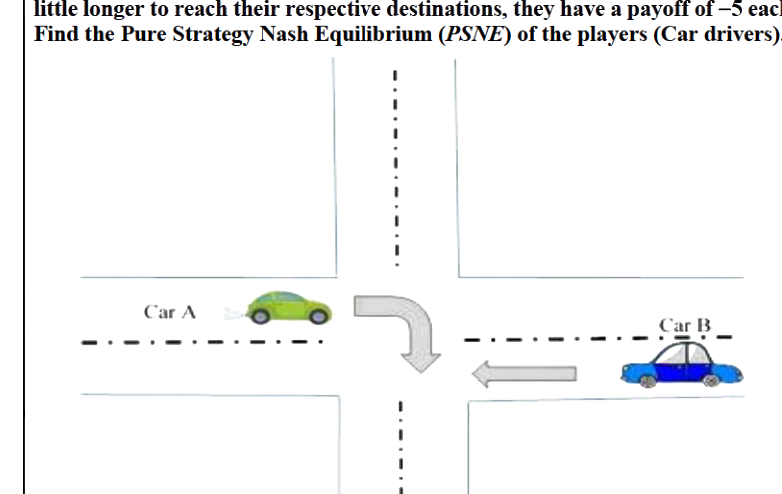
Consider an intersection of roads without any traffic light. Two cars A and B approach an intersection and they want to proceed as indicated by respective arrows in the following diagram. If both proceed without stopping and there is an accident, then A would have a payoff of –100 and B would have a payoff of –500 (since B is responsible for the accident). If one stops, and the other proceeds then the payoff is: –5 and 10, respectively. If both of them stop, then it takes a little longer to reach their respective destinations, they have a payoff of –5 each. Find the Pure Strategy Nash Equilibrium (PSNE) of the players (Car drivers).

Question diagram

Open complete paper
3
2021 · Economics · Microeconomics · Uncertainty, Information and Game Theory
Humanities & Social Sciences-Economics (XH-C1) 2021

Suppose Vijay has purchased a high-speed car worth ₹1000000. During the purchase, an Insurance company has shared the latest available road safety survey, wherein it is mentioned that, due to heavy congestion on roads, there is 40% chance of an accident within the first year of car purchase resulting in loss of the car value by 60%. Vijay’s utility function for wealth (W) is given by \(U(W) = ln(W)\). If Vijay plans to buy an accident insurance having a premium of 30%, then he will purchase an insurance of ₹__________ (round off to the nearest integer).

Open complete paper
4
2021 · Economics · Microeconomics · Uncertainty, Information and Game Theory
Humanities & Social Sciences-Economics (XH-C1) 2021
Consider an individual who maximizes her expected utility having Bernoulli utility function \(u(w) = \alpha - \beta e^{-rw}\) ; \(w > 0\) is wealth. The individual displays ________ relative risk aversion.
Open complete paper
5
2021 · Economics · Microeconomics · Uncertainty, Information and Game Theory
Humanities & Social Sciences-Economics (XH-C1) 2021
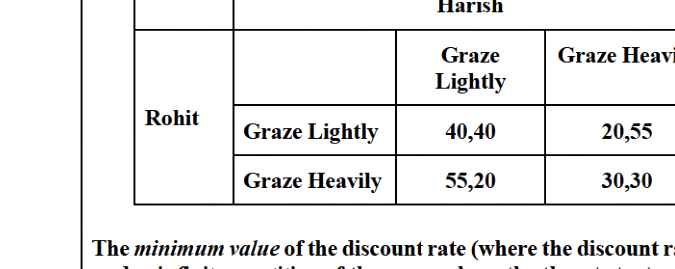
Two farmers, Rohit and Harish, graze their animals on a common land. They can choose to use this common resource ‘lightly’ or ‘heavily’ and the resulting strategic interaction may be described as a simultaneous-move game. The payoff matrix is given below:
Harish
Graze LightlyGraze Heavily
RohitGraze Lightly40,4020,55
Graze Heavily55,2030,30

The minimum value of the discount rate (where the discount rate is less than one) under infinite repetition of the game where the threat strategy (“Graze lightly if the opponent also grazes lightly, whereas, if the opponent renege then always graze heavily in all the future periods”), is a Sub-game Perfect Nash Equilibrium (SPNE) and, both the farmers graze their animals lightly is ______________ (round off to one decimal place).

Question diagram

Open complete paper
6
2022 · Economics · Microeconomics · Uncertainty, Information and Game Theory
Humanities & Social Sciences-Economics (XH-C1) 2022
Consider a lottery with two possible outcomes:
  • Rupees 100 with probability 0.6
  • Rupees 50 with probability 0.4
The maximum amount that a risk-neutral person would be willing to pay to play the above lottery equals Rupees ______ (in integer).
Open complete paper
7
2024 · Economics · Microeconomics · Uncertainty, Information and Game Theory
Humanities & Social Sciences-Economics (XH-C1) 2024
Two friends Aditi and Raju are deciding independently whether to watch a movie or go to a music concert that evening. Both friends would prefer to spend the evening together than apart. Aditi would prefer that they watch a movie together, while Raju would prefer that they go to the concert together. The payoff matrix arising from their actions is presented below. \(p\) and \((1 - p)\) are the probabilities that Aditi will decide in favour of the movie and concert, respectively. Similarly, \(q\) and \((1 - q)\) are the probabilities that Raju will decide in favour of the movie and concert, respectively. Which one of the following options correctly contains all the Nash Equilibria?
Open complete paper
8
2024 · Economics · Microeconomics · Uncertainty, Information and Game Theory
Humanities & Social Sciences-Economics (XH-C1) 2024
An incumbent firm (\(I\)) faces the possibility of entry by a challenger firm (\(C\)). If \(C\) enters, \(I\) may either accommodate or fight. If \(C\) does not enter, its payoff is 1, while \(I\)'s payoff is 2. If \(C\) enters, and \(I\) accommodates, their payoffs are 2 and 1, respectively. However, if \(C\)'s entry is met with a fight by \(I\), their payoffs are 0 and 1, respectively. Which one of the following is a subgame perfect Nash equilibrium (SPNE) under perfect information?
Open complete paper
9
2025 · Economics · Microeconomics · Uncertainty, Information and Game Theory
Humanities & Social Sciences-Economics (XH-C1) 2025
Consider a lottery with three possible outcomes:
OutcomesProbabilityReward/Win (in INR)
I0.225
II0.350
III0.5100
The maximum amount that a risk-neutral person would be willing to pay to play the above lottery is INR ______ (in integer)
Open complete paper
10
2025 · Economics · Microeconomics · Uncertainty, Information and Game Theory
Humanities & Social Sciences-Economics (XH-C1) 2025
There are two firms in an industry producing a homogeneous product. The market demand function is given by \( P = 1 - (q_1 + q_2) \), where \( q_1 \) and \( q_2 \) are the output levels of Firm 1 and Firm 2, respectively.
Firm 1’s cost function is common knowledge and equals zero. Firm 2’s cost function is private information. Firm 1 believes that Firm 2’s cost function is \( 0.5q_2 \) with probability 0.5 and that Firm 2’s cost function is \( 0.25q_2 \) with probability 0.5. The firms choose their quantities simultaneously.
Let \( q_1^{*} \) denote the quantity produced by Firm 1 in the Bayesian Nash equilibrium of this game. Then, the value of \( 24q_1^{*} \) is __________ (round off to one decimal place)
Open complete paper
11
2025 · Economics · Microeconomics · Uncertainty, Information and Game Theory
Humanities & Social Sciences-Economics (XH-C1) 2025
Two players \(A\) and \(B\) are playing a game. Player \(A\) has two available actions \(a_1\) and \(a_2\). Player \(B\) has two available actions \(b_1\) and \(b_2\). The payoff matrix arising from their actions is presented below.
\(b_1\)\(b_2\)
\(a_1\)−1, 34, −1
\(a_2\)3, −4−2, 2
Let \(p\) be the probability that player \(A\) plays action \(a_1\) in the mixed strategy Nash equilibrium of the game. Then the value of \(p\) is __________ (round off to one decimal place)
Open complete paper
12
2026 · Economics · Microeconomics · Uncertainty, Information and Game Theory
Humanities & Social Sciences - Economics (XH-C1) 2026
Two players use the following procedure to divide a perfectly homogeneous and continuously divisible cake.
First, Player 1 divides the cake into two pieces and then Player 2 chooses one of the pieces. Player 1 gets the remaining piece. Each player cares only about the size of the piece s/he gets.
How is the cake divided in a sub-game perfect equilibrium if both the players are rational?
Open complete paper
13
2026 · Economics · Microeconomics · Uncertainty, Information and Game Theory
Humanities & Social Sciences - Economics (XH-C1) 2026
Two companies, Company 1 and Company 2, are playing a simultaneous-move game. They are selling competing devices, whose quantity demanded are given by \(x_1\) and \(x_2\), and their prices are \(p_1\) and \(p_2\), respectively. The demand equation for the device of Company 1 is \(x_1 = 300(90 - 0.5p_1 + 0.25p_2)\), and that of Company 2 is \(x_2 = 300(90 - 0.5p_2 + 0.25p_1)\). The cost of production of both devices is zero. Each company is interested in maximizing its own profit.
Which one of the following price combinations constitutes the Nash equilibrium of the game?
Open complete paper
14
2026 · Economics · Microeconomics · Uncertainty, Information and Game Theory
Humanities & Social Sciences - Economics (XH-C1) 2026
In the town of Belapur, 5000 used cars are available for sale. The cars vary in quality and only the car owners know the true worth of their car. All used cars look the same to potential buyers. If a car is of quality x, then the original owner is ready to sell it for any price greater than or equal to x. For a buyer, the expected worth of a car is equal to half of the number of cars selling in the market. As the buyer does not know the exact quality of the car, he is willing to pay a price that is equal to 1000 more than the expected worth of the car. At the equilibrium, the number of cars that remain unsold in the market is _____ (in integer)
Open complete paper
15
2026 · Economics · Microeconomics · Uncertainty, Information and Game Theory
Humanities & Social Sciences - Economics (XH-C1) 2026
Table 1 and Table 2 represent a 3-player game. The payoff (a, b, c), in each cell, represents Player 1, Player 2, and Player 3’s payoffs respectively. Player 1 (P1) decides to play either A, B, or C. Player 2 (P2) decides to play either X, Y, or Z. Player 3 (P3) decides between Table 1 and Table 2. The number of Nash equilibrium in pure strategy in this game is _____ (in integer)
Open complete paper