My Cart
Your Cart 0

    Your cart is empty.

  • Total (Amount) ₹0.00
Previous year question hub

Money, Banking and Monetary Policy - Macroeconomics - Economics Previous Year Questions

Practice Money, Banking and Monetary Policy - Macroeconomics - Economics previous year questions organised from real papers, with year-wise coverage and clear topic navigation.

6Papers
6Years
12Questions
1Topics

Money, Banking and Monetary Policy question pattern

Every graph below is calculated only from this selection.

Questions by year

Year-wise coverage for Money, Banking and Monetary Policy. Each bar uses a separate theme-derived color.

Difficulty distribution

How the classified questions are distributed by difficulty.

Easy 8 66.7%
Medium 4 33.3%

Question type distribution

MCQ, numerical, multiple-select and other formats found in these papers.

Numerical Answer Type (NAT) 5 41.7%
MCQ 4 33.3%
MSQ 3 25%

Subject weightage

Top subjects by unique question coverage.

Economics
12 Qs

Most asked topics

Top topics across the included previous year papers.

Macroeconomics
12 Qs

Subtopic coverage

Top subtopics inside this exact selection.

Money, Banking and Monetary Policy
12 Qs

Paper coverage

Question coverage for the most populated papers. Every active PYP paper remains listed below.

Humanities & Social Sciences - Economics (XH-C1) 2026
4 Qs
Humanities & Social Sciences-Economics (XH-C1) 2025
1 Qs
Humanities & Social Sciences-Economics (XH-C1) 2024
1 Qs
Humanities & Social Sciences-Economics (XH-C1) 2023
2 Qs
Humanities & Social Sciences-Economics (XH-C1) 2022
1 Qs
Humanities & Social Sciences-Economics (XH-C1) 2021
3 Qs

Included previous year papers

Newest papers appear first. Sort by year, question coverage or name.

PaperYear / sessionQuestions in this viewOpen
Humanities & Social Sciences - Economics (XH-C1) 202620264View paper
Humanities & Social Sciences-Economics (XH-C1) 202520251View paper
Humanities & Social Sciences-Economics (XH-C1) 202420241View paper
Humanities & Social Sciences-Economics (XH-C1) 202320232View paper
Humanities & Social Sciences-Economics (XH-C1) 202220221View paper
Humanities & Social Sciences-Economics (XH-C1) 202120213View paper

All Money, Banking and Monetary Policy previous year questions

Practice every matching question in batches of 20, with every available option.

1
2021 · Economics · Macroeconomics · Money, Banking and Monetary Policy
Humanities & Social Sciences-Economics (XH-C1) 2021

The basic tenets of ‘Monetarism’ are

Open complete paper
2
2021 · Economics · Macroeconomics · Money, Banking and Monetary Policy
Humanities & Social Sciences-Economics (XH-C1) 2021
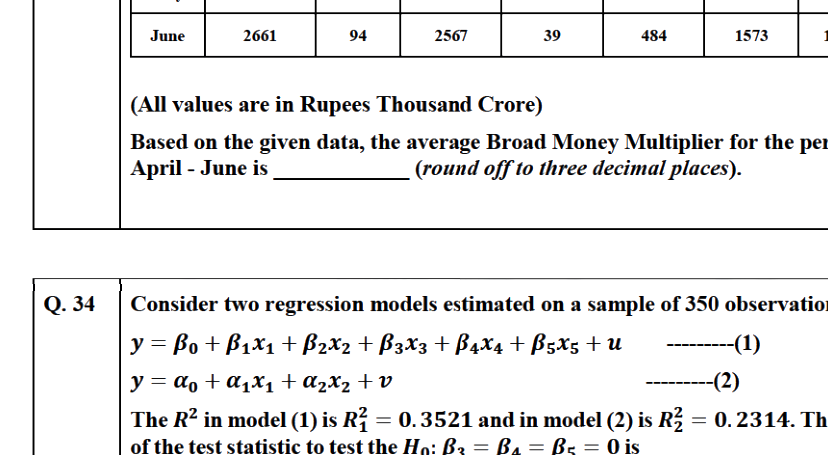
Consider the following Table.
MonthCurrency in CirculationCash with BanksCurrency with the PublicOther Deposits with the RBIBankers’ Deposits with the RBIDemand DepositsTime Deposits
April252398242540457158212988
May261198251342468156513112
June266194256739484157313141

(All values are in Rupees Thousand Crore)
Based on the given data, the average Broad Money Multiplier for the period April - June is ____________ (round off to three decimal places).

Question diagram

Open complete paper
3
2021 · Economics · Macroeconomics · Money, Banking and Monetary Policy
Humanities & Social Sciences-Economics (XH-C1) 2021
Let the rate of inflation in an economy be 4.2%, the growth rate of velocity of money be 2% and, the growth rate of real GDP be 6%. According to Milton Friedman's 'k' percent rule, the rate of growth of money supply for maintaining stable prices will be __________ (round off to one decimal place).
Open complete paper
4
2022 · Economics · Macroeconomics · Money, Banking and Monetary Policy
Humanities & Social Sciences-Economics (XH-C1) 2022
Which of the following variables are pushed upwards by ‘Seigniorage’?
Open complete paper
5
2023 · Economics · Macroeconomics · Money, Banking and Monetary Policy
Humanities & Social Sciences-Economics (XH-C1) 2023
According to the Working Group on Money Supply: Analytics and Methodology of Compilation (1998) constituted by the Reserve Bank of India (RBI), which of the following is NOT a component of the new monetary aggregate NM1 ?
Open complete paper
6
2023 · Economics · Macroeconomics · Money, Banking and Monetary Policy
Humanities & Social Sciences-Economics (XH-C1) 2023
Suppose Amar borrows Rs. 1000 from Ujala. After one year, Ujala wants Rs. 1100 back from Amar. The yield to maturity in percent (%) on this borrowing is ______ (round off to one decimal place).
Open complete paper
7
2024 · Economics · Macroeconomics · Money, Banking and Monetary Policy
Humanities & Social Sciences-Economics (XH-C1) 2024

In the Keynesian system, the speculative demand for money arises because of

Open complete paper
8
2025 · Economics · Macroeconomics · Money, Banking and Monetary Policy
Humanities & Social Sciences-Economics (XH-C1) 2025

Which one of the following is part of the unconventional monetary policy?

Open complete paper
9
2026 · Economics · Macroeconomics · Money, Banking and Monetary Policy
Humanities & Social Sciences - Economics (XH-C1) 2026

High powered money belongs to the

Open complete paper
10
2026 · Economics · Macroeconomics · Money, Banking and Monetary Policy
Humanities & Social Sciences - Economics (XH-C1) 2026

According to the theory of Keynesian Liquidity Preference, demand for money

Open complete paper
11
2026 · Economics · Macroeconomics · Money, Banking and Monetary Policy
Humanities & Social Sciences - Economics (XH-C1) 2026
When the currency-deposit ratio is 0, and the reserve-deposit ratio is 0.5, then the value of the money multiplier is ________ (in integer)
Open complete paper
12
2026 · Economics · Macroeconomics · Money, Banking and Monetary Policy
Humanities & Social Sciences - Economics (XH-C1) 2026
The money demand function is \(\frac{M}{P} = 800 + 0.3Y - 2000i\), where, M is nominal money supply, P is the aggregate price level, Y is the real GDP, and i is the nominal interest rate. Suppose that Y = 2000, and i = 0.20. The velocity of money is _____ (in integer)
Open complete paper