My Cart
Your Cart 0

    Your cart is empty.

  • Total (Amount) ₹0.00
Previous year question hub

Circles - Geometry - General Aptitude (GA) Previous Year Questions

Practice Circles - Geometry - General Aptitude (GA) previous year questions organised from real papers, with year-wise coverage and clear topic navigation.

2Papers
2Years
2Questions
1Topics

Circles question pattern

Every graph below is calculated only from this selection.

Questions by year

Year-wise coverage for Circles. Each bar uses a separate theme-derived color.

Difficulty distribution

How the classified questions are distributed by difficulty.

Medium 2 100%

Question type distribution

MCQ, numerical, multiple-select and other formats found in these papers.

MCQ 2 100%

Subject weightage

Top subjects by unique question coverage.

General Aptitude (GA)
2 Qs

Most asked topics

Top topics across the included previous year papers.

Geometry
2 Qs

Subtopic coverage

Top subtopics inside this exact selection.

Circles
2 Qs

Paper coverage

Question coverage for the most populated papers. Every active PYP paper remains listed below.

Environmental Science & Engineering (ES) 2026
1 Qs
Environmental Science & Engineering (ES) 2023
1 Qs

Included previous year papers

Newest papers appear first. Sort by year, question coverage or name.

PaperYear / sessionQuestions in this viewOpen
Environmental Science & Engineering (ES) 202620261View paper
Environmental Science & Engineering (ES) 202320231View paper

All Circles previous year questions

Practice every matching question in batches of 20, with every available option.
1
2023 · General Aptitude (GA) · Geometry · Circles
Environmental Science & Engineering (ES) 2023
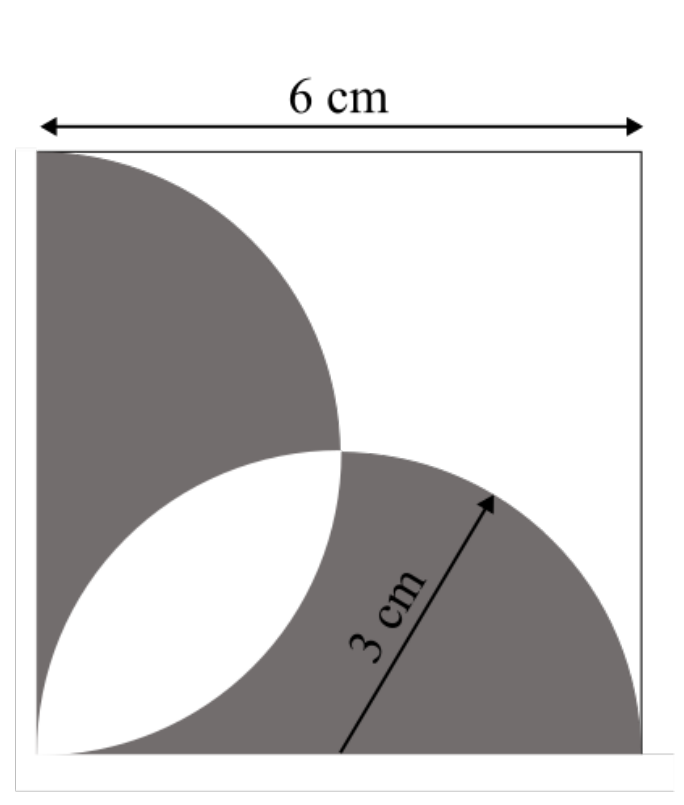
A square with sides of length 6 cm is given. The boundary of the shaded region is defined by two semi-circles whose diameters are the sides of the square, as shown.
The area of the shaded region is ______ cm².

Question source image

Open complete paper
2
2026 · General Aptitude (GA) · Geometry · Circles
Environmental Science & Engineering (ES) 2026
Circles \(C_1\), \(C_2\), and \(C_3\), with centers \(O_1\), \(O_2\), and \(O_3\), and radii \(r_1\), \(r_2\), and \(r_3\), respectively, touch each other as shown in the following figure. Given \(r_1 = 2\) cm, \(r_2 = 1\) cm and the angle \(\angle O_1 O_3 O_2 = 90^\circ\), \(r_3 = \) ______ cm.
Open complete paper