My Cart
Your Cart 0

    Your cart is empty.

  • Total (Amount) ₹0.00
Previous year question hub

Sewerage and Sewage Treatment - Water & Wastewater Treatment and Management - Environmental Science & Engineering Previous Year Questions

Practice Sewerage and Sewage Treatment - Water & Wastewater Treatment and Management - Environmental Science & Engineering previous year questions organised from real papers, with year-wise coverage and clear topic navigation.

4Papers
4Years
7Questions
1Topics

Sewerage and Sewage Treatment question pattern

Every graph below is calculated only from this selection.

Questions by year

Year-wise coverage for Sewerage and Sewage Treatment. Each bar uses a separate theme-derived color.

Difficulty distribution

How the classified questions are distributed by difficulty.

Medium 4 57.1%
Easy 3 42.9%

Question type distribution

MCQ, numerical, multiple-select and other formats found in these papers.

MCQ 4 57.1%
MSQ 2 28.6%
Numerical Answer Type (NAT) 1 14.3%

Subject weightage

Top subjects by unique question coverage.

Environmental Science & Engineering
7 Qs

Most asked topics

Top topics across the included previous year papers.

Water & Wastewater Treatment and Management
7 Qs

Subtopic coverage

Top subtopics inside this exact selection.

Sewerage and Sewage Treatment
7 Qs

Paper coverage

Question coverage for the most populated papers. Every active PYP paper remains listed below.

Environmental Science & Engineering (ES) 2026
1 Qs
Environmental Science & Engineering (ES) 2025
1 Qs
Environmental Science & Engineering (ES) 2024
2 Qs
Environmental Science & Engineering (ES) 2021
3 Qs

Included previous year papers

Newest papers appear first. Sort by year, question coverage or name.

PaperYear / sessionQuestions in this viewOpen
Environmental Science & Engineering (ES) 202620261View paper
Environmental Science & Engineering (ES) 202520251View paper
Environmental Science & Engineering (ES) 202420242View paper
Environmental Science & Engineering (ES) 202120213View paper

All Sewerage and Sewage Treatment previous year questions

Practice every matching question in batches of 20, with every available option.

1
2024 · Environmental Science & Engineering · Water & Wastewater Treatment and Management · Sewerage and Sewage Treatment
Environmental Science & Engineering (ES) 2024
Crown corrosion of reinforced cement concrete sewer is caused by _____.
Open complete paper
2
2024 · Environmental Science & Engineering · Water & Wastewater Treatment and Management · Sewerage and Sewage Treatment
Environmental Science & Engineering (ES) 2024

With respect to particle settling in wastewater treatment systems; the correct statement(s) is/are

Open complete paper
3
2025 · Environmental Science & Engineering · Water & Wastewater Treatment and Management · Sewerage and Sewage Treatment
Environmental Science & Engineering (ES) 2025

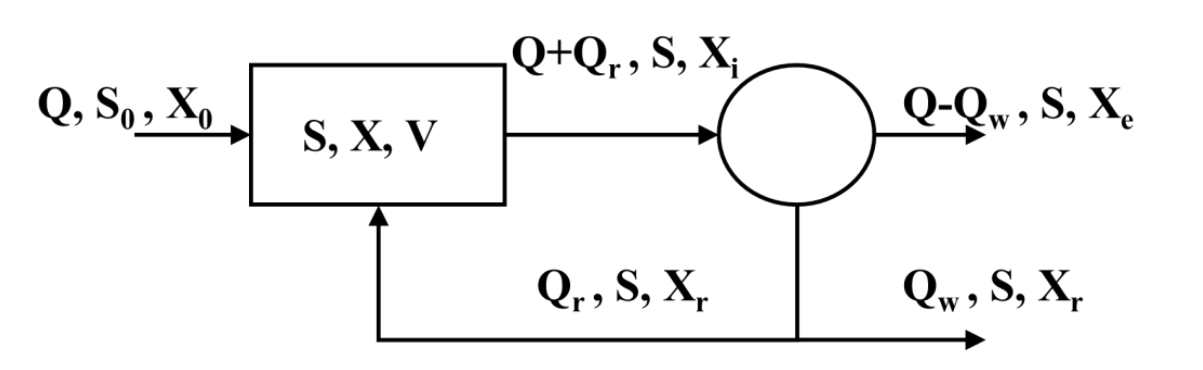
Consider the following figure of an activated sludge process (ASP), depicting the flow (Q), substrate (S), and microorganism concentration (X) at various points in the system, where subscripts “0”, “r”, “w”, “e”, and “i” indicate influent, recycle line, wastage, effluent, and flow from aeration tank to settling tank, respectively. Note that influent to the ASP has microbes too. V is volume of aeration tank. Choose the correct option for net rate of formation of microorganisms in the system at steady state, from the following

Source question diagram

Open complete paper
4
2021 · Environmental Science & Engineering · Water & Wastewater Treatment and Management · Sewerage and Sewage Treatment
Environmental Science & Engineering (ES) 2021
Which of the following causes ‘Type-I’ settling in a sedimentation tank?
Open complete paper
5
2021 · Environmental Science & Engineering · Water & Wastewater Treatment and Management · Sewerage and Sewage Treatment
Environmental Science & Engineering (ES) 2021
A sewage treatment plant (STP) receives sewage at a flow rate of 20000 m³ per day. The sewage has 200 mg/L of suspended solids. Assume 60 % suspended solids are removed in the primary clarifier. The underflow (i.e. sludge) removed from the clarifier contains 5 % solids (by weight).
The daily volume of the sludge generated will be ______ m³ per day.
Assume sludge density = 1000 kg/m³.
Open complete paper
6
2021 · Environmental Science & Engineering · Water & Wastewater Treatment and Management · Sewerage and Sewage Treatment
Environmental Science & Engineering (ES) 2021
A 900 mm internal diameter sewer is laid at a slope of 0.004 and has an actual flow of 0.15 m³/s. Assuming Manning’s roughness coefficient to be 0.013, the ratio of the actual flow to the flow when the sewer is running full is ______________ (rounded off to two decimal places).
Take π = 3.14.
Open complete paper
7
2026 · Environmental Science & Engineering · Water & Wastewater Treatment and Management · Sewerage and Sewage Treatment
Environmental Science & Engineering (ES) 2026
Which of the following processes is/are primarily used to remove the organic matter in sludge?
Open complete paper