My Cart
Your Cart 0

    Your cart is empty.

  • Total (Amount) ₹0.00
Previous year question hub

Groundwater Resources - Water Resources and Environmental Hydraulics - Environmental Science & Engineering Previous Year Questions

Practice Groundwater Resources - Water Resources and Environmental Hydraulics - Environmental Science & Engineering previous year questions organised from real papers, with year-wise coverage and clear topic navigation.

6Papers
6Years
10Questions
1Topics

Groundwater Resources question pattern

Every graph below is calculated only from this selection.

Questions by year

Year-wise coverage for Groundwater Resources. Each bar uses a separate theme-derived color.

Difficulty distribution

How the classified questions are distributed by difficulty.

Easy 5 50%
Medium 5 50%

Question type distribution

MCQ, numerical, multiple-select and other formats found in these papers.

Numerical Answer Type (NAT) 7 70%
MCQ 3 30%

Subject weightage

Top subjects by unique question coverage.

Environmental Science & Engineering
10 Qs

Most asked topics

Top topics across the included previous year papers.

Water Resources and Environmental Hydraulics
10 Qs

Subtopic coverage

Top subtopics inside this exact selection.

Groundwater Resources
10 Qs

Paper coverage

Question coverage for the most populated papers. Every active PYP paper remains listed below.

Environmental Science & Engineering (ES) 2026
1 Qs
Environmental Science & Engineering (ES) 2025
2 Qs
Environmental Science & Engineering (ES) 2024
1 Qs
Environmental Science & Engineering (ES) 2023
1 Qs
Environmental Science & Engineering (ES) 2022
2 Qs
Environmental Science & Engineering (ES) 2021
3 Qs

Included previous year papers

Newest papers appear first. Sort by year, question coverage or name.

PaperYear / sessionQuestions in this viewOpen
Environmental Science & Engineering (ES) 202620261View paper
Environmental Science & Engineering (ES) 202520252View paper
Environmental Science & Engineering (ES) 202420241View paper
Environmental Science & Engineering (ES) 202320231View paper
Environmental Science & Engineering (ES) 202220222View paper
Environmental Science & Engineering (ES) 202120213View paper

All Groundwater Resources previous year questions

Practice every matching question in batches of 20, with every available option.

1
2024 · Environmental Science & Engineering · Water Resources and Environmental Hydraulics · Groundwater Resources
Environmental Science & Engineering (ES) 2024
Consider two horizontal layers of an aquifer as shown in figure. Each layer is isotropic and homogeneous. Flow is parallel to the stratification. Thickness and horizontal hydraulic conductivity of layer-1 are \(h_1\) and \(K_1\), respectively. Thickness and horizontal hydraulic conductivity of layer-2 are \(h_2\) and \(K_2\), respectively, where \(h_1\) is not equal to \(h_2\). The equivalent horizontal conductivity \(K_x\) for the aquifer system is given by ______.
Open complete paper
2
2025 · Environmental Science & Engineering · Water Resources and Environmental Hydraulics · Groundwater Resources
Environmental Science & Engineering (ES) 2025
An unconfined aquifer of areal extent 20 km × 20 km has hydraulic conductivity of 4 m/day, porosity of 0.32, and storage coefficient (specific yield) of 0.18. If the initial saturated thickness of the aquifer is 30 m, and 4×10⁶ m³ of water is extracted from the aquifer, then the decline in the saturated thickness is __________ m. (rounded off to two decimal places)
Open complete paper
3
2025 · Environmental Science & Engineering · Water Resources and Environmental Hydraulics · Groundwater Resources
Environmental Science & Engineering (ES) 2025
A homogeneous isotropic confined aquifer of uniform thickness 30 m has hydraulic conductivity of 5 m/day and porosity of 0.3. There are two observation wells X and Y along a radial line from a fully penetrating pumping well at 100 m and 200 m distance, respectively. The well is pumped at a uniform rate to produce steady drawdown of 5 m at X and 3 m at Y. If a non-reactive pollutant enters at the observation well Y, then the time taken by the pollutant (under advection) to reach the observation well X is __________ days. (rounded off to two decimal places)
Open complete paper
4
2021 · Environmental Science & Engineering · Water Resources and Environmental Hydraulics · Groundwater Resources
Environmental Science & Engineering (ES) 2021
If \(d\) is the depth of an aquifer through which water is flowing, then the relationship between permeability \(K\) and transmissibility (also known as transmissivity) \(T\) is given by __________.
Open complete paper
5
2021 · Environmental Science & Engineering · Water Resources and Environmental Hydraulics · Groundwater Resources
Environmental Science & Engineering (ES) 2021
In a field test of a geological formation of permeable soil (porosity = 20 %), the hydraulic gradient was found to be 2 %. The actual seepage velocity of the flow was found to be 0.0025 m/s. Assume that the flow is in the laminar regime. The permeability (K) of the aquifer is ______________ m/s (rounded off to three decimal places).
Open complete paper
6
2021 · Environmental Science & Engineering · Water Resources and Environmental Hydraulics · Groundwater Resources
Environmental Science & Engineering (ES) 2021
An underground hazardous waste storage tank is leaking. The contaminant concentration directly beneath the site is 0.5 mg/L. The contaminant is travelling at an effective rate of 0.4 m per day towards a water well which is 2 km away.
Assume that the degradation of the contaminant follows a first order reaction, and the initial concentration of the contaminant becomes half in 10 years.
In this case, the contaminant concentration expected at the well under steady state conditions is ______________ mg/L (rounded off to two decimal places).
Open complete paper
7
2022 · Environmental Science & Engineering · Water Resources and Environmental Hydraulics · Groundwater Resources
Environmental Science & Engineering (ES) 2022

The correct order of hydraulic conductivity for the geologic formations is

Open complete paper
8
2022 · Environmental Science & Engineering · Water Resources and Environmental Hydraulics · Groundwater Resources
Environmental Science & Engineering (ES) 2022
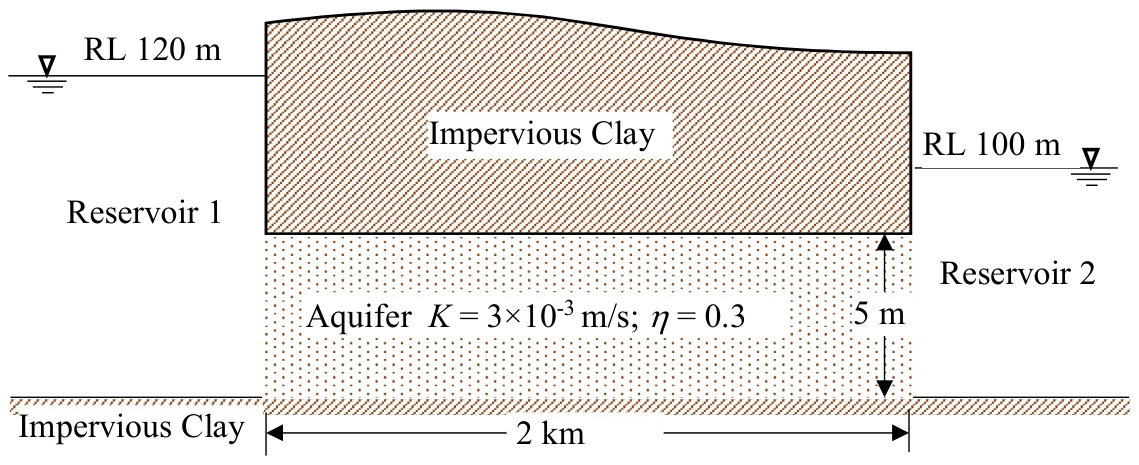
Two reservoirs having a difference of 20 m in their water surface elevations are connected through a confined aquifer (thickness = 5 m, length = 2 km, hydraulic conductivity \( K = 3 \times 10^{-3} \) m/s, and porosity \( \eta = 0.3 \)) as shown in the following figure (draw not to scale). If the Reservoir 1 is contaminated by a pollutant then the time (in days, rounded off to one decimal place) taken by the pollutant to reach to the Reservoir 2 under advection will be __________.

Question source image

Open complete paper
9
2023 · Environmental Science & Engineering · Water Resources and Environmental Hydraulics · Groundwater Resources
Environmental Science & Engineering (ES) 2023
A fully penetrating well is installed in a homogenous and isotropic confined aquifer. The aquifer has uniform thickness of 16 m and hydraulic conductivity of 25 m/d. Water is being pumped out from the well at a constant rate of 0.1 m³/s till steady state condition is reached. If a drawdown of 3.5 m is observed at a distance of 75 m from the well then the drawdown at a distance of 150 m from the well will be ______________ (in m, rounded off to two decimal places).
Open complete paper
10
2026 · Environmental Science & Engineering · Water Resources and Environmental Hydraulics · Groundwater Resources
Environmental Science & Engineering (ES) 2026
A well penetrates an unconfined aquifer. The water level (i.e., head) in the well prior to pumping is 25 m. After a long period of pumping at a constant rate of 0.05 m3/s, the drawdowns at distances of 50 m and 150 m from the well are observed to be 3 m and 1.2 m, respectively.
The hydraulic conductivity of the unconfined aquifer is _____ × 10−4 m/s (rounded off to two decimal places).
Consider π = 3.14.
Open complete paper