My Cart
Your Cart 0

    Your cart is empty.

  • Total (Amount) ₹0.00
Previous year question hub

Municipal solid waste management - Solid and Hazardous Waste Management - Environmental Science & Engineering Previous Year Questions

Practice Municipal solid waste management - Solid and Hazardous Waste Management - Environmental Science & Engineering previous year questions organised from real papers, with year-wise coverage and clear topic navigation.

6Papers
6Years
21Questions
1Topics

Municipal solid waste management question pattern

Every graph below is calculated only from this selection.

Questions by year

Year-wise coverage for Municipal solid waste management. Each bar uses a separate theme-derived color.

Difficulty distribution

How the classified questions are distributed by difficulty.

Medium 11 52.4%
Easy 10 47.6%

Question type distribution

MCQ, numerical, multiple-select and other formats found in these papers.

Numerical Answer Type (NAT) 11 52.4%
MCQ 8 38.1%
MSQ 2 9.5%

Subject weightage

Top subjects by unique question coverage.

Environmental Science & Engineering
21 Qs

Most asked topics

Top topics across the included previous year papers.

Solid and Hazardous Waste Management
21 Qs

Subtopic coverage

Top subtopics inside this exact selection.

Municipal solid waste management
21 Qs

Paper coverage

Question coverage for the most populated papers. Every active PYP paper remains listed below.

Environmental Science & Engineering (ES) 2026
3 Qs
Environmental Science & Engineering (ES) 2025
3 Qs
Environmental Science & Engineering (ES) 2024
5 Qs
Environmental Science & Engineering (ES) 2023
2 Qs
Environmental Science & Engineering (ES) 2022
3 Qs
Environmental Science & Engineering (ES) 2021
5 Qs

Included previous year papers

Newest papers appear first. Sort by year, question coverage or name.

PaperYear / sessionQuestions in this viewOpen
Environmental Science & Engineering (ES) 202620263View paper
Environmental Science & Engineering (ES) 202520253View paper
Environmental Science & Engineering (ES) 202420245View paper
Environmental Science & Engineering (ES) 202320232View paper
Environmental Science & Engineering (ES) 202220223View paper
Environmental Science & Engineering (ES) 202120215View paper

All Municipal solid waste management previous year questions

Practice every matching question in batches of 20, with every available option.

1
2024 · Environmental Science & Engineering · Solid and Hazardous Waste Management · Municipal solid waste management
Environmental Science & Engineering (ES) 2024
The costliest functional element in an urban centralized Municipal Solid Waste management infrastructure for a typical Indian Tier I city is ______.
Open complete paper
2
2024 · Environmental Science & Engineering · Solid and Hazardous Waste Management · Municipal solid waste management
Environmental Science & Engineering (ES) 2024
A municipal solid waste digester generates 1000 kg of methane gas. The volume of the tank needed to store this gas at 30 °C and 3 atmospheric pressure is ______ liters (an integer value). Use R=0.082 L-atm/mole-K, Atomic weights of C=12, and H=1
Open complete paper
3
2024 · Environmental Science & Engineering · Solid and Hazardous Waste Management · Municipal solid waste management
Environmental Science & Engineering (ES) 2024
Two hypothetical organic waste streams A and B are mixed prior to the composting process. Waste-A has 2.16% of C and 1.20% of N. Waste-B has 19.10% of C and 0.14% of N. The quantity of Waste-B that should be mixed with per kg of Waste-A to achieve the desired C:N ratio of 25 is __________ kg (rounded off to 2 decimal places).
Assume both the waste streams are completely dry.
Open complete paper
4
2024 · Environmental Science & Engineering · Solid and Hazardous Waste Management · Municipal solid waste management
Environmental Science & Engineering (ES) 2024
Food waste, paper waste and plastic waste have typical densities of 280 kg/m³, 80 kg/m³, and 50 kg/m³, respectively. The mixed waste is composed of 70% food waste, 20% paper waste and 10% plastic waste. The density of the mixed waste is ______ kg/m³ (rounded off to 2 decimal places).
Neglect compaction effect.
Open complete paper
5
2024 · Environmental Science & Engineering · Solid and Hazardous Waste Management · Municipal solid waste management
Environmental Science & Engineering (ES) 2024
For a biodegradable waste with a chemical formula C₆₀H₁₀₀O₆₀N, the maximum theoretical methane production per ton of waste is ______ kg (rounded off to 2 decimal places).
Assume 100% anaerobic conversion. Atomic weights of C-12; H-1; O-16; N-14
Open complete paper
6
2025 · Environmental Science & Engineering · Solid and Hazardous Waste Management · Municipal solid waste management
Environmental Science & Engineering (ES) 2025

Which option gives the components that are most likely to be present in the segregated combustible fraction (SCF) separated from raw mixed municipal solid waste (MSW)?

Open complete paper
7
2025 · Environmental Science & Engineering · Solid and Hazardous Waste Management · Municipal solid waste management
Environmental Science & Engineering (ES) 2025

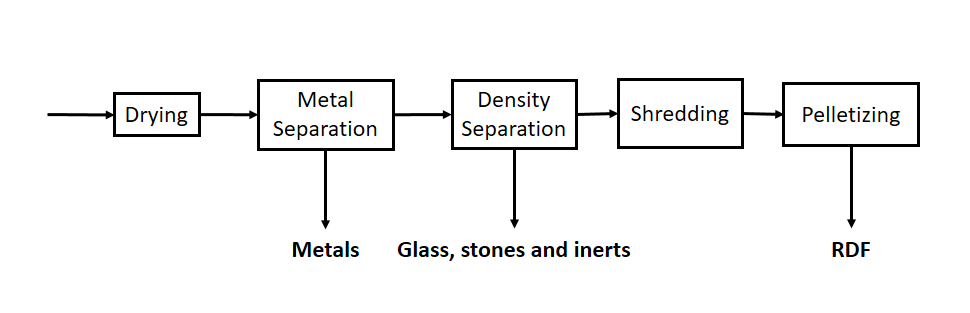
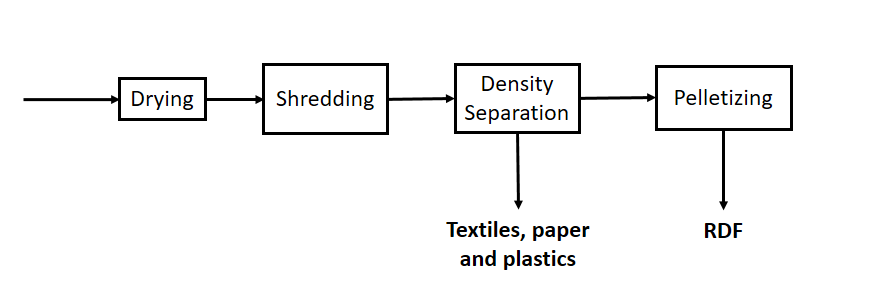
Choose the option(s) giving the correct process flow-sheet for producing refuse derived fuel (RDF) from the segregated waste collected in the dry waste containers (blue coloured containers of the municipal solid waste (MSW) collection scheme).

Open complete paper
8
2025 · Environmental Science & Engineering · Solid and Hazardous Waste Management · Municipal solid waste management
Environmental Science & Engineering (ES) 2025
A solid waste of composition C₆₀H₁₃₅O₄₀N is to be composted aerobically in a closed vessel mechanical composting facility. Given: all ammonia generated escapes the facility; air contains 23% of Oxygen by weight; 100% excess air requirement for the closed vessel composting facility. The atomic weights: C – 12, H – 1, O – 16, N – 14. The actual air required for composting is ______ kg per kg waste. (rounded off to one decimal place)
Open complete paper
9
2021 · Environmental Science & Engineering · Solid and Hazardous Waste Management · Municipal solid waste management
Environmental Science & Engineering (ES) 2021
Choose the correct order of biodegradability (highest to lowest) of the following municipal solid waste components.
Open complete paper
10
2021 · Environmental Science & Engineering · Solid and Hazardous Waste Management · Municipal solid waste management
Environmental Science & Engineering (ES) 2021
In proximate analysis, when a 10 kg moisture-free solid sample is heated in a furnace at 950 °C in the absence of air, its mass is reduced by 6 kg. If the same 10 kg moisture-free solid sample is heated in the furnace at the same temperature in the presence of air, its mass is reduced by 7 kg. The percentage of fixed carbon in the sample is __________.
Open complete paper
11
2021 · Environmental Science & Engineering · Solid and Hazardous Waste Management · Municipal solid waste management
Environmental Science & Engineering (ES) 2021
In context of municipal solid waste treatment, match the equipment in List I with their function in List II.
Open complete paper
12
2021 · Environmental Science & Engineering · Solid and Hazardous Waste Management · Municipal solid waste management
Environmental Science & Engineering (ES) 2021
The municipal solid waste (MSW) generated in a community (population = 100000) is disposed on a 12×10⁴ m² landfill site, which can be filled to a total depth of 25 m (including soil cover). Assume that MSW is generated at a rate of 2.5 kg per person per day and its compacted density is 800 kg/m³. If the volumetric ratio of MSW and soil cover is 5:1, the useful life of the landfill site is ______________ years (rounded off to the nearest integer).
Open complete paper
13
2021 · Environmental Science & Engineering · Solid and Hazardous Waste Management · Municipal solid waste management
Environmental Science & Engineering (ES) 2021
A mechanized stationary container system is proposed for waste collection from a commercial area. The container unloading time is 0.1 hours per container. There are two containers at each location and the drive time between the two locations is 0.2 hours. The maximum waste ‘pick-up time’ is 2.4 hours per trip.
The ‘pick-up time’ starts at the instant the truck arrives at the first pick-up location and ends when the last container on the route is emptied. The maximum number of locations which can be covered in a trip by the collection vehicle are ______________ (answer in integer).
Open complete paper
14
2022 · Environmental Science & Engineering · Solid and Hazardous Waste Management · Municipal solid waste management
Environmental Science & Engineering (ES) 2022
Leachate generated from a legacy municipal solid waste dumping site has to be collected and managed carefully. Which one of the following statements is correct in the context of treatment of leachate from such a site?
Open complete paper
15
2022 · Environmental Science & Engineering · Solid and Hazardous Waste Management · Municipal solid waste management
Environmental Science & Engineering (ES) 2022
Biodegradable wastes like vegetable peelings from kitchen are usually processed by composting techniques. Which of the following option(s) regarding the processing of biodegradable wastes is/are correct?
Open complete paper
16
2022 · Environmental Science & Engineering · Solid and Hazardous Waste Management · Municipal solid waste management
Environmental Science & Engineering (ES) 2022
Figure below gives the heat inflow into the furnace of a waste-to-energy plant along with the heat outflows from the furnace. Assume: (i) total heat loss equal to 3% of heat released while burning waste, (ii) sensible heat of the waste is negligible, (iii) complete burning of the waste is ensured. If the waste feed rate into this plant is 70 kg/h, the heat content of the waste (in kcal/kg, rounded off to one decimal place) is __________.

Question source image

Question source image

Open complete paper
17
2023 · Environmental Science & Engineering · Solid and Hazardous Waste Management · Municipal solid waste management
Environmental Science & Engineering (ES) 2023
Read the following statements about aerobic composting of organic fraction of municipal solid waste
I. The majority of the odour problem in an aerobic composting process is due to the development of anaerobic conditions within the compost pile.
II. All organic carbon present in the waste will completely biodegrade in 14 days.
III. At high C/N ratio, ammonia would be released and biological activity may also be impeded.
IV. Optimum moisture content for aerobic composting process would be 50–60%. Lower moisture would slow down the biological process. Excessive moisture will make it difficult to maintain aerobic conditions.
The correct choice(s) is/are
Open complete paper
18
2023 · Environmental Science & Engineering · Solid and Hazardous Waste Management · Municipal solid waste management
Environmental Science & Engineering (ES) 2023
Ultimate analysis of a municipal solid waste sample is given below
Percent by weight
CarbonHydrogenOxygenNitrogenAsh
4863565

For 1 kg of the municipal solid waste burnt, assuming that air contains only nitrogen and oxygen, maximum CO2 emitted is __________ (in kg, rounded off to three decimal places).
Open complete paper
19
2026 · Environmental Science & Engineering · Solid and Hazardous Waste Management · Municipal solid waste management
Environmental Science & Engineering (ES) 2026
Which ONE of the following options is NOT a parameter as a part of proximate analysis of municipal solid waste?
Open complete paper
20
2026 · Environmental Science & Engineering · Solid and Hazardous Waste Management · Municipal solid waste management
Environmental Science & Engineering (ES) 2026
An anaerobic digestion system is operated for methane gas generation from organic fraction of municipal solid waste (OFMSW). The moisture content and volatile solids (VS) content of OFMSW are 20% and 90%, respectively. The biodegradable volatile solids (BVS) in the VS is 70%, and the BVS conversion efficiency to methane gas is 85%.
If the methane gas generation in the system is 12 m3 per kg of BVS converted, the total volume of gas produced from one kilogram of OFMSW is _____ m3 (rounded off to two decimal places).
Open complete paper

Showing 20 of 21 questions