My Cart
Your Cart 0

    Your cart is empty.

  • Total (Amount) ₹0.00
Previous year question hub

Reaction Kinetics and Diffusion - Thermodynamics, Kinetics and Phase Transformations - Engineering Sciences Previous Year Questions

Practice Reaction Kinetics and Diffusion - Thermodynamics, Kinetics and Phase Transformations - Engineering Sciences previous year questions organised from real papers, with year-wise coverage and clear topic navigation.

15Papers
15Years
18Questions
1Topics

Reaction Kinetics and Diffusion question pattern

Every graph below is calculated only from this selection.

Questions by year

Year-wise coverage for Reaction Kinetics and Diffusion. Each bar uses a separate theme-derived color.

Difficulty distribution

How the classified questions are distributed by difficulty.

Medium 11 61.1%
Easy 7 38.9%

Question type distribution

MCQ, numerical, multiple-select and other formats found in these papers.

Numerical Answer Type (NAT) 9 50%
MCQ 7 38.9%
MSQ 2 11.1%

Subject weightage

Top subjects by unique question coverage.

Engineering Sciences
18 Qs

Most asked topics

Top topics across the included previous year papers.

Thermodynamics, Kinetics and Phase Transformations
18 Qs

Subtopic coverage

Top subtopics inside this exact selection.

Reaction Kinetics and Diffusion
18 Qs

Paper coverage

Question coverage for the most populated papers. Every active PYP paper remains listed below.

Engineering Sciences (XE) 2026
2 Qs
Engineering Sciences (XE) 2024
1 Qs
Engineering Sciences (XE) 2023
2 Qs
Engineering Sciences (XE) 2022
1 Qs
Engineering Sciences (XE) 2020
1 Qs
Engineering Sciences (XE) 2019
1 Qs
Engineering Sciences (XE) 2018
1 Qs
Engineering Sciences (XE) 2017
1 Qs
Engineering Sciences (XE) 2016
1 Qs
Engineering Sciences (XE) 2015
1 Qs
Engineering Sciences (XE) 2014
1 Qs
Engineering Sciences (XE) 2013
1 Qs
Engineering Sciences (XE) 2011
1 Qs
Engineering Sciences (XE) 2008
2 Qs
Engineering Sciences (XE) 2007
1 Qs

Included previous year papers

Newest papers appear first. Sort by year, question coverage or name.

PaperYear / sessionQuestions in this viewOpen
Engineering Sciences (XE) 202620262View paper
Engineering Sciences (XE) 202420241View paper
Engineering Sciences (XE) 202320232View paper
Engineering Sciences (XE) 202220221View paper
Engineering Sciences (XE) 202020201View paper
Engineering Sciences (XE) 201920191View paper
Engineering Sciences (XE) 201820181View paper
Engineering Sciences (XE) 201720171View paper
Engineering Sciences (XE) 201620161View paper
Engineering Sciences (XE) 201520151View paper
Engineering Sciences (XE) 201420141View paper
Engineering Sciences (XE) 201320131View paper
Engineering Sciences (XE) 201120111View paper
Engineering Sciences (XE) 200820082View paper
Engineering Sciences (XE) 200720071View paper

All Reaction Kinetics and Diffusion previous year questions

Practice every matching question in batches of 20, with every available option.

1
2007 · Engineering Sciences · Thermodynamics, Kinetics and Phase Transformations · Reaction Kinetics and Diffusion
Engineering Sciences (XE) 2007
In a material, which of the following diffusion mechanisms would have lowest activation energy ?
Open complete paper
2
2008 · Engineering Sciences · Thermodynamics, Kinetics and Phase Transformations · Reaction Kinetics and Diffusion
Engineering Sciences (XE) 2008

The characteristic diffusion distance in a material with diffusivity “D” in time “t” is proportional to

Open complete paper
3
2008 · Engineering Sciences · Thermodynamics, Kinetics and Phase Transformations · Reaction Kinetics and Diffusion
Engineering Sciences (XE) 2008
The extent of reaction will be
Open complete paper
4
2011 · Engineering Sciences · Thermodynamics, Kinetics and Phase Transformations · Reaction Kinetics and Diffusion
Engineering Sciences (XE) 2011
It takes 4 h for carburising a steel at 900°C. If the same carburising is to be accomplished in 2 h, what should be the temperature? The activation energy of diffusion of carbon in the steel is 151 kJ mol-1.
Open complete paper
5
2013 · Engineering Sciences · Thermodynamics, Kinetics and Phase Transformations · Reaction Kinetics and Diffusion
Engineering Sciences (XE) 2013
As temperature increases, diffusivity of an atom in a solid material,
Open complete paper
6
2014 · Engineering Sciences · Thermodynamics, Kinetics and Phase Transformations · Reaction Kinetics and Diffusion
Engineering Sciences (XE) 2014
The diffusion coefficients of Mg in Al at 500 and 550 °C are 1.9x10⁻¹³ and 5.8x10⁻¹³ m2/s respectively. The activation energy for diffusion of Mg in Al in kJ/mol is__________.
Open complete paper
7
2015 · Engineering Sciences · Thermodynamics, Kinetics and Phase Transformations · Reaction Kinetics and Diffusion
Engineering Sciences (XE) 2015
The diffusion coefficient of copper atoms in aluminium is found to be 1.28 x 10⁻²² m2s-1 at T=400K and 5.75 x 10⁻¹⁹ m2s-1 at T=500K. Find the temperature (in Kelvin) at which the value of the diffusion coefficient is 10-16 m2s-1
Open complete paper
8
2016 · Engineering Sciences · Thermodynamics, Kinetics and Phase Transformations · Reaction Kinetics and Diffusion
Engineering Sciences (XE) 2016
Gallium is to be diffused into pure silicon wafer such that its concentration at a depth of \(10^{-3}\) cm will be one half the surface concentration. Given that the diffusion coefficient (D) of gallium in silicon at 1355 °C is \(6 \times 10^{-11}\) cm\(^2\) s\(^{-1}\), the time the silicon wafer should be heated in contact with gallium vapour at 1355 °C is __________ s.
(Given: \(erf(0.5) \approx 0.5\))
Open complete paper
9
2017 · Engineering Sciences · Thermodynamics, Kinetics and Phase Transformations · Reaction Kinetics and Diffusion
Engineering Sciences (XE) 2017
The value of diffusivity (D) for the diffusion of carbon (C) in γ-iron at 727 °C is………x10-13 m2/s (Given Do = 2x10⁻⁵ m2/s; activation energy, Q = 142 kJ/mol; R = 8.314 J/mol. K)
Open complete paper
10
2018 · Engineering Sciences · Thermodynamics, Kinetics and Phase Transformations · Reaction Kinetics and Diffusion
Engineering Sciences (XE) 2018
Mild steel is carburized at 1300 K for 1 hour to obtain a certain case depth. Keeping the time as 1 hour, the case depth can be doubled by increasing the temperature to ______ K (round off to the nearest whole number)
(Given: Activation energy Q = 148 kJ mol⁻¹, Gas constant, R = 8.314 J mol⁻¹ K⁻¹)
Open complete paper
11
2019 · Engineering Sciences · Thermodynamics, Kinetics and Phase Transformations · Reaction Kinetics and Diffusion
Engineering Sciences (XE) 2019
Copper is diffused into aluminium at 400 °C for 100 hours to obtain a certain concentration at a given depth. In another experiment conducted at 500 °C, to achieve the same concentration of copper at the same depth, the time required in hours is
(Given: Diffusion coefficients of copper in aluminium at 400 °C and 500 °C are 5 × 10⁻¹⁴ m² s⁻¹ and 6 × 10⁻¹³ m² s⁻¹, respectively)
Open complete paper
12
2020 · Engineering Sciences · Thermodynamics, Kinetics and Phase Transformations · Reaction Kinetics and Diffusion
Engineering Sciences (XE) 2020
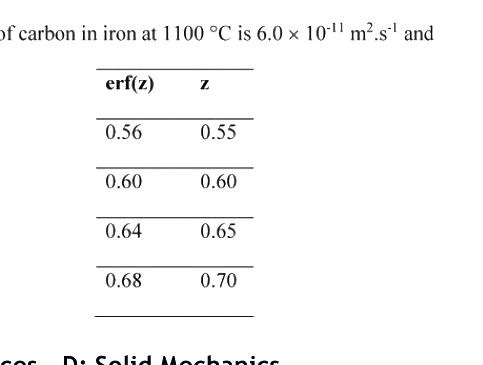
A plain carbon steel sample containing 0.1 wt% carbon is undergoing carburization at 1100 °C in a carbon rich surroundings with fixed carbon content of 1.0 wt% all the time. The carburization time necessary to achieve a carbon concentration of 0.46 wt% at a depth of 5 mm at 1100 °C is ______ hour (round off to the nearest integer). Given: Diffusivity of carbon in iron at 1100 °C is 6.0 × 10⁻¹¹ m².s⁻¹ and

Question diagram

Open complete paper
13
2022 · Engineering Sciences · Thermodynamics, Kinetics and Phase Transformations · Reaction Kinetics and Diffusion
Engineering Sciences (XE) 2022
It is known that component A diffuses into a solid to a depth of 10 μm in 1 hour at 300 K. Treat diffusion in one dimension. The time taken for A to diffuse to the same depth at 600 K is __________ seconds. (Round off to 1 decimal).
Diffusivity of A in the solid is given by
\[ D_A = D_A^0 \exp\left(-\frac{E_a}{k_B T}\right) \]
\( D_A^0 \): Diffusivity coefficient
\( E_a \): Activation energy = 0.3 eV
\( k_B \): Boltzmann’s constant = 8.62×10⁻⁵ eV/K
\( T \): Absolute temperature
Open complete paper
14
2023 · Engineering Sciences · Thermodynamics, Kinetics and Phase Transformations · Reaction Kinetics and Diffusion
Engineering Sciences (XE) 2023
A metal has a certain vacancy fraction at a temperature of 600 K. On increasing the temperature to 900 K, the vacancy fraction increases by a factor of ______ (rounded off to one decimal place)
Given: Gas constant, R = 8.31 J mol^{-1}K^{-1} and activation energy for vacancy formation, Q = 68 kJ mol^{-1}
Open complete paper
15
2023 · Engineering Sciences · Thermodynamics, Kinetics and Phase Transformations · Reaction Kinetics and Diffusion
Engineering Sciences (XE) 2023
A pure Silicon wafer is doped with Boron by exposing it to \(B_2O_3\) vapour at an elevated temperature. It takes 1000 seconds to reach a Boron concentration of \(10^{20} atoms\ m^{-3}\) at a depth of 1 \(\mu m\). The time taken to reach the same concentration of Boron at a depth of 2 \(\mu m\) is (in seconds): __________ (rounded off to nearest integer) Given: Boron concentration on the wafer surface remains constant.
Open complete paper
16
2024 · Engineering Sciences · Thermodynamics, Kinetics and Phase Transformations · Reaction Kinetics and Diffusion
Engineering Sciences (XE) 2024

Given that k is the first order reaction rate constant and T is the temperature in absolute scale, the temperature dependence of rate constant is/are represented by

Open complete paper
17
2026 · Engineering Sciences · Thermodynamics, Kinetics and Phase Transformations · Reaction Kinetics and Diffusion
Engineering Sciences (XE) 2026

Which of the following statements is/are applicable to Fick’s second law:

Open complete paper
18
2026 · Engineering Sciences · Thermodynamics, Kinetics and Phase Transformations · Reaction Kinetics and Diffusion
Engineering Sciences (XE) 2026
A radioactive isotope sample has a decay constant \(\lambda = 2.31 \times 10^{-4} \text{ year}^{-1}\). Initially the sample contains \(8000 \times 10^{15}\) atoms. The sample decays to 25% of its initial value. The number of years it takes to decay to this stage is closest to __________
Open complete paper