My Cart
Your Cart 0

    Your cart is empty.

  • Total (Amount) ₹0.00
Previous year question hub

Nucleation, Solidification and Phase Transformations - Thermodynamics, Kinetics and Phase Transformations - Engineering Sciences Previous Year Questions

Practice Nucleation, Solidification and Phase Transformations - Thermodynamics, Kinetics and Phase Transformations - Engineering Sciences previous year questions organised from real papers, with year-wise coverage and clear topic navigation.

9Papers
9Years
12Questions
1Topics

Nucleation, Solidification and Phase Transformations question pattern

Every graph below is calculated only from this selection.

Questions by year

Year-wise coverage for Nucleation, Solidification and Phase Transformations. Each bar uses a separate theme-derived color.

Difficulty distribution

How the classified questions are distributed by difficulty.

Medium 7 58.3%
Easy 5 41.7%

Question type distribution

MCQ, numerical, multiple-select and other formats found in these papers.

MCQ 8 66.7%
Numerical Answer Type (NAT) 2 16.7%
MSQ 2 16.7%

Subject weightage

Top subjects by unique question coverage.

Engineering Sciences
12 Qs

Most asked topics

Top topics across the included previous year papers.

Thermodynamics, Kinetics and Phase Transformations
12 Qs

Subtopic coverage

Top subtopics inside this exact selection.

Nucleation, Solidification and Phase Transformations
12 Qs

Paper coverage

Question coverage for the most populated papers. Every active PYP paper remains listed below.

Engineering Sciences (XE) 2025
1 Qs
Engineering Sciences (XE) 2023
1 Qs
Engineering Sciences (XE) 2022
3 Qs
Engineering Sciences (XE) 2021
2 Qs
Engineering Sciences (XE) 2020
1 Qs
Engineering Sciences (XE) 2019
1 Qs
Engineering Sciences (XE) 2010
1 Qs
Engineering Sciences (XE) 2008
1 Qs
Engineering Sciences (XE) 2007
1 Qs

Included previous year papers

Newest papers appear first. Sort by year, question coverage or name.

PaperYear / sessionQuestions in this viewOpen
Engineering Sciences (XE) 202520251View paper
Engineering Sciences (XE) 202320231View paper
Engineering Sciences (XE) 202220223View paper
Engineering Sciences (XE) 202120212View paper
Engineering Sciences (XE) 202020201View paper
Engineering Sciences (XE) 201920191View paper
Engineering Sciences (XE) 201020101View paper
Engineering Sciences (XE) 200820081View paper
Engineering Sciences (XE) 200720071View paper

All Nucleation, Solidification and Phase Transformations previous year questions

Practice every matching question in batches of 20, with every available option.

1
2007 · Engineering Sciences · Thermodynamics, Kinetics and Phase Transformations · Nucleation, Solidification and Phase Transformations
Engineering Sciences (XE) 2007
Melting point of a metal is 1000 K and its enthalpy of melting is 2.0x10⁹ J.m-3. If the solid-liquid interface energy is 0.5 J.m-2, the radius of critical nucleus during solidification at 900 K would be
Open complete paper
2
2008 · Engineering Sciences · Thermodynamics, Kinetics and Phase Transformations · Nucleation, Solidification and Phase Transformations
Engineering Sciences (XE) 2008
What is the driving force for grain growth (stored grain boundary energy) just after recrystallization at 450°C in the given specimen?
Open complete paper
3
2010 · Engineering Sciences · Thermodynamics, Kinetics and Phase Transformations · Nucleation, Solidification and Phase Transformations
Engineering Sciences (XE) 2010
A plain carbon steel sample is water- quenched from 900°C to room temperature. Its microstructure will consist of
Open complete paper
4
2019 · Engineering Sciences · Thermodynamics, Kinetics and Phase Transformations · Nucleation, Solidification and Phase Transformations
Engineering Sciences (XE) 2019

Which one of the following conditions will NOT favour the separation of impurities in zone refining process?

Open complete paper
5
2020 · Engineering Sciences · Thermodynamics, Kinetics and Phase Transformations · Nucleation, Solidification and Phase Transformations
Engineering Sciences (XE) 2020
During homogeneous solidification of a liquid metal, the radius of critical nucleus (in nanometer, nm) at a temperature \(T_s\) which is below the melting point (\(T_m\)), is _________ nm (round-off to one decimal place). Given that \(\gamma_{sl}\) (solid | liquid interfacial energy) is 0.18 J.m\(^{-2}\) and \(\Delta G_v\) (change in volume free energy upon transformation from liquid to solid) at \(T_s\) is \(0.18 \times 10^9\) J.m\(^{-3}\).
Open complete paper
6
2021 · Engineering Sciences · Thermodynamics, Kinetics and Phase Transformations · Nucleation, Solidification and Phase Transformations
Engineering Sciences (XE) 2021

A metal has a melting point of 600 °C. By rapid cooling, liquid metal can be made to solidify either at 500 °C or 400 °C or 300 °C. Critical size of the solid nuclei is

Open complete paper
7
2021 · Engineering Sciences · Thermodynamics, Kinetics and Phase Transformations · Nucleation, Solidification and Phase Transformations
Engineering Sciences (XE) 2021
Match the different transformations/reactions in Column I with the most suitable information in Column II.

Column I
(P) Eutectoid reaction
(Q) Martensitic transformation
(R) Precipitation reaction

Column II
(1) involves no diffusion
(2) one solid phase transforms into two solid phases
(3) occurs in supersaturated solutions
Open complete paper
8
2022 · Engineering Sciences · Thermodynamics, Kinetics and Phase Transformations · Nucleation, Solidification and Phase Transformations
Engineering Sciences (XE) 2022
During the ageing of a homogenized Al-Cu alloy (1 to 4 wt.% Cu) below the GP zone solvus, hardness of the alloy:
Open complete paper
9
2022 · Engineering Sciences · Thermodynamics, Kinetics and Phase Transformations · Nucleation, Solidification and Phase Transformations
Engineering Sciences (XE) 2022
For a diffusional transformation (i.e., growth of β precipitates in an α matrix), which of the following is/are true with increasing degree of undercooling?
Open complete paper
10
2022 · Engineering Sciences · Thermodynamics, Kinetics and Phase Transformations · Nucleation, Solidification and Phase Transformations
Engineering Sciences (XE) 2022
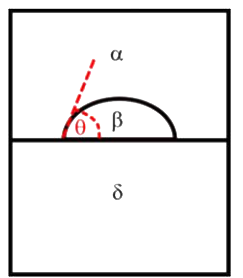
A spherical β particle nucleates from the α matrix on a non-deformable substrate δ, forming a contact angle of θ as shown in the schematic.
The value of \(\frac{\Delta G_{het}^*}{\Delta G_{hom}^*}\) is __________. (Round off to three decimal places)

\(\Delta G_{hom}^*\) = Gibbs free energy change at the critical radius for homogeneous nucleation
\(\Delta G_{het}^*\) = Gibbs free energy change at the critical radius for heterogeneous nucleation
α-β interfacial energy = 0.4 J/m²
α-δ interfacial energy = 0.3 J/m²
β-δ interfacial energy = 0.02 J/m²

Question diagram

Open complete paper
11
2023 · Engineering Sciences · Thermodynamics, Kinetics and Phase Transformations · Nucleation, Solidification and Phase Transformations
Engineering Sciences (XE) 2023
In age-hardening of an aluminium alloy, the purpose of solution treatment followed by quenching is to
Open complete paper
12
2025 · Engineering Sciences · Thermodynamics, Kinetics and Phase Transformations · Nucleation, Solidification and Phase Transformations
Engineering Sciences (XE) 2025

For Al – 4.5 wt% Cu alloy, the correct sequence of precipitation during age hardening at room temperature is

Open complete paper