My Cart
Your Cart 0

    Your cart is empty.

  • Total (Amount) ₹0.00
Previous year question hub

Thermodynamic Potentials and Property Relations - Thermodynamic Relations - Engineering Sciences Previous Year Questions

Practice Thermodynamic Potentials and Property Relations - Thermodynamic Relations - Engineering Sciences previous year questions organised from real papers, with year-wise coverage and clear topic navigation.

18Papers
18Years
40Questions
1Topics

Thermodynamic Potentials and Property Relations question pattern

Every graph below is calculated only from this selection.

Questions by year

Year-wise coverage for Thermodynamic Potentials and Property Relations. Each bar uses a separate theme-derived color.

Difficulty distribution

How the classified questions are distributed by difficulty.

Medium 23 57.5%
Easy 16 40%
Hard 1 2.5%
Question type distribution

MCQ, numerical, multiple-select and other formats found in these papers.

MCQ 37 92.5%
Numerical Answer Type (NAT) 3 7.5%

Subject weightage

Top subjects by unique question coverage.

Engineering Sciences
40 Qs

Most asked topics

Top topics across the included previous year papers.

Thermodynamic Relations
40 Qs

Subtopic coverage

Top subtopics inside this exact selection.

Thermodynamic Potentials and Property Relations
40 Qs

Paper coverage

Question coverage for the most populated papers. Every active PYP paper remains listed below.

Engineering Sciences (XE) 2026
4 Qs
Engineering Sciences (XE) 2025
2 Qs
Engineering Sciences (XE) 2024
5 Qs
Engineering Sciences (XE) 2022
2 Qs
Engineering Sciences (XE) 2021
4 Qs
Engineering Sciences (XE) 2019
3 Qs
Engineering Sciences (XE) 2018
1 Qs
Engineering Sciences (XE) 2017
2 Qs
Engineering Sciences (XE) 2016
1 Qs
Engineering Sciences (XE) 2015
1 Qs
Engineering Sciences (XE) 2014
1 Qs
Engineering Sciences (XE) 2013
3 Qs
Engineering Sciences (XE) 2012
3 Qs
Engineering Sciences (XE) 2011
1 Qs
Engineering Sciences (XE) 2010
1 Qs
Engineering Sciences (XE) 2009
1 Qs
Engineering Sciences (XE) 2008
3 Qs
Engineering Sciences (XE) 2007
2 Qs

Included previous year papers

Newest papers appear first. Sort by year, question coverage or name.

PaperYear / sessionQuestions in this viewOpen
Engineering Sciences (XE) 202620264View paper
Engineering Sciences (XE) 202520252View paper
Engineering Sciences (XE) 202420245View paper
Engineering Sciences (XE) 202220222View paper
Engineering Sciences (XE) 202120214View paper
Engineering Sciences (XE) 201920193View paper
Engineering Sciences (XE) 201820181View paper
Engineering Sciences (XE) 201720172View paper
Engineering Sciences (XE) 201620161View paper
Engineering Sciences (XE) 201520151View paper
Engineering Sciences (XE) 201420141View paper
Engineering Sciences (XE) 201320133View paper
Engineering Sciences (XE) 201220123View paper
Engineering Sciences (XE) 201120111View paper
Engineering Sciences (XE) 201020101View paper
Engineering Sciences (XE) 200920091View paper
Engineering Sciences (XE) 200820083View paper
Engineering Sciences (XE) 200720072View paper

All Thermodynamic Potentials and Property Relations previous year questions

Practice every matching question in batches of 20, with every available option.

1
2007 · Engineering Sciences · Thermodynamic Relations · Thermodynamic Potentials and Property Relations
Engineering Sciences (XE) 2007
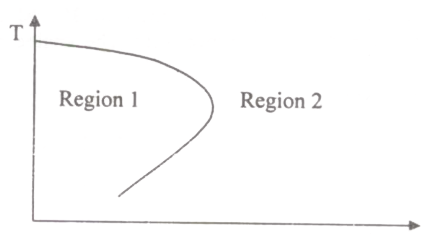
In the following T-p diagram, an inversion curve is shown. Which one of the following is correct?

Question diagram

Open complete paper
2
2007 · Engineering Sciences · Thermodynamic Relations · Thermodynamic Potentials and Property Relations
Engineering Sciences (XE) 2007
For a system containing an ideal gas, the difference between Gibbs function and Helmholtz function
Open complete paper
3
2008 · Engineering Sciences · Thermodynamic Relations · Thermodynamic Potentials and Property Relations
Engineering Sciences (XE) 2008
Which one of the following relations is wrong?
Open complete paper
4
2008 · Engineering Sciences · Thermodynamic Relations · Thermodynamic Potentials and Property Relations
Engineering Sciences (XE) 2008
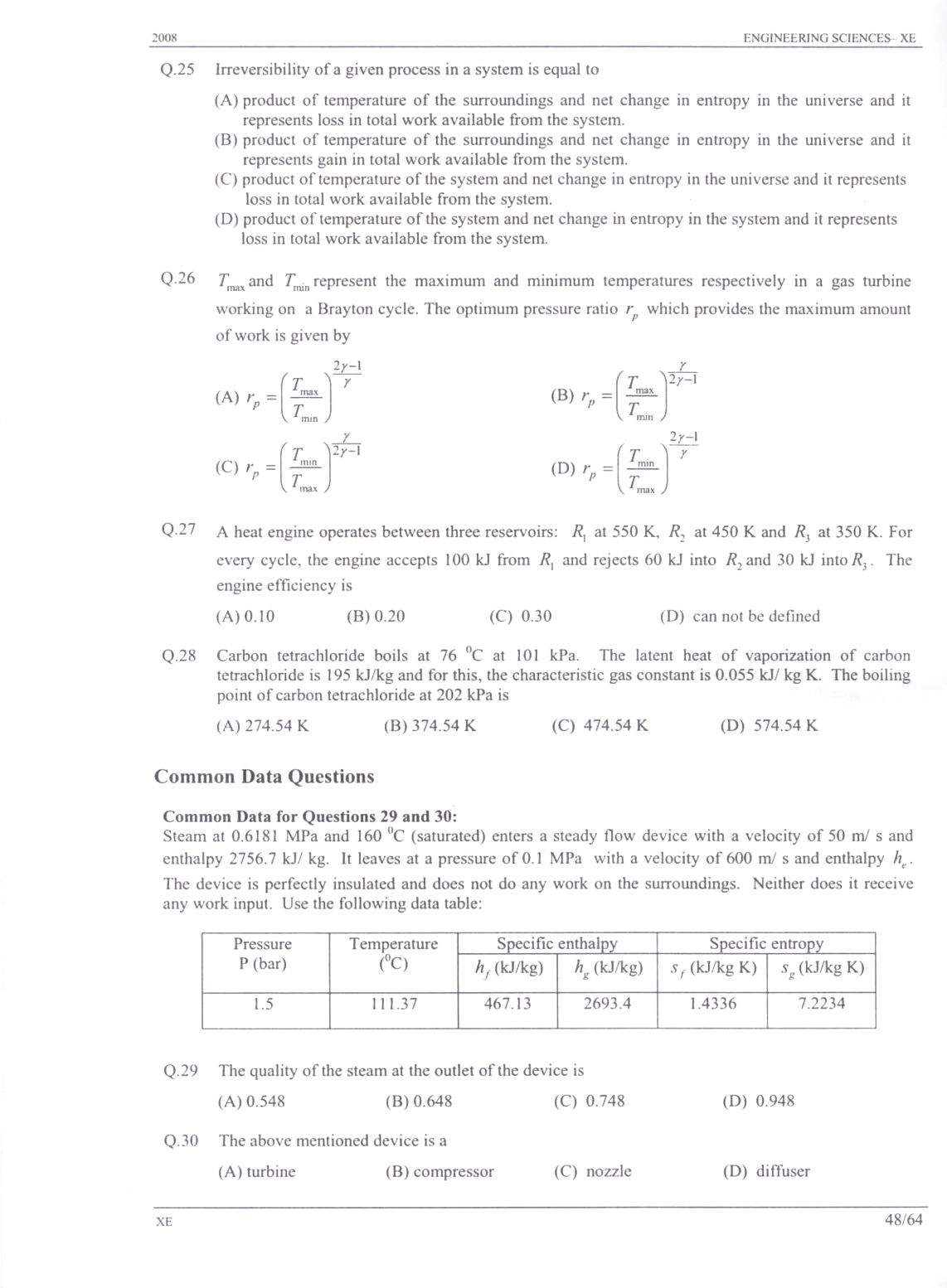
Carbon tetrachloride boils at 76 °C at 101 kPa. The latent heat of vaporization of carbon tetrachloride is 195 kJ/kg and for this, the characteristic gas constant is 0.055 kJ/kg·K. The boiling point of carbon tetrachloride at 202 kPa is

Question diagram

Open complete paper
5
2008 · Engineering Sciences · Thermodynamic Relations · Thermodynamic Potentials and Property Relations
Engineering Sciences (XE) 2008
The quality of the steam at the outlet of the device is

Question diagram

Open complete paper
6
2009 · Engineering Sciences · Thermodynamic Relations · Thermodynamic Potentials and Property Relations
Engineering Sciences (XE) 2009
Air (\( \gamma = 1.4 \)) is compressed ideally from an initial state of 1 bar, 300 K to a final temperature of 600 K. The value of the final pressure in bar is
Open complete paper
7
2010 · Engineering Sciences · Thermodynamic Relations · Thermodynamic Potentials and Property Relations
Engineering Sciences (XE) 2010
\(\left(\frac{\partial P}{\partial T}\right)_S\) is equal to
Open complete paper
8
2011 · Engineering Sciences · Thermodynamic Relations · Thermodynamic Potentials and Property Relations
Engineering Sciences (XE) 2011

Which one of the following expressions represents the Joule-Thomson coefficient?

Open complete paper
9
2012 · Engineering Sciences · Thermodynamic Relations · Thermodynamic Potentials and Property Relations
Engineering Sciences (XE) 2012
The slope of a Mollier diagram at constant pressure indicates
Open complete paper
10
2012 · Engineering Sciences · Thermodynamic Relations · Thermodynamic Potentials and Property Relations
Engineering Sciences (XE) 2012
Joule-Thomson coefficient for a gas, \(\mu_J\), obeying the relation \(p(v-b)=RT\) is
Open complete paper
11
2012 · Engineering Sciences · Thermodynamic Relations · Thermodynamic Potentials and Property Relations
Engineering Sciences (XE) 2012
The correct expression representing \(Z\) to be a thermodynamic property is
Open complete paper
12
2013 · Engineering Sciences · Thermodynamic Relations · Thermodynamic Potentials and Property Relations
Engineering Sciences (XE) 2013

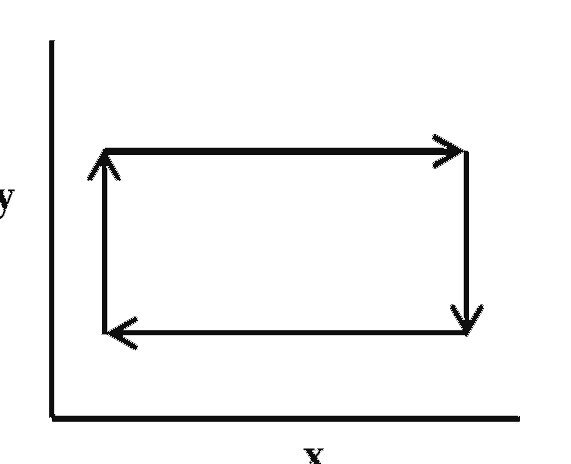
Which of the following processes, shown in the figure below, represents the throttling of an ideal gas?

Open complete paper
13
2013 · Engineering Sciences · Thermodynamic Relations · Thermodynamic Potentials and Property Relations
Engineering Sciences (XE) 2013
On a ln pvs h coordinate system, where ln p is the y-coordinate and h is the x coordinate, the slope of a constant entropy line is
Open complete paper
14
2013 · Engineering Sciences · Thermodynamic Relations · Thermodynamic Potentials and Property Relations
Engineering Sciences (XE) 2013
Starting from the definition of Gibbs free energy function g=h-Ts, the Maxwell relation that can be derived is
Open complete paper
15
2014 · Engineering Sciences · Thermodynamic Relations · Thermodynamic Potentials and Property Relations
Engineering Sciences (XE) 2014
The equation of state for a certain gas is given by \(v = RT / P - C_1 / T^2 + C_2\), where \(C_1\) is 50,000 (K3.m3)/kg and \(C_2\) is 0.8 m3/kg. The relation \(\left(\frac{\partial h}{\partial P}\right)_T = v - T \left(\frac{\partial v}{\partial T}\right)_p\) is known for the gas. The inversion temperature, given by the condition, \(\left(\frac{\partial h}{\partial P}\right)_T = 0\) is __________ K.
Open complete paper
16
2015 · Engineering Sciences · Thermodynamic Relations · Thermodynamic Potentials and Property Relations
Engineering Sciences (XE) 2015
For a real gas undergoing volume expansion through a porous plug with \(\alpha = \frac{1}{v}\left(\frac{\partial v}{\partial T}\right)_p\), the Joule-Thomson cooling effect is observed if
(A) \(0 < \alpha T < 1\)
(B) \(\alpha T = 1\)
(C) \(\alpha T > 1\)
(D) \(\alpha T = 0\)
Open complete paper
17
2016 · Engineering Sciences · Thermodynamic Relations · Thermodynamic Potentials and Property Relations
Engineering Sciences (XE) 2016
The Maxwell relation that results from the expression for the Helmholtz free energy \(A = U - TS\), is:
Open complete paper
18
2017 · Engineering Sciences · Thermodynamic Relations · Thermodynamic Potentials and Property Relations
Engineering Sciences (XE) 2017
Given the thermodynamic functional relations: \( p = p(v,T) \) and \( T = T(p,v) \), the term \( \frac{\partial p}{\partial v} \bigg|_T \times \frac{\partial v}{\partial T} \bigg|_p \) is equal to
Open complete paper
19
2017 · Engineering Sciences · Thermodynamic Relations · Thermodynamic Potentials and Property Relations
Engineering Sciences (XE) 2017
Given $d\phi = f(T)dT + (T/V)dV$ and $d\psi = Tdp + (T/p^2)dV$, then
Open complete paper
20
2018 · Engineering Sciences · Thermodynamic Relations · Thermodynamic Potentials and Property Relations
Engineering Sciences (XE) 2018
A gas obeys the following equation of state:
\( P(\bar{v}-b)=R T+\frac{a P^{2}}{T} \), where \( \bar{v} \) is molar volume, and \( a \), \( b \) are constants with values \( a=10^{-5} \mathrm{~J} . \mathrm{K} / \mathrm{Pa}^{2} \cdot \mathrm{kmol} \) and \( b=8 \times 10^{-2} \mathrm{~m}^{3} / \mathrm{kmol} \). Take \( C_{p}=30 \mathrm{~kJ} / \mathrm{kmol} . \mathrm{K} \). At 10 bar and 500 K, the value of the Joule-Thomson coefficient (in K/Pa) is
Open complete paper

Showing 20 of 40 questions