My Cart
Your Cart 0

    Your cart is empty.

  • Total (Amount) ₹0.00
Previous year question hub

Air-standard Power Cycles - Thermodynamic Cycles - Engineering Sciences Previous Year Questions

Practice Air-standard Power Cycles - Thermodynamic Cycles - Engineering Sciences previous year questions organised from real papers, with year-wise coverage and clear topic navigation.

20Papers
20Years
41Questions
1Topics

Air-standard Power Cycles question pattern

Every graph below is calculated only from this selection.

Questions by year

Year-wise coverage for Air-standard Power Cycles. Each bar uses a separate theme-derived color.

Difficulty distribution

How the classified questions are distributed by difficulty.

Medium 27 65.9%
Easy 13 31.7%
Hard 1 2.4%
Question type distribution

MCQ, numerical, multiple-select and other formats found in these papers.

MCQ 29 70.7%
Numerical Answer Type (NAT) 12 29.3%

Subject weightage

Top subjects by unique question coverage.

Engineering Sciences
41 Qs

Most asked topics

Top topics across the included previous year papers.

Thermodynamic Cycles
41 Qs

Subtopic coverage

Top subtopics inside this exact selection.

Air-standard Power Cycles
41 Qs

Paper coverage

Question coverage for the most populated papers. Every active PYP paper remains listed below.

Engineering Sciences (XE) 2026
2 Qs
Engineering Sciences (XE) 2025
3 Qs
Engineering Sciences (XE) 2024
1 Qs
Engineering Sciences (XE) 2023
3 Qs
Engineering Sciences (XE) 2022
2 Qs
Engineering Sciences (XE) 2021
1 Qs
Engineering Sciences (XE) 2020
3 Qs
Engineering Sciences (XE) 2019
2 Qs
Engineering Sciences (XE) 2018
1 Qs
Engineering Sciences (XE) 2017
1 Qs
Engineering Sciences (XE) 2016
2 Qs
Engineering Sciences (XE) 2015
2 Qs
Engineering Sciences (XE) 2014
3 Qs
Engineering Sciences (XE) 2013
1 Qs
Engineering Sciences (XE) 2012
2 Qs
Engineering Sciences (XE) 2011
4 Qs
Engineering Sciences (XE) 2010
2 Qs
Engineering Sciences (XE) 2009
1 Qs
Engineering Sciences (XE) 2008
3 Qs
Engineering Sciences (XE) 2007
2 Qs

Included previous year papers

Newest papers appear first. Sort by year, question coverage or name.

PaperYear / sessionQuestions in this viewOpen
Engineering Sciences (XE) 202620262View paper
Engineering Sciences (XE) 202520253View paper
Engineering Sciences (XE) 202420241View paper
Engineering Sciences (XE) 202320233View paper
Engineering Sciences (XE) 202220222View paper
Engineering Sciences (XE) 202120211View paper
Engineering Sciences (XE) 202020203View paper
Engineering Sciences (XE) 201920192View paper
Engineering Sciences (XE) 201820181View paper
Engineering Sciences (XE) 201720171View paper
Engineering Sciences (XE) 201620162View paper
Engineering Sciences (XE) 201520152View paper
Engineering Sciences (XE) 201420143View paper
Engineering Sciences (XE) 201320131View paper
Engineering Sciences (XE) 201220122View paper
Engineering Sciences (XE) 201120114View paper
Engineering Sciences (XE) 201020102View paper
Engineering Sciences (XE) 200920091View paper
Engineering Sciences (XE) 200820083View paper
Engineering Sciences (XE) 200720072View paper

All Air-standard Power Cycles previous year questions

Practice every matching question in batches of 20, with every available option.

1
2007 · Engineering Sciences · Thermodynamic Cycles · Air-standard Power Cycles
Engineering Sciences (XE) 2007
A Diesel engine has a compression ratio of 16 and cut-off takes place at 8% of stroke. Assuming an air-standard cycle, the cut-off ratio is
Open complete paper
2
2007 · Engineering Sciences · Thermodynamic Cycles · Air-standard Power Cycles
Engineering Sciences (XE) 2007
In a Brayton cycle, if \(\Delta T_e\) is the temperature change during the expansion process, and \(\Delta T_c\) is the change in temperature during the compression process, then
Open complete paper
3
2008 · Engineering Sciences · Thermodynamic Cycles · Air-standard Power Cycles
Engineering Sciences (XE) 2008

Thermal efficiency of a Diesel cycle can be increased by

Open complete paper
4
2008 · Engineering Sciences · Thermodynamic Cycles · Air-standard Power Cycles
Engineering Sciences (XE) 2008
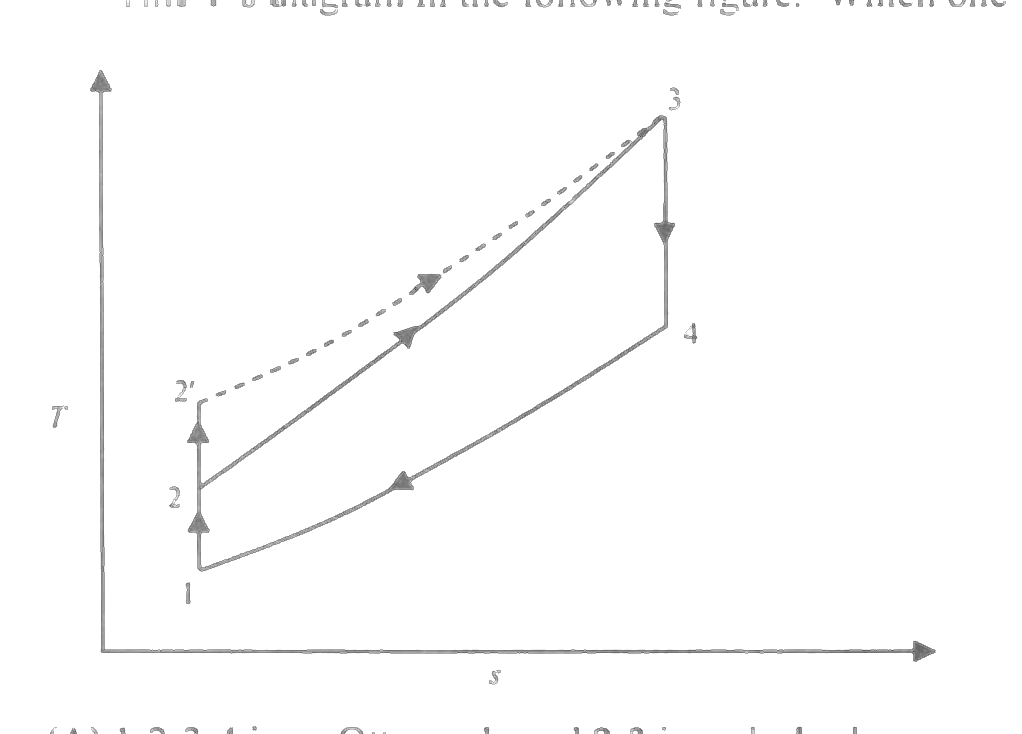
For the same maximum temperature and pressure, an Otto cycle and a Diesel cycle are shown on the same T-s diagram in the following figure. Which one of the following is correct?
Open complete paper
5
2008 · Engineering Sciences · Thermodynamic Cycles · Air-standard Power Cycles
Engineering Sciences (XE) 2008
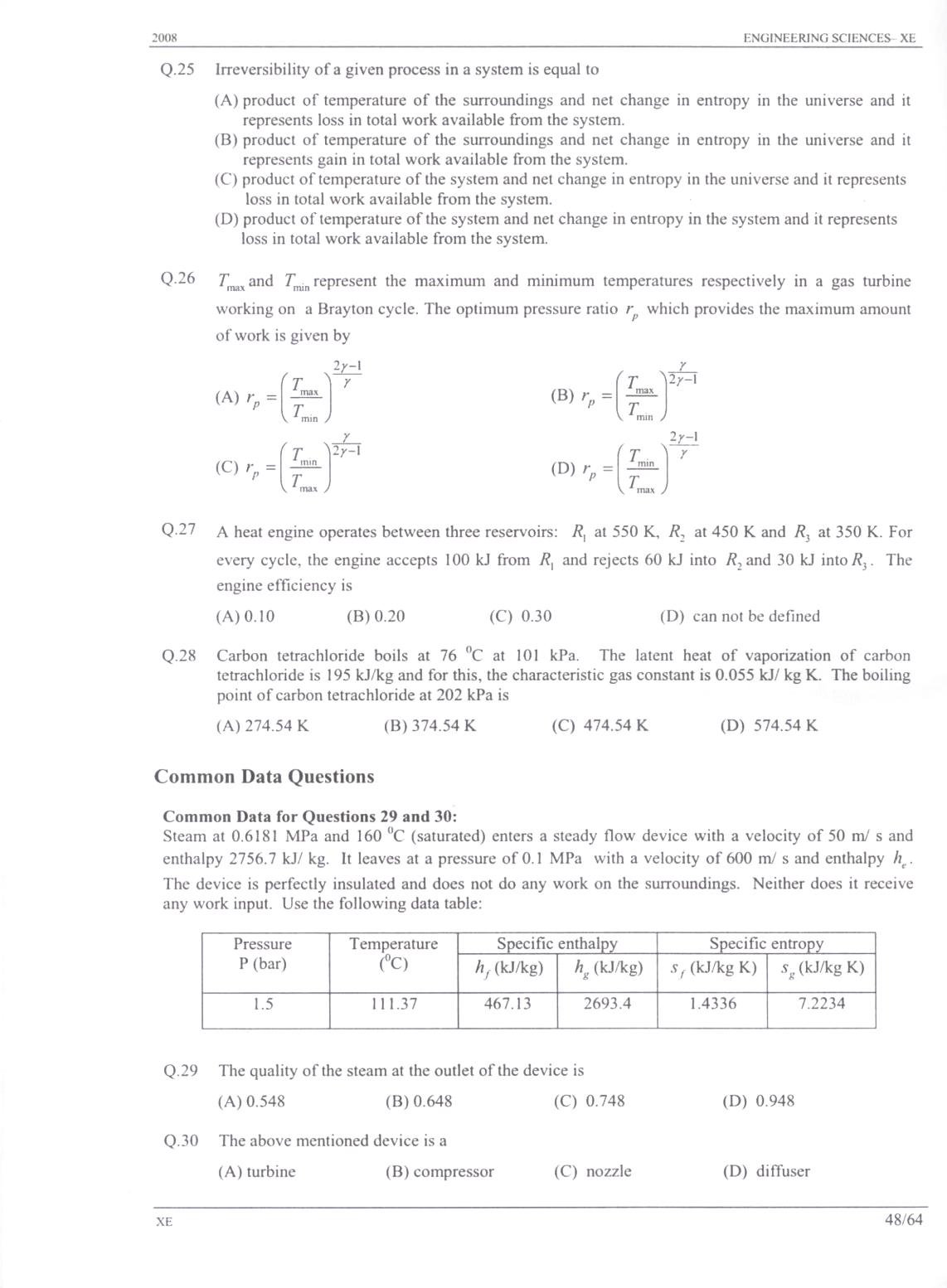
T_max and T_min represent the maximum and minimum temperatures respectively in a gas turbine working on a Brayton cycle. The optimum pressure ratio r_p which provides the maximum amount of work is given by

Question diagram

Open complete paper
6
2009 · Engineering Sciences · Thermodynamic Cycles · Air-standard Power Cycles
Engineering Sciences (XE) 2009
A gas turbine power plant operates with air ($\gamma = 1.4$) between 1 bar and 20 bar. The maximum thermal efficiency (in %) for the corresponding air-standard cycle is
Open complete paper
7
2010 · Engineering Sciences · Thermodynamic Cycles · Air-standard Power Cycles
Engineering Sciences (XE) 2010

Air (R = 287 J/kg·K, Cp = 1005 J/kg·K and γ = 1.4) flows sequentially through a compressor, a heater and a turbine as shown in the figure. Volume flow rate of air coming out from the compressor is 2.33 m3/s when pressure and temperature are 276 kPa and 43 °C respectively. Air is then heated at same pressure to 430 °C in a heater. From heater, air flows through a turbine which produces 1860 kW of power. Heat loss from turbine to the surrounding is 90 kW. Air temperature at the turbine exit is

Open complete paper
8
2010 · Engineering Sciences · Thermodynamic Cycles · Air-standard Power Cycles
Engineering Sciences (XE) 2010
In an air standard Diesel cycle, compression ratio is 14. At the beginning of compression of air (R = 287 J/kg·K, Cp = 1005 J/kg·K and γ = 1.4) the temperature is 27°C and the pressure is 1 bar. If the specific volume after heat addition is two times the specific volume after compression, heat added (in kJ per kg of air) at constant pressure is
Open complete paper
9
2011 · Engineering Sciences · Thermodynamic Cycles · Air-standard Power Cycles
Engineering Sciences (XE) 2011
The thermal efficiency of the cycle is
Open complete paper
10
2011 · Engineering Sciences · Thermodynamic Cycles · Air-standard Power Cycles
Engineering Sciences (XE) 2011
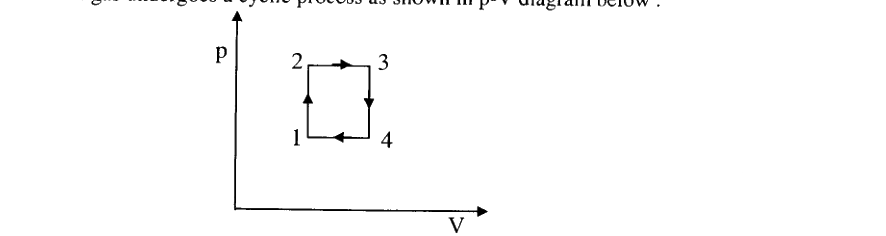
An ideal gas undergoes a cyclic process as shown in p-V diagram below :
The same cycle, represented in T-S diagram is

Question diagram

Open complete paper
11
2011 · Engineering Sciences · Thermodynamic Cycles · Air-standard Power Cycles
Engineering Sciences (XE) 2011
The net work done per cycle (kJ/kg) is approximately
Open complete paper
12
2012 · Engineering Sciences · Thermodynamic Cycles · Air-standard Power Cycles
Engineering Sciences (XE) 2012
In a Diesel cycle, the ratio of cylinder volumes after and before combustion process is called
Open complete paper
13
2012 · Engineering Sciences · Thermodynamic Cycles · Air-standard Power Cycles
Engineering Sciences (XE) 2012
The net workdone in the cycle is approximately
Open complete paper
14
2013 · Engineering Sciences · Thermodynamic Cycles · Air-standard Power Cycles
Engineering Sciences (XE) 2013
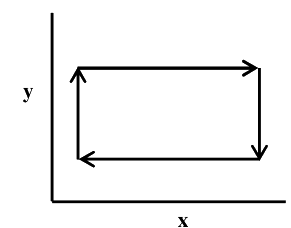
An air standard Otto cycle has the following shape on a thermodynamic property plane.

The x and y coordinates, respectively, are

Question diagram

Open complete paper
15
2014 · Engineering Sciences · Thermodynamic Cycles · Air-standard Power Cycles
Engineering Sciences (XE) 2014
The minimum and maximum volumes in an air standard Otto cycle are 100 and 800 cm³. Its thermal efficiency (%) is
Open complete paper
16
2014 · Engineering Sciences · Thermodynamic Cycles · Air-standard Power Cycles
Engineering Sciences (XE) 2014
The maximum pressure and temperature in an air standard diesel cycle are 44 bar and 1600 K, respectively. If the minimum pressure and temperature are 1 bar and 300 K, respectively, then the cut-off ratio (the ratio of the volume at the end of the heat addition process to that at the beginning of the heat addition process) is
Open complete paper
17
2014 · Engineering Sciences · Thermodynamic Cycles · Air-standard Power Cycles
Engineering Sciences (XE) 2014
The thermal efficiency of an air standard Brayton cycle 0.35. The pressure ratio across the turbine is
Open complete paper
18
2015 · Engineering Sciences · Thermodynamic Cycles · Air-standard Power Cycles
Engineering Sciences (XE) 2015
A cycle 1-2-3-1 is proposed with the following processes:
1-2: Constant pressure expansion, 2-3: Reversible adiabatic expansion, 3-1: Irreversible adiabatic compression. Which one of the following statements is TRUE?
Open complete paper
19
2015 · Engineering Sciences · Thermodynamic Cycles · Air-standard Power Cycles
Engineering Sciences (XE) 2015
In a Brayton cycle with air (\(\gamma = 1.4\)) as working fluid, \(T_{min} = 300\) K and \(T_{max} = 1000\) K. The pressure ratio corresponding to maximum net work per cycle is ______.
Open complete paper
20
2016 · Engineering Sciences · Thermodynamic Cycles · Air-standard Power Cycles
Engineering Sciences (XE) 2016
Consider the following statements related to air-standard Otto, Diesel, and Brayton cycles:
P. Brayton cycle has at least one isentropic and one isobaric process.
Q. Otto cycle has at least one isentropic and one isochoric process.
R. Diesel cycle has at least one isentropic and one isothermal process.
S. At least one of the cycles has an isothermal process.
For which of the following options, BOTH the statements are consistent with the operation of the above cycles:
Open complete paper

Showing 20 of 40 questions