Difficulty distribution
How the classified questions are distributed by difficulty.
Your cart is empty.
Practice Thermoplastics and Thermosets - Synthesis, Manufacturing and Properties - Engineering Sciences previous year questions organised from real papers, with year-wise coverage and clear topic navigation.
Every graph below is calculated only from this selection.
Year-wise coverage for Thermoplastics and Thermosets. Each bar uses a separate theme-derived color.
How the classified questions are distributed by difficulty.
MCQ, numerical, multiple-select and other formats found in these papers.
Top subjects by unique question coverage.
Top topics across the included previous year papers.
Top subtopics inside this exact selection.
Question coverage for the most populated papers. Every active PYP paper remains listed below.
Newest papers appear first. Sort by year, question coverage or name.
| Paper | Year / session | Questions in this view | Open |
|---|---|---|---|
| Engineering Sciences (XE) 2025 | 2025 | 2 | View paper |
| Engineering Sciences (XE) 2023 | 2023 | 3 | View paper |
| Engineering Sciences (XE) 2022 | 2022 | 2 | View paper |
| Engineering Sciences (XE) 2021 | 2021 | 1 | View paper |
| Engineering Sciences (XE) 2020 | 2020 | 2 | View paper |
| Engineering Sciences (XE) 2019 | 2019 | 2 | View paper |
| Engineering Sciences (XE) 2018 | 2018 | 1 | View paper |
| Engineering Sciences (XE) 2017 | 2017 | 4 | View paper |
| Engineering Sciences (XE) 2016 | 2016 | 2 | View paper |
| Engineering Sciences (XE) 2015 | 2015 | 3 | View paper |
| Engineering Sciences (XE) 2014 | 2014 | 1 | View paper |
| Engineering Sciences (XE) 2012 | 2012 | 1 | View paper |
| Engineering Sciences (XE) 2011 | 2011 | 2 | View paper |
| Engineering Sciences (XE) 2010 | 2010 | 4 | View paper |
| Engineering Sciences (XE) 2009 | 2009 | 3 | View paper |
| Engineering Sciences (XE) 2008 | 2008 | 2 | View paper |
Practice every matching question in batches of 20, with every available option.
| Group I (polymers) | Group II (m. p., °C) |
|---|---|
| P. Nylon66 | 1. 108 |
| Q. PBT | 2. 320 |
| R. PP | 3. 264 |
| S. LDPE | 4. 165 |
| 5. 220 |
| Polymer X | Polymer Y | Polymer Z | |
|---|---|---|---|
| Density (kgm-3) | 920 | 1130 | 900 |
| Heat Distortion Temp. (°C) | 40 | 110 | 55 |
| Tensile strength (MPa) | 10 | 85 | 35 |
| Elongation at break (%) | 600 | 200 | 400 |
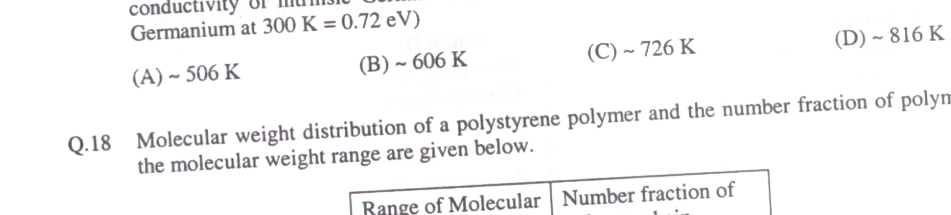
Molecular weight distribution of a polystyrene polymer and the number fraction of polymer chains in the molecular weight range are given below.
| Range of Molecular weight (kg/mol) | Number fraction of polymer chain |
|---|---|
| 5 - 10 | 0.05 |
| 10 - 15 | 0.15 |
| 15 - 20 | 0.20 |
| 20 - 25 | 0.30 |
| 25 - 30 | 0.20 |
| 30 - 35 | 0.08 |
| 35 - 40 | 0.02 |

From the following four groups of polymers, identify the group in which all four polymers are semicrystalline
Match the materials in Column-I with the descriptions in Column-II.
| Column-I | Column-II |
|---|---|
| P. Polyacrylonitrile | 1. Hard and brittle material |
| Q. Nylon-6,6 | 2. Very high temperature resistant polymer |
| R. Polytetrafluoroethylene (PTFE) | 3. H-bonding |
| S. Ebonite | 4. Acrylic fibre |
| 5. Rubber | |
| 6. Polyester fibre |
The melting temperature of poly tetrafluoroethylene is higher than its degradation temperature due to
Showing 20 of 35 questions