My Cart
Your Cart 0

    Your cart is empty.

  • Total (Amount) ₹0.00
Previous year question hub

Second Law of Thermodynamics - Engineering Sciences Previous Year Questions

Practice Second Law of Thermodynamics - Engineering Sciences previous year questions organised from real papers, with year-wise coverage and clear topic navigation.

14Papers
14Years
27Questions
1Topics

Second Law of Thermodynamics question pattern

Every graph below is calculated only from this selection.

Questions by year

Year-wise coverage for Second Law of Thermodynamics. Each bar uses a separate theme-derived color.

Difficulty distribution

How the classified questions are distributed by difficulty.

Easy 18 66.7%
Medium 9 33.3%

Question type distribution

MCQ, numerical, multiple-select and other formats found in these papers.

MCQ 16 59.3%
Numerical Answer Type (NAT) 10 37%
Fill in the blanks 1 3.7%

Subject weightage

Top subjects by unique question coverage.

Engineering Sciences
27 Qs

Most asked topics

Top topics across the included previous year papers.

Second Law of Thermodynamics
27 Qs

Subtopic coverage

Top subtopics inside this exact selection.

Heat Engines, Refrigerators and Carnot Principles
27 Qs

Paper coverage

Question coverage for the most populated papers. Every active PYP paper remains listed below.

Engineering Sciences (XE) 2026
1 Qs
Engineering Sciences (XE) 2025
3 Qs
Engineering Sciences (XE) 2024
1 Qs
Engineering Sciences (XE) 2023
1 Qs
Engineering Sciences (XE) 2022
3 Qs
Engineering Sciences (XE) 2021
2 Qs
Engineering Sciences (XE) 2020
2 Qs
Engineering Sciences (XE) 2019
2 Qs
Engineering Sciences (XE) 2018
2 Qs
Engineering Sciences (XE) 2017
2 Qs
Engineering Sciences (XE) 2016
3 Qs
Engineering Sciences (XE) 2014
2 Qs
Engineering Sciences (XE) 2013
1 Qs
Engineering Sciences (XE) 2012
2 Qs

Browse by subtopics

Open a focused page built from the same verified paper data.

Included previous year papers

Newest papers appear first. Sort by year, question coverage or name.

PaperYear / sessionQuestions in this viewOpen
Engineering Sciences (XE) 202620261View paper
Engineering Sciences (XE) 202520253View paper
Engineering Sciences (XE) 202420241View paper
Engineering Sciences (XE) 202320231View paper
Engineering Sciences (XE) 202220223View paper
Engineering Sciences (XE) 202120212View paper
Engineering Sciences (XE) 202020202View paper
Engineering Sciences (XE) 201920192View paper
Engineering Sciences (XE) 201820182View paper
Engineering Sciences (XE) 201720172View paper
Engineering Sciences (XE) 201620163View paper
Engineering Sciences (XE) 201420142View paper
Engineering Sciences (XE) 201320131View paper
Engineering Sciences (XE) 201220122View paper

Sample previous year questions

A varied preview from the papers represented in this selection, with every available option.

1
2012 · Engineering Sciences · Second Law of Thermodynamics · Heat Engines, Refrigerators and Carnot Principles
Engineering Sciences (XE) 2012
If \( Q_L \) represents the magnitude of heat transfer from a low temperature reservoir to a cyclic device and \( Q_H \) represents the magnitude of heat transfer from a cyclic device to a high temperature reservoir, then for the same \( Q_L \) and \( Q_H \), the coefficient performance of a refrigerator ( \( COP_R \) ) and the coefficient performance of a heat pump ( \( COP_{HP} \) ) can be related as
Open complete paper
2
2013 · Engineering Sciences · Second Law of Thermodynamics · Heat Engines, Refrigerators and Carnot Principles
Engineering Sciences (XE) 2013
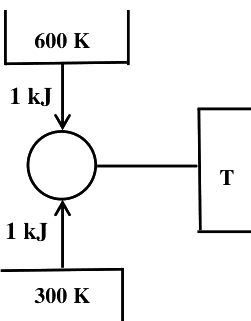
A thermodynamic cycle operates between one source at a temperature of 600 K, another source at a temperature of 300 K and a sink at a temperature T as shown in the figure below
If the First and Second laws of thermodynamics are not violated, what should be the value of T in K?______

Question diagram

Open complete paper
3
2014 · Engineering Sciences · Second Law of Thermodynamics · Heat Engines, Refrigerators and Carnot Principles
Engineering Sciences (XE) 2014
The efficiency of a reversible engine operating between two temperatures is 40 %. The COP of a reversible refrigerator operating between the same temperatures is
Open complete paper
4
2016 · Engineering Sciences · Second Law of Thermodynamics · Heat Engines, Refrigerators and Carnot Principles
Engineering Sciences (XE) 2016
The thermal efficiency of a Carnot engine is 0.5. If the temperature of the cold reservoir is 300 K, then the temperature of the hot reservoir is:
Open complete paper
5
2017 · Engineering Sciences · Second Law of Thermodynamics · Heat Engines, Refrigerators and Carnot Principles
Engineering Sciences (XE) 2017
A refrigerator is used to maintain certain space at 10°C. It pumps 18000 kJ/hour of heat from the space to the atmosphere at 30°C. If the power input to the refrigerator is 2 kW, the ratio of COP of this refrigerator to that of a Carnot refrigerator (up to 2 decimal places) is ________.
Open complete paper
6
2018 · Engineering Sciences · Second Law of Thermodynamics · Heat Engines, Refrigerators and Carnot Principles
Engineering Sciences (XE) 2018
A reversible engine receives 75 kJ/s of energy from a reservoir at 750 K and does 12 kJ/s of work. The heat is rejected to two reservoirs at 650 K and 550 K. The rate of heat rejection (in kJ/s) to the reservoir at 650 K is
Open complete paper