My Cart
Your Cart 0

    Your cart is empty.

  • Total (Amount) ₹0.00
Previous year question hub

Thermal Properties - Properties and Applications of Materials - Engineering Sciences Previous Year Questions

Practice Thermal Properties - Properties and Applications of Materials - Engineering Sciences previous year questions organised from real papers, with year-wise coverage and clear topic navigation.

9Papers
9Years
14Questions
1Topics

Thermal Properties question pattern

Every graph below is calculated only from this selection.

Questions by year

Year-wise coverage for Thermal Properties. Each bar uses a separate theme-derived color.

Difficulty distribution

How the classified questions are distributed by difficulty.

Easy 9 64.3%
Medium 5 35.7%

Question type distribution

MCQ, numerical, multiple-select and other formats found in these papers.

MCQ 7 50%
Numerical Answer Type (NAT) 5 35.7%
Fill in the blanks 1 7.1%
MSQ 1 7.1%

Subject weightage

Top subjects by unique question coverage.

Engineering Sciences
14 Qs

Most asked topics

Top topics across the included previous year papers.

Properties and Applications of Materials
14 Qs

Subtopic coverage

Top subtopics inside this exact selection.

Thermal Properties
14 Qs

Paper coverage

Question coverage for the most populated papers. Every active PYP paper remains listed below.

Engineering Sciences (XE) 2023
1 Qs
Engineering Sciences (XE) 2022
1 Qs
Engineering Sciences (XE) 2021
1 Qs
Engineering Sciences (XE) 2018
1 Qs
Engineering Sciences (XE) 2017
1 Qs
Engineering Sciences (XE) 2016
1 Qs
Engineering Sciences (XE) 2015
3 Qs
Engineering Sciences (XE) 2013
2 Qs
Engineering Sciences (XE) 2012
3 Qs

Included previous year papers

Newest papers appear first. Sort by year, question coverage or name.

PaperYear / sessionQuestions in this viewOpen
Engineering Sciences (XE) 202320231View paper
Engineering Sciences (XE) 202220221View paper
Engineering Sciences (XE) 202120211View paper
Engineering Sciences (XE) 201820181View paper
Engineering Sciences (XE) 201720171View paper
Engineering Sciences (XE) 201620161View paper
Engineering Sciences (XE) 201520153View paper
Engineering Sciences (XE) 201320132View paper
Engineering Sciences (XE) 201220123View paper

All Thermal Properties previous year questions

Practice every matching question in batches of 20, with every available option.

1
2012 · Engineering Sciences · Properties and Applications of Materials · Thermal Properties
Engineering Sciences (XE) 2012

Which material has the lowest specific heat capacity at room temperature?

Open complete paper
2
2012 · Engineering Sciences · Properties and Applications of Materials · Thermal Properties
Engineering Sciences (XE) 2012
The crystalline melting temperature of the polymers high density polyethylene (HDPE), isotactic polypropylene (iPP), nylon 6 (PA6) and poly(ethylene terephthalate) (PET) can be arranged as
Open complete paper
3
2012 · Engineering Sciences · Properties and Applications of Materials · Thermal Properties
Engineering Sciences (XE) 2012
Most engineering polymers have heat distortion temperature (HDT) in excess of
Open complete paper
4
2013 · Engineering Sciences · Properties and Applications of Materials · Thermal Properties
Engineering Sciences (XE) 2013
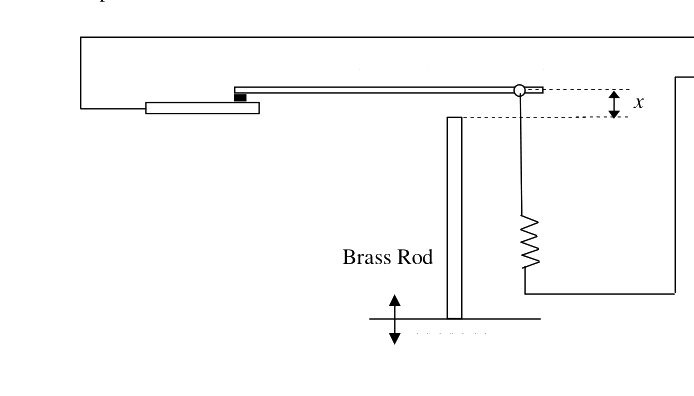
For automatic control of household electric water heater a relay switch is activated by thermal expansion of a brass rod of length 50 cm as shown in the schematic below. The distance between the rod and the lever, x, is adjusted by moving the base of the rod. As the water gets heated the rod expands and as soon as the rod touches the lever, the circuit is broken disconnecting the heater from the power supply. Find the distance, x, in mm, to be set at water temperature of 20°C such that the circuit is broken at 70°C. The coefficient of linear thermal expansion of brass is 20 x 10⁻⁶°C⁻¹

Question diagram

Open complete paper
5
2013 · Engineering Sciences · Properties and Applications of Materials · Thermal Properties
Engineering Sciences (XE) 2013
The length of a glass fiber reinforced polymer increased by 0.03mm, from its initial length of 100mm, when the temperature was changed from -30°C to +30°C. The coefficient of linear thermal expansion is
Open complete paper
6
2015 · Engineering Sciences · Properties and Applications of Materials · Thermal Properties
Engineering Sciences (XE) 2015
Arrange the following elements in order of increasing melting point:
(P) gallium (Q) tungsten (R) aluminium (S) gold
Open complete paper
7
2015 · Engineering Sciences · Properties and Applications of Materials · Thermal Properties
Engineering Sciences (XE) 2015
Which of the following statements is TRUE about the glass transition temperature (Tg)?
Open complete paper
8
2015 · Engineering Sciences · Properties and Applications of Materials · Thermal Properties
Engineering Sciences (XE) 2015
With increasing temperature from 15°C in winter to 45°C in summer, the length of an iron rail track increases by 0.05 cm. Calculate the original length of the iron rail track in cm. (linear thermal expansion coefficient of iron is 11.0 x 10⁻⁶ K⁻¹)
Open complete paper
9
2016 · Engineering Sciences · Properties and Applications of Materials · Thermal Properties
Engineering Sciences (XE) 2016
Which one of the following effects is the working principle of a thermocouple?
Open complete paper
10
2017 · Engineering Sciences · Properties and Applications of Materials · Thermal Properties
Engineering Sciences (XE) 2017
Length of a certain metal rod at 0 °C is 10 cm. The coefficient of linear expansion of that metal varies with temperature as 10-4 + 10-5×T (cm/cm)/°C. When the length of the metal rod is 10.2 cm, the rise in temperature in °C is ________.
Open complete paper
11
2018 · Engineering Sciences · Properties and Applications of Materials · Thermal Properties
Engineering Sciences (XE) 2018
For a two-dimensional solid, the variation of lattice specific heat as a function of temperature \(T\) (in K, at low temperatures) is given as: \(C_p = bT^n\), where \(b\) is a constant. The value of \(n\) is __________.
Open complete paper
12
2021 · Engineering Sciences · Properties and Applications of Materials · Thermal Properties
Engineering Sciences (XE) 2021
At 1000 K, the linear thermal expansion coefficients of graphite, parallel and perpendicular to the graphite layers, are \(0.8 \times 10^{-6} \; \mathrm{K^{-1}}\) and \(29 \times 10^{-6} \; \mathrm{K^{-1}}\), respectively. The percentage increase in the volume of graphite when heated from 900 K to 1100 K is __________ (round off to 2 decimal places)
Open complete paper
13
2022 · Engineering Sciences · Properties and Applications of Materials · Thermal Properties
Engineering Sciences (XE) 2022
The thermal conductivity values of glass fiber and epoxy resin are 1.05 W m⁻¹ K⁻¹ and 0.25 W m⁻¹ K⁻¹, respectively. The thermal conductivity of a glass fiber reinforced epoxy composite with a fiber content of 60% by volume along the fiber direction is __________ W m⁻¹ K⁻¹ (rounded off to two decimal places).
Open complete paper
14
2023 · Engineering Sciences · Properties and Applications of Materials · Thermal Properties
Engineering Sciences (XE) 2023
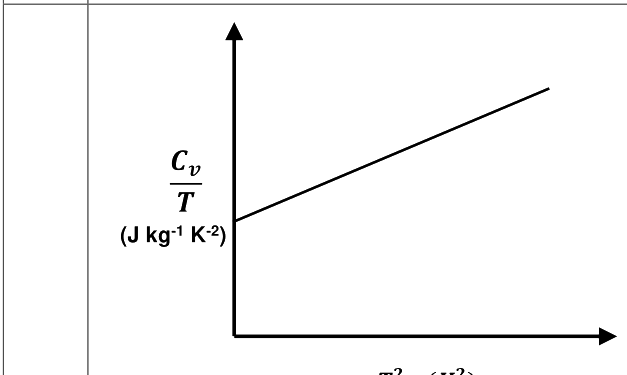
Specific heat \(C_v\) of a material was found to depend on temperature as shown below. Which of the following statement(s) is/are true?

Question diagram

Open complete paper