My Cart
Your Cart 0

    Your cart is empty.

  • Total (Amount) ₹0.00
Previous year question hub

Correlation and Linear Regression - Probability and Statistics - Engineering Sciences Previous Year Questions

Practice Correlation and Linear Regression - Probability and Statistics - Engineering Sciences previous year questions organised from real papers, with year-wise coverage and clear topic navigation.

8Papers
8Years
9Questions
1Topics

Correlation and Linear Regression question pattern

Every graph below is calculated only from this selection.

Questions by year

Year-wise coverage for Correlation and Linear Regression. Each bar uses a separate theme-derived color.

Difficulty distribution

How the classified questions are distributed by difficulty.

Medium 6 66.7%
Easy 3 33.3%

Question type distribution

MCQ, numerical, multiple-select and other formats found in these papers.

MCQ 7 77.8%
Numerical Answer Type (NAT) 1 11.1%
MSQ 1 11.1%

Subject weightage

Top subjects by unique question coverage.

Engineering Sciences
9 Qs

Most asked topics

Top topics across the included previous year papers.

Probability and Statistics
9 Qs

Subtopic coverage

Top subtopics inside this exact selection.

Correlation and Linear Regression
9 Qs

Paper coverage

Question coverage for the most populated papers. Every active PYP paper remains listed below.

Engineering Sciences (XE) 2026
1 Qs
Engineering Sciences (XE) 2024
1 Qs
Engineering Sciences (XE) 2020
1 Qs
Engineering Sciences (XE) 2019
1 Qs
Engineering Sciences (XE) 2017
1 Qs
Engineering Sciences (XE) 2016
1 Qs
Engineering Sciences (XE) 2008
2 Qs
Engineering Sciences (XE) 2007
1 Qs

Included previous year papers

Newest papers appear first. Sort by year, question coverage or name.

PaperYear / sessionQuestions in this viewOpen
Engineering Sciences (XE) 202620261View paper
Engineering Sciences (XE) 202420241View paper
Engineering Sciences (XE) 202020201View paper
Engineering Sciences (XE) 201920191View paper
Engineering Sciences (XE) 201720171View paper
Engineering Sciences (XE) 201620161View paper
Engineering Sciences (XE) 200820082View paper
Engineering Sciences (XE) 200720071View paper

All Correlation and Linear Regression previous year questions

Practice every matching question in batches of 20, with every available option.

1
2007 · Engineering Sciences · Probability and Statistics · Correlation and Linear Regression
Engineering Sciences (XE) 2007
The equation of the straight line of best fit using the following data by the principle of least square is
x12345
y1413952
Open complete paper
2
2008 · Engineering Sciences · Probability and Statistics · Correlation and Linear Regression
Engineering Sciences (XE) 2008
The two lines of regression of the variables \( x \) and \( y \) are \( 4x + 2.4y = 20 \) and \( 1.6x + 4y = 12 \). The coefficient of correlation between \( x \) and \( y \) is
Open complete paper
3
2008 · Engineering Sciences · Probability and Statistics · Correlation and Linear Regression
Engineering Sciences (XE) 2008
The following table gives a function \(f(x)\) vs \(x\).
\(x\)01234
\(f(x)\)1.03.76.59.312.1
The best fit of a straight line for the above data points, using a least square error method is

Question diagram

Open complete paper
4
2016 · Engineering Sciences · Probability and Statistics · Correlation and Linear Regression
Engineering Sciences (XE) 2016
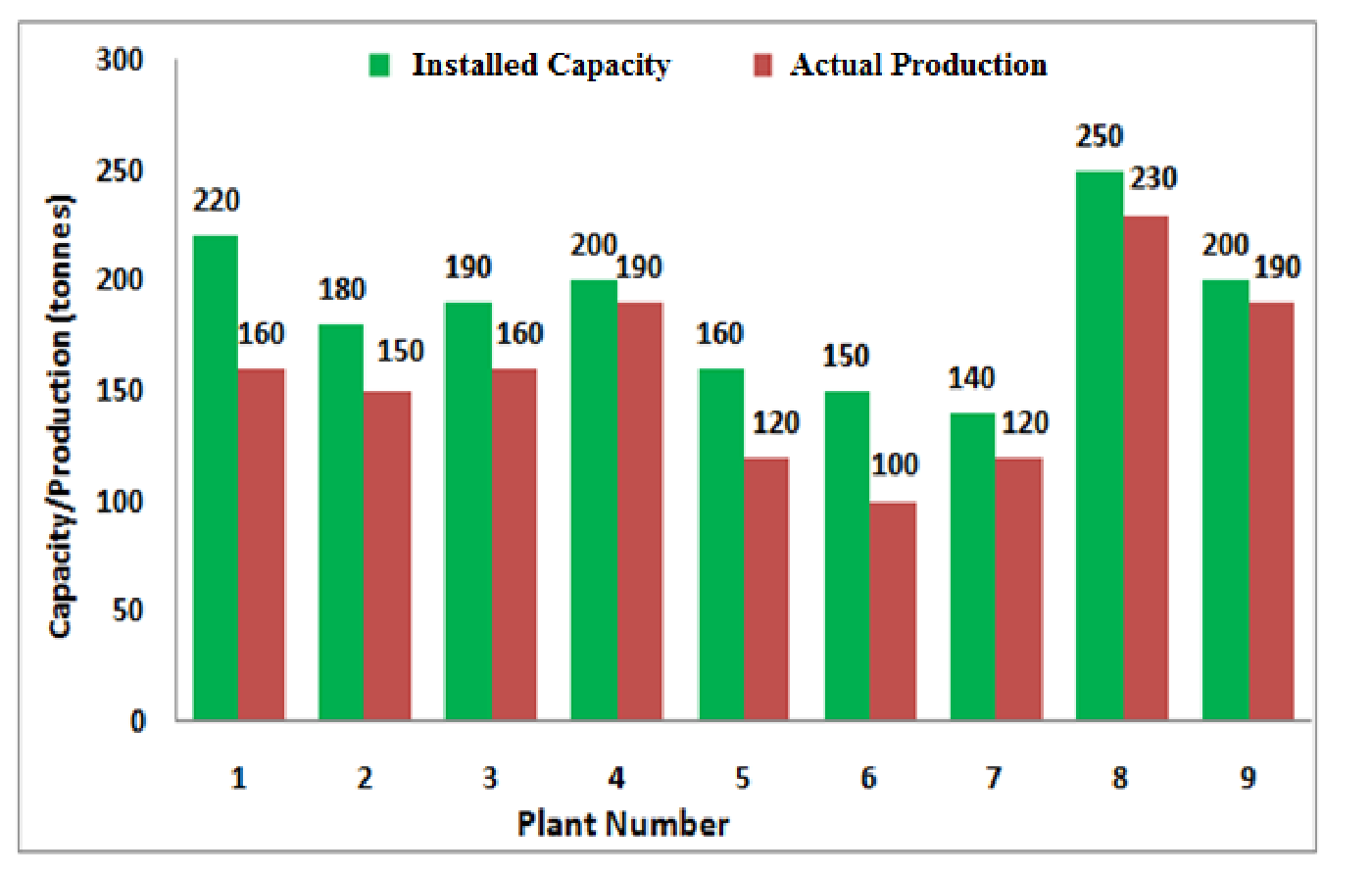
The following graph represents the installed capacity for cement production (in tonnes) and the actual production (in tonnes) of nine cement plants of a cement company. Capacity utilization of a plant is defined as ratio of actual production of cement to installed capacity. A plant with installed capacity of at least 200 tonnes is called a large plant and a plant with lesser capacity is called a small plant. The difference between total production of large plants and small plants, in tonnes is ______.

Source question diagram

Open complete paper
5
2017 · Engineering Sciences · Probability and Statistics · Correlation and Linear Regression
Engineering Sciences (XE) 2017
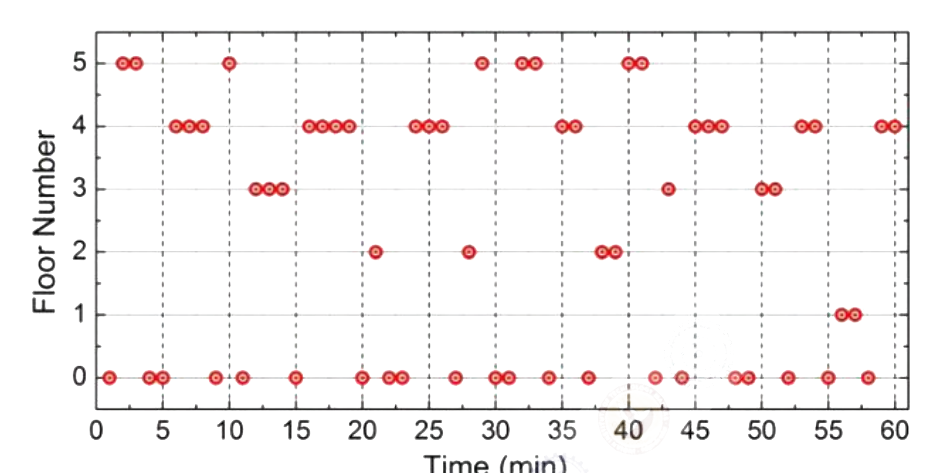
The points in the graph below represent the halts of a lift for durations of 1 minute, over a period of 1 hour.
Which of the following statements are correct?
i. The elevator never moves directly from any non-ground floor to another non-ground floor over the one hour period
ii. The elevator stays on the fourth floor for the longest duration over the one hour period

Question diagram

Open complete paper
6
2019 · Engineering Sciences · Probability and Statistics · Correlation and Linear Regression
Engineering Sciences (XE) 2019
Mola is a digital platform for taxis in a city. It offers three types of rides – Pool, Mini and Prime. The Table below presents the number of rides for the past four months. The platform earns one US dollar per ride. What is the percentage share of revenue contributed by Prime to the total revenues of Mola, for the entire duration?

Question diagram

Open complete paper
7
2020 · Engineering Sciences · Probability and Statistics · Correlation and Linear Regression
Engineering Sciences (XE) 2020
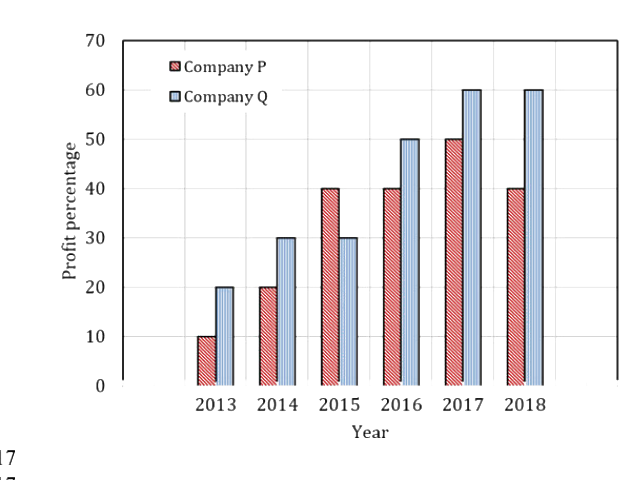
The profit shares of two companies P and Q are shown in the figure. If the two companies have invested a fixed and equal amount every year, then the ratio of the total revenue of company P to the total revenue of company Q, during 2013 - 2018 is ____.

Question diagram

Open complete paper
8
2024 · Engineering Sciences · Probability and Statistics · Correlation and Linear Regression
Engineering Sciences (XE) 2024
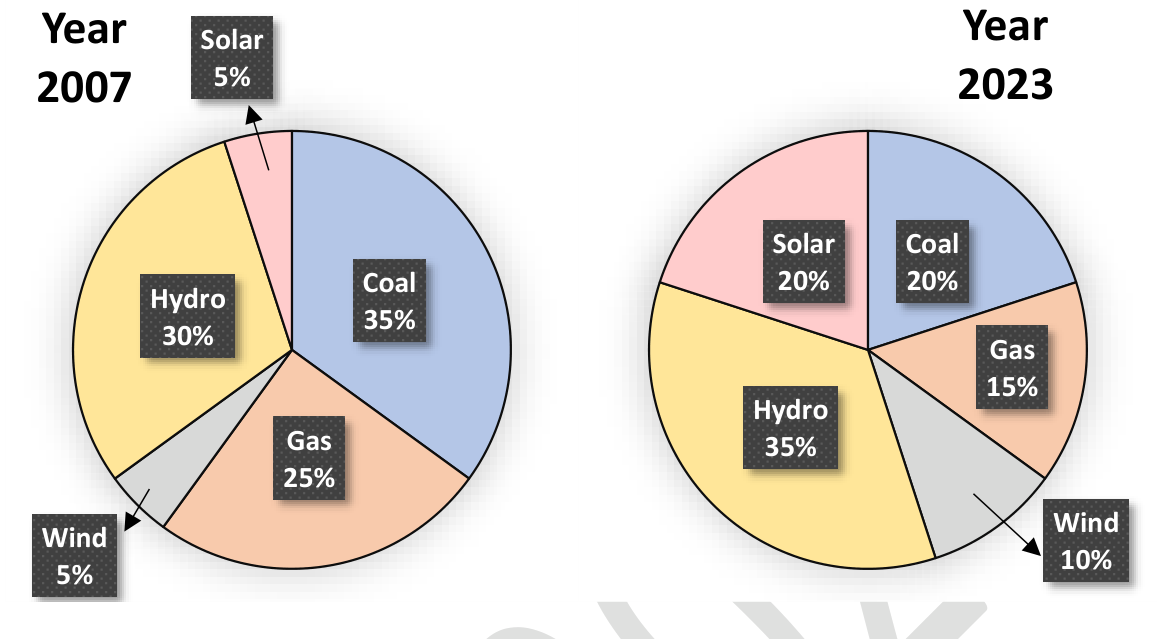
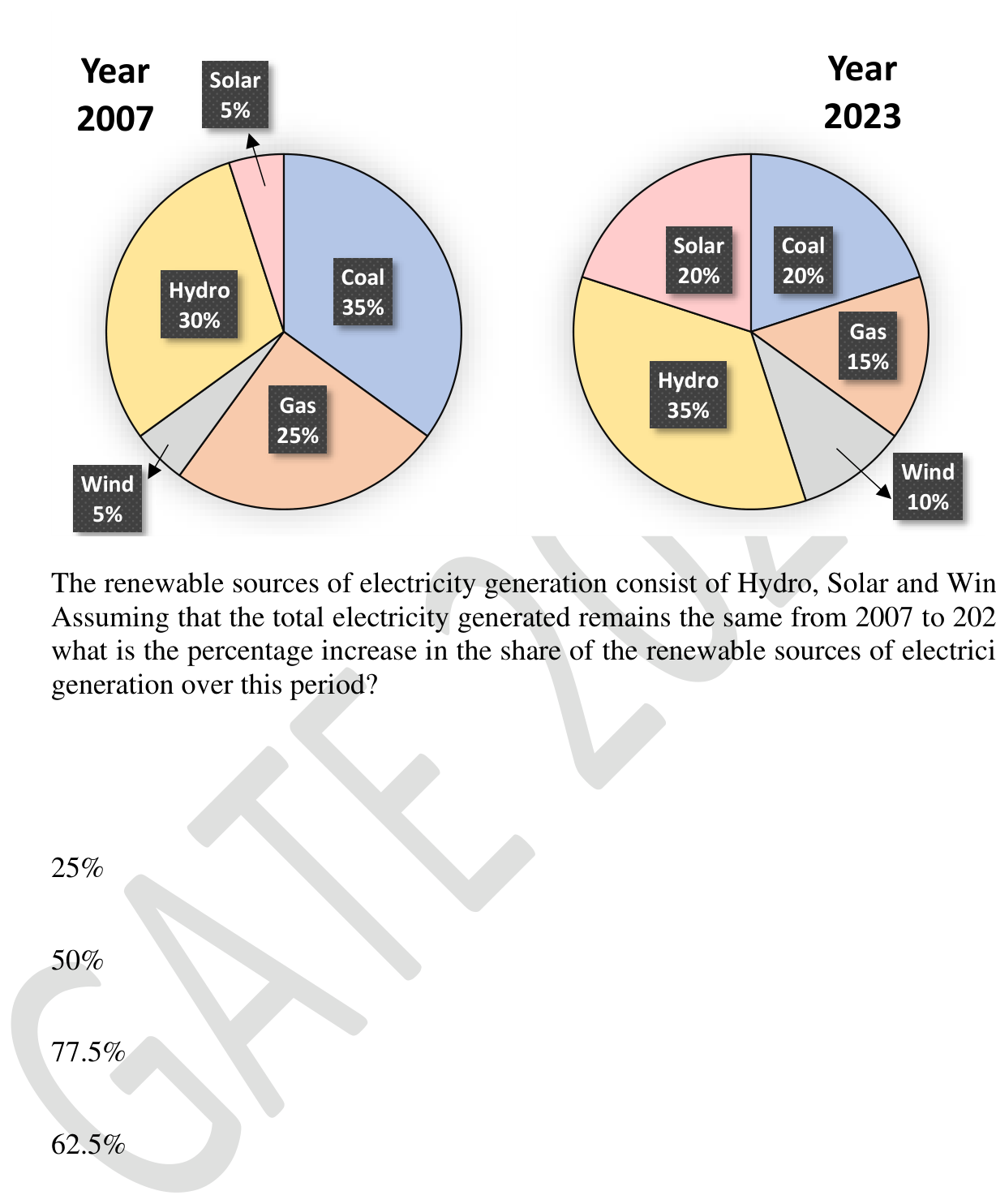
The pie charts depict the shares of various power generation technologies in the total electricity generation of a country for the years 2007 and 2023.

The renewable sources of electricity generation consist of Hydro, Solar and Wind. Assuming that the total electricity generated remains the same from 2007 to 2023, what is the percentage increase in the share of the renewable sources of electricity generation over this period?

Source question diagram

Source question diagram

Open complete paper
9
2026 · Engineering Sciences · Probability and Statistics · Correlation and Linear Regression
Engineering Sciences (XE) 2026

Which of the following statements is/are true?

Open complete paper