My Cart
Your Cart 0

    Your cart is empty.

  • Total (Amount) β‚Ή0.00
Previous year question hub

Polymer Flow and Viscoelasticity - Polymer Rheology - Engineering Sciences Previous Year Questions

Practice Polymer Flow and Viscoelasticity - Polymer Rheology - Engineering Sciences previous year questions organised from real papers, with year-wise coverage and clear topic navigation.

15Papers
15Years
31Questions
1Topics

Polymer Flow and Viscoelasticity question pattern

Every graph below is calculated only from this selection.

Questions by year

Year-wise coverage for Polymer Flow and Viscoelasticity. Each bar uses a separate theme-derived color.

Difficulty distribution

How the classified questions are distributed by difficulty.

Medium 16 51.6%
Easy 14 45.2%
Hard 1 3.2%
Question type distribution

MCQ, numerical, multiple-select and other formats found in these papers.

MCQ 21 67.7%
Numerical Answer Type (NAT) 8 25.8%
Fill in the blanks 1 3.2%
MSQ 1 3.2%

Subject weightage

Top subjects by unique question coverage.

Engineering Sciences
31 Qs

Most asked topics

Top topics across the included previous year papers.

Polymer Rheology
31 Qs

Subtopic coverage

Top subtopics inside this exact selection.

Polymer Flow and Viscoelasticity
31 Qs

Paper coverage

Question coverage for the most populated papers. Every active PYP paper remains listed below.

Engineering Sciences (XE) 2026
2 Qs
Engineering Sciences (XE) 2024
2 Qs
Engineering Sciences (XE) 2023
4 Qs
Engineering Sciences (XE) 2022
1 Qs
Engineering Sciences (XE) 2021
3 Qs
Engineering Sciences (XE) 2019
1 Qs
Engineering Sciences (XE) 2018
1 Qs
Engineering Sciences (XE) 2017
3 Qs
Engineering Sciences (XE) 2015
1 Qs
Engineering Sciences (XE) 2013
3 Qs
Engineering Sciences (XE) 2012
1 Qs
Engineering Sciences (XE) 2011
2 Qs
Engineering Sciences (XE) 2010
1 Qs
Engineering Sciences (XE) 2009
3 Qs
Engineering Sciences (XE) 2008
3 Qs

Included previous year papers

Newest papers appear first. Sort by year, question coverage or name.

PaperYear / sessionQuestions in this viewOpen
Engineering Sciences (XE) 202620262View paper
Engineering Sciences (XE) 202420242View paper
Engineering Sciences (XE) 202320234View paper
Engineering Sciences (XE) 202220221View paper
Engineering Sciences (XE) 202120213View paper
Engineering Sciences (XE) 201920191View paper
Engineering Sciences (XE) 201820181View paper
Engineering Sciences (XE) 201720173View paper
Engineering Sciences (XE) 201520151View paper
Engineering Sciences (XE) 201320133View paper
Engineering Sciences (XE) 201220121View paper
Engineering Sciences (XE) 201120112View paper
Engineering Sciences (XE) 201020101View paper
Engineering Sciences (XE) 200920093View paper
Engineering Sciences (XE) 200820083View paper

All Polymer Flow and Viscoelasticity previous year questions

Practice every matching question in batches of 20, with every available option.

1
2008 Β· Engineering Sciences Β· Polymer Rheology Β· Polymer Flow and Viscoelasticity
Engineering Sciences (XE) 2008

Most polymers exhibit Newtonian behaviour at

Open complete paper
2
2008 Β· Engineering Sciences Β· Polymer Rheology Β· Polymer Flow and Viscoelasticity
Engineering Sciences (XE) 2008

The extension ratio of an elastomer deformed to 10 times is

Open complete paper
3
2008 Β· Engineering Sciences Β· Polymer Rheology Β· Polymer Flow and Viscoelasticity
Engineering Sciences (XE) 2008

For a viscoelastic material behaving as Maxwell model, the modulus at its relaxation time under constant strain reduces to

Open complete paper
4
2009 Β· Engineering Sciences Β· Polymer Rheology Β· Polymer Flow and Viscoelasticity
Engineering Sciences (XE) 2009
Which of the following trends is the most appropriate for a thixotropic fluid ?
Open complete paper
5
2009 Β· Engineering Sciences Β· Polymer Rheology Β· Polymer Flow and Viscoelasticity
Engineering Sciences (XE) 2009

The ratio of the complex dynamic modulus to the storage modulus of a polymer system with a phase angle of 45Β° is

Open complete paper
6
2009 Β· Engineering Sciences Β· Polymer Rheology Β· Polymer Flow and Viscoelasticity
Engineering Sciences (XE) 2009
Strain, \( \gamma \), in a polymer melt varies with time on application of stress \( s \) by the following relation : \[ \eta \frac{d\gamma}{dt} + G\gamma = s \] If a steady shear stress, \( s_0 \), is applied, the strain at the steady state, \( \gamma_0 \), is given by
Open complete paper
7
2010 Β· Engineering Sciences Β· Polymer Rheology Β· Polymer Flow and Viscoelasticity
Engineering Sciences (XE) 2010

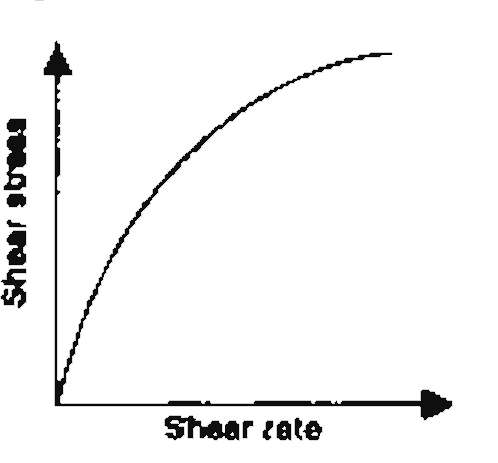
The change of shear stress with shear rate of a polymer melt as shown in the figure below indicates

Open complete paper
8
2011 Β· Engineering Sciences Β· Polymer Rheology Β· Polymer Flow and Viscoelasticity
Engineering Sciences (XE) 2011
As the molecular weight (M) increases beyond the critical molecular weight (M_c), the zero shear viscosity of a polymer melt becomes proportional to
Open complete paper
9
2011 Β· Engineering Sciences Β· Polymer Rheology Β· Polymer Flow and Viscoelasticity
Engineering Sciences (XE) 2011
In the log (viscosity) versus log (shear rate) behaviour of polymer melts, the upper (\(\mu_{upper}\)) and lower (\(\mu_{lower}\)) Newtonian viscosities are related as
Open complete paper
10
2012 Β· Engineering Sciences Β· Polymer Rheology Β· Polymer Flow and Viscoelasticity
Engineering Sciences (XE) 2012
If the above sample is stressed to 2 MPa initially, then the time required to relax the stress to 1 MPa will be
Open complete paper
11
2013 Β· Engineering Sciences Β· Polymer Rheology Β· Polymer Flow and Viscoelasticity
Engineering Sciences (XE) 2013
What is the relaxation time constant for this material?
Open complete paper
12
2013 Β· Engineering Sciences Β· Polymer Rheology Β· Polymer Flow and Viscoelasticity
Engineering Sciences (XE) 2013

Stretching of rubber leads to

Open complete paper
13
2013 Β· Engineering Sciences Β· Polymer Rheology Β· Polymer Flow and Viscoelasticity
Engineering Sciences (XE) 2013
The constitutive equation (relation between stress \(\sigma\) and strain \(\gamma\) in which overdot represents the time derivative) for the fluid is:
Open complete paper
14
2015 Β· Engineering Sciences Β· Polymer Rheology Β· Polymer Flow and Viscoelasticity
Engineering Sciences (XE) 2015
The viscoelastic behavior of a plastic is represented by spring and dashpot elements having constants of 2 GN m⁻² and 90 GN s m⁻², respectively. If a constant stress of 12 MN m⁻² is applied, the strain predicted by Maxwell model after 50 s is _____ %.
Open complete paper
15
2017 Β· Engineering Sciences Β· Polymer Rheology Β· Polymer Flow and Viscoelasticity
Engineering Sciences (XE) 2017
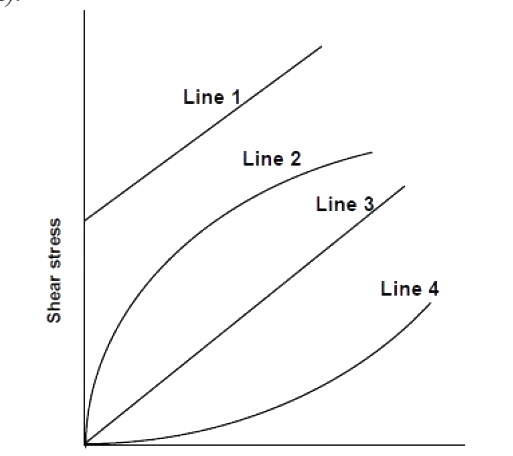
Match plots 1-4 given in the figure below with the correct flow behavior of polymeric fluid listed as P, Q, R & S:
P. Newtonian
Q. Shear thickening
R. Pseudoplastic
S. Bingham plastic
Open complete paper
16
2017 Β· Engineering Sciences Β· Polymer Rheology Β· Polymer Flow and Viscoelasticity
Engineering Sciences (XE) 2017
Refer the shear stress – shear rate plot shown in the figure below. Match the lines (Column I) with appropriate rheological behavior (Column II).
Column I
P. Line 1
Q. Line 2
R. Line 3
S. Line 4
Column II
1. Dilatant
2. Newtonian
3. Pseudoplastic
4. Bingham plastic

Question diagram

Open complete paper
17
2017 Β· Engineering Sciences Β· Polymer Rheology Β· Polymer Flow and Viscoelasticity
Engineering Sciences (XE) 2017
The relaxation time for a rubber band at 23 Β°C is 60 days. If it is stressed to 2 MPa initially, then the time required before the stress relaxes to 1 MPa is ______ days (round off final answer to two digits after decimal point).
Open complete paper
18
2018 Β· Engineering Sciences Β· Polymer Rheology Β· Polymer Flow and Viscoelasticity
Engineering Sciences (XE) 2018
A plot of strain (%) versus time of a polymer is given below. Based on this plot and the properties as mentioned below, find out the correct combination.
1 = Viscoelastic deformation; 2 = Elastic deformation
3 = Viscoelastic recovery; 4 = Elastic recovery
Open complete paper
19
2019 Β· Engineering Sciences Β· Polymer Rheology Β· Polymer Flow and Viscoelasticity
Engineering Sciences (XE) 2019
A linear amorphous polymer has a \(T_g\) of +10 Β°C. At 28 Β°C, it has a melt viscosity of \(4 \times 10^8\) poise. The viscosity of the polymer at its \(T_g\) is ______ \(\times 10^{13}\) poise (round off to one decimal place).
Open complete paper
20
2021 Β· Engineering Sciences Β· Polymer Rheology Β· Polymer Flow and Viscoelasticity
Engineering Sciences (XE) 2021
Equal and opposite forces of a constant magnitude \( F \) are applied at the two ends of a thin elastomeric rod, which is held at a temperature \( T_1 \) (\( T_g < T_1 < T_m \)), where \( T_g \) and \( T_m \) are the glass transition temperature and melting temperature respectively. If the temperature is increased to \( T_2 \) (\( T_g < T_2 < T_m \) and \( T_2 > T_1 \)), the rod will ____________________.
Open complete paper

Showing 20 of 31 questions