My Cart
Your Cart 0

    Your cart is empty.

  • Total (Amount) ₹0.00
Previous year question hub

Extrusion, Spinning and Coating - Polymer Processing - Engineering Sciences Previous Year Questions

Practice Extrusion, Spinning and Coating - Polymer Processing - Engineering Sciences previous year questions organised from real papers, with year-wise coverage and clear topic navigation.

12Papers
12Years
16Questions
1Topics

Extrusion, Spinning and Coating question pattern

Every graph below is calculated only from this selection.

Questions by year

Year-wise coverage for Extrusion, Spinning and Coating. Each bar uses a separate theme-derived color.

Difficulty distribution

How the classified questions are distributed by difficulty.

Medium 9 56.3%
Easy 7 43.8%

Question type distribution

MCQ, numerical, multiple-select and other formats found in these papers.

MCQ 10 62.5%
Numerical Answer Type (NAT) 5 31.3%
MSQ 1 6.3%

Subject weightage

Top subjects by unique question coverage.

Engineering Sciences
16 Qs

Most asked topics

Top topics across the included previous year papers.

Polymer Processing
16 Qs

Subtopic coverage

Top subtopics inside this exact selection.

Extrusion, Spinning and Coating
16 Qs

Paper coverage

Question coverage for the most populated papers. Every active PYP paper remains listed below.

Engineering Sciences (XE) 2026
1 Qs
Engineering Sciences (XE) 2025
1 Qs
Engineering Sciences (XE) 2023
2 Qs
Engineering Sciences (XE) 2021
1 Qs
Engineering Sciences (XE) 2019
1 Qs
Engineering Sciences (XE) 2017
1 Qs
Engineering Sciences (XE) 2015
1 Qs
Engineering Sciences (XE) 2014
2 Qs
Engineering Sciences (XE) 2013
2 Qs
Engineering Sciences (XE) 2011
2 Qs
Engineering Sciences (XE) 2009
1 Qs
Engineering Sciences (XE) 2008
1 Qs

Included previous year papers

Newest papers appear first. Sort by year, question coverage or name.

PaperYear / sessionQuestions in this viewOpen
Engineering Sciences (XE) 202620261View paper
Engineering Sciences (XE) 202520251View paper
Engineering Sciences (XE) 202320232View paper
Engineering Sciences (XE) 202120211View paper
Engineering Sciences (XE) 201920191View paper
Engineering Sciences (XE) 201720171View paper
Engineering Sciences (XE) 201520151View paper
Engineering Sciences (XE) 201420142View paper
Engineering Sciences (XE) 201320132View paper
Engineering Sciences (XE) 201120112View paper
Engineering Sciences (XE) 200920091View paper
Engineering Sciences (XE) 200820081View paper

All Extrusion, Spinning and Coating previous year questions

Practice every matching question in batches of 20, with every available option.

1
2008 · Engineering Sciences · Polymer Processing · Extrusion, Spinning and Coating
Engineering Sciences (XE) 2008

The capacity of an extruder can be maximized by a combination of

Open complete paper
2
2009 · Engineering Sciences · Polymer Processing · Extrusion, Spinning and Coating
Engineering Sciences (XE) 2009

The power consumed by the plasticizing screw is

Open complete paper
3
2011 · Engineering Sciences · Polymer Processing · Extrusion, Spinning and Coating
Engineering Sciences (XE) 2011
Assume a flat plate model in the melt zone of a single-screw extruder \(\partial P/\partial z = \eta \partial^2 v_z/\partial y^2\), \(v_z = 0\) at \(y = 0\) and \(v_z = V_{bz}\) at \(y = H\). For fully developed flow in the z direction \(v_z\) is found to be
Open complete paper
4
2011 · Engineering Sciences · Polymer Processing · Extrusion, Spinning and Coating
Engineering Sciences (XE) 2011
In the absence of a die in a single screw extruder \(\Delta P = 0\) and Q is equal to
Open complete paper
5
2013 · Engineering Sciences · Polymer Processing · Extrusion, Spinning and Coating
Engineering Sciences (XE) 2013
In the extruder barrel, the compression is achieved by back pressure created by the die and by
Open complete paper
6
2013 · Engineering Sciences · Polymer Processing · Extrusion, Spinning and Coating
Engineering Sciences (XE) 2013
An extruder is supplied with 40 kW of power. The mass flow rate of a polymer through the extruder is 240 kg h-1 and the specific heat capacity of the polymer is 4 kJ kg-1 K-1. The maximum possible temperature rise in the polymer is
Open complete paper
7
2014 · Engineering Sciences · Polymer Processing · Extrusion, Spinning and Coating
Engineering Sciences (XE) 2014
A continuous annular product is produced by
Open complete paper
8
2014 · Engineering Sciences · Polymer Processing · Extrusion, Spinning and Coating
Engineering Sciences (XE) 2014
The shear rates involved in calendering ($\dot{\gamma}_{cal}$), compression molding ($\dot{\gamma}_{comp}$), extrusion ($\dot{\gamma}_{ext}$), and injection molding ($\dot{\gamma}_{inj}$) processes follow the order
Open complete paper
9
2015 · Engineering Sciences · Polymer Processing · Extrusion, Spinning and Coating
Engineering Sciences (XE) 2015
The diameter of a die of an extruder producing extrudate of diameter 2.4 mm with a die-swell ratio of 2 is ______ mm.
Open complete paper
10
2017 · Engineering Sciences · Polymer Processing · Extrusion, Spinning and Coating
Engineering Sciences (XE) 2017
Which processing technique is best suited for manufacturing decorative PVC floor tiles?
Open complete paper
11
2019 · Engineering Sciences · Polymer Processing · Extrusion, Spinning and Coating
Engineering Sciences (XE) 2019
A single screw extruder is to be used to manufacture a nylon rod of 0.5 cm diameter at a production rate of 2.5 cm s⁻¹. The density of solid nylon and nylon melt are 1.140 g cm⁻³ and 0.790 g cm⁻³, respectively. The melt flow rate through the die is ______ cm³ s⁻¹ (round off to two decimal places).
Open complete paper
12
2021 · Engineering Sciences · Polymer Processing · Extrusion, Spinning and Coating
Engineering Sciences (XE) 2021
A single screw extruder is operating at a rotational speed of 2 revolutions per second for the extrusion of a Newtonian polymer under open-discharge conditions (in absence of a die, the pressure drop, Δp = 0). The extruder has a screw diameter, D = 5 cm, a channel depth, H = 0.4 cm, distance between flights, W = 1 cm, and a helix angle, θ = 20°. Assume the value of π = 3.14. The volumetric flow rate (rounded off to 2 decimal places) is __________ cm³/s.
Open complete paper
13
2023 · Engineering Sciences · Polymer Processing · Extrusion, Spinning and Coating
Engineering Sciences (XE) 2023
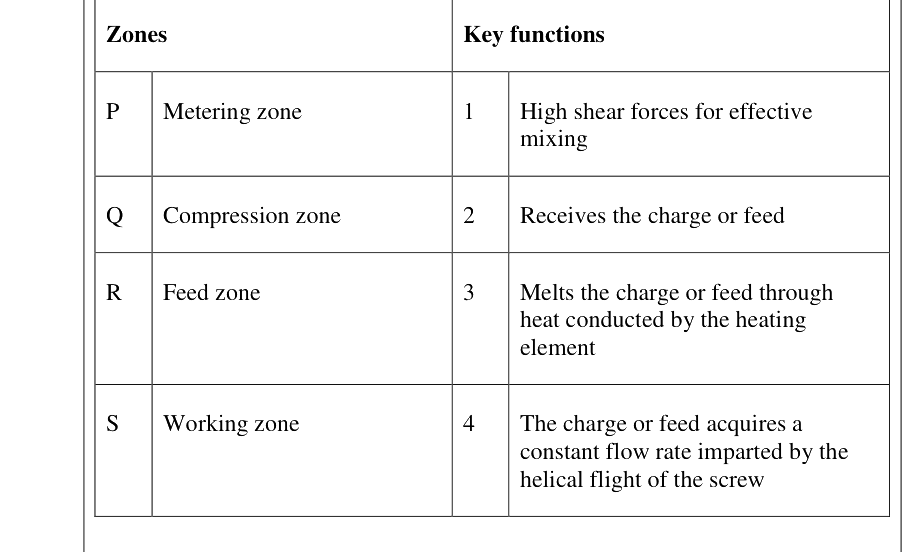
A high molecular weight polymer passes through different zones from the hopper to the die in an extruder. Among the options given, identify the correct match between the zones and their key functions.

Question diagram

Open complete paper
14
2023 · Engineering Sciences · Polymer Processing · Extrusion, Spinning and Coating
Engineering Sciences (XE) 2023
A polymeric material of density 0.9 g/cc and melt volume of 10 cc in an extruder has a residence time of 100 s. The output of the extruder is _____ kg/h. (Rounded off to two decimal places)
Open complete paper
15
2025 · Engineering Sciences · Polymer Processing · Extrusion, Spinning and Coating
Engineering Sciences (XE) 2025
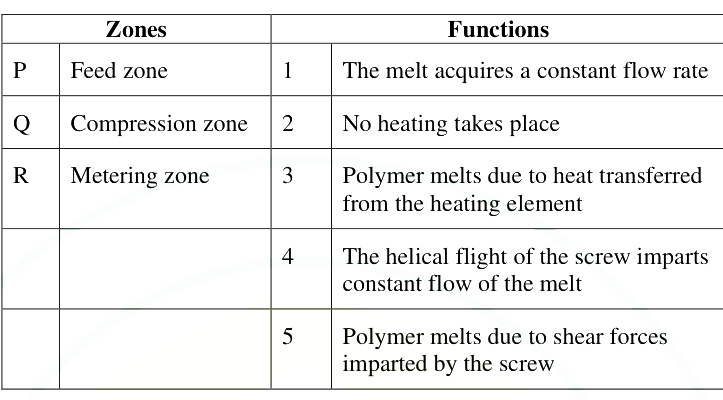
Choose the option(s) that correctly match(es) the Zones with their typical Functions in an industrial extruder.
ZonesFunctions
PFeed zone1The melt acquires a constant flow rate
QCompression zone2No heating takes place
RMetering zone3Polymer melts due to heat transferred from the heating element
4The helical flight of the screw imparts constant flow of the melt
5Polymer melts due to shear forces imparted by the screw

Question diagram

Open complete paper
16
2026 · Engineering Sciences · Polymer Processing · Extrusion, Spinning and Coating
Engineering Sciences (XE) 2026
A single-screw extruder is operated at 12 rpm under open discharge condition (i.e., without a die).
The screw has a diameter of 10 cm, a distance of 2.5 cm between the adjacent flights, a gap of 0.25 cm between the screw and the inner wall of the barrel, and a helix angle (i.e., angle between the flights and the plane perpendicular to the screw axis) of 8°.
If the flow of the molten polymer in the metering zone through the extruder is assumed isothermal, Newtonian and incompressible, the volumetric flow rate of the polymer melt is ______ cm³/min (rounded off to the nearest integer).
Open complete paper