My Cart
Your Cart 0

    Your cart is empty.

  • Total (Amount) ₹0.00
Previous year question hub

Partial Differential Equations - Engineering Sciences Previous Year Questions

Practice Partial Differential Equations - Engineering Sciences previous year questions organised from real papers, with year-wise coverage and clear topic navigation.

11Papers
11Years
12Questions
1Topics

Partial Differential Equations question pattern

Every graph below is calculated only from this selection.

Questions by year

Year-wise coverage for Partial Differential Equations. Each bar uses a separate theme-derived color.

Difficulty distribution

How the classified questions are distributed by difficulty.

Medium 10 83.3%
Easy 2 16.7%

Question type distribution

MCQ, numerical, multiple-select and other formats found in these papers.

MCQ 7 58.3%
Numerical Answer Type (NAT) 4 33.3%
MSQ 1 8.3%

Subject weightage

Top subjects by unique question coverage.

Engineering Sciences
12 Qs

Most asked topics

Top topics across the included previous year papers.

Partial Differential Equations
12 Qs

Subtopic coverage

Top subtopics inside this exact selection.

Heat, Wave and Laplace Equations
6 Qs
PDE Classification and Separation of Variables
6 Qs

Paper coverage

Question coverage for the most populated papers. Every active PYP paper remains listed below.

Engineering Sciences (XE) 2026
1 Qs
Engineering Sciences (XE) 2025
2 Qs
Engineering Sciences (XE) 2023
1 Qs
Engineering Sciences (XE) 2022
1 Qs
Engineering Sciences (XE) 2021
1 Qs
Engineering Sciences (XE) 2019
1 Qs
Engineering Sciences (XE) 2018
1 Qs
Engineering Sciences (XE) 2017
1 Qs
Engineering Sciences (XE) 2016
1 Qs
Engineering Sciences (XE) 2013
1 Qs
Engineering Sciences (XE) 2012
1 Qs

Browse by subtopics

Open a focused page built from the same verified paper data.

Included previous year papers

Newest papers appear first. Sort by year, question coverage or name.

PaperYear / sessionQuestions in this viewOpen
Engineering Sciences (XE) 202620261View paper
Engineering Sciences (XE) 202520252View paper
Engineering Sciences (XE) 202320231View paper
Engineering Sciences (XE) 202220221View paper
Engineering Sciences (XE) 202120211View paper
Engineering Sciences (XE) 201920191View paper
Engineering Sciences (XE) 201820181View paper
Engineering Sciences (XE) 201720171View paper
Engineering Sciences (XE) 201620161View paper
Engineering Sciences (XE) 201320131View paper
Engineering Sciences (XE) 201220121View paper

Sample previous year questions

A varied preview from the papers represented in this selection, with every available option.

1
2012 · Engineering Sciences · Partial Differential Equations · Heat, Wave and Laplace Equations
Engineering Sciences (XE) 2012
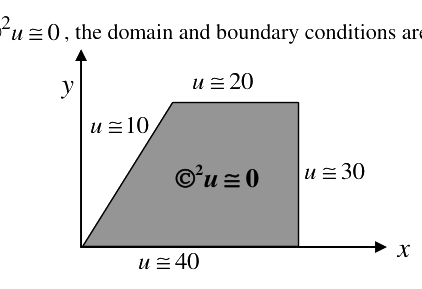
For the solution of \(\nabla^2 u = 0\), the domain and boundary conditions are shown below.

Which of the following statements is TRUE?

Question diagram

Open complete paper
2
2013 · Engineering Sciences · Partial Differential Equations · PDE Classification and Separation of Variables
Engineering Sciences (XE) 2013

Which one of the following partial differential equations CAN NOT be reduced to two ordinary differential equations by the method of separation of variables?

Open complete paper
3
2016 · Engineering Sciences · Partial Differential Equations · PDE Classification and Separation of Variables
Engineering Sciences (XE) 2016
Which of the following is a quasi-linear partial differential equation?
Open complete paper
4
2017 · Engineering Sciences · Partial Differential Equations · Heat, Wave and Laplace Equations
Engineering Sciences (XE) 2017
If \(u(x, t) = g(t) \sin x\) is the solution of the wave equation
\(u_{tt} = u_{xx}, \quad t > 0, \quad 0 < x < \pi,\)
with the initial conditions
\(u(x, 0) = 2 \sin x, \quad u_t(x, 0) = 0, \quad 0 \le x \le \pi,\)
and the boundary conditions
\(u(0, t) = u(\pi, t) = 0, \quad t \ge 0,\)
then the value of \(g\left(\frac{\pi}{3}\right)\) is ______________.
Open complete paper
5
2018 · Engineering Sciences · Partial Differential Equations · Heat, Wave and Laplace Equations
Engineering Sciences (XE) 2018
Let \( u(x,t) \) satisfy the initial and boundary value problem \( \frac{\partial u}{\partial t} = 2 \frac{\partial^2 u}{\partial x^2}, \ 0 < x < \pi, \ t > 0, \ u(0,t) = 0 = u(\pi,t), \ t > 0, \ u(x,0) = \sin x + 2\sin 4x, \ 0 < x < \pi. \) Then the value of \( u\left( \frac{\pi}{2}, \ln(5) \right) \) is __________
Open complete paper
6
2019 · Engineering Sciences · Partial Differential Equations · PDE Classification and Separation of Variables
Engineering Sciences (XE) 2019
If the transformation \(u(x, t) = e^x v(x, t)\) reduces the partial differential equation \(\frac{\partial^2 u}{\partial x^2} - 2\frac{\partial u}{\partial x} - \frac{\partial u}{\partial t} + u = 0\) to the equation \(\frac{\partial v}{\partial t} - \frac{\partial^2 v}{\partial x^2} = 9 f(x)\), then \(f(x)\) equals
Open complete paper