My Cart
Your Cart 0

    Your cart is empty.

  • Total (Amount) ₹0.00
Previous year question hub

Ocean Properties, Circulation and Waves - Ocean Sciences - Engineering Sciences Previous Year Questions

Practice Ocean Properties, Circulation and Waves - Ocean Sciences - Engineering Sciences previous year questions organised from real papers, with year-wise coverage and clear topic navigation.

10Papers
10Years
61Questions
1Topics

Ocean Properties, Circulation and Waves question pattern

Every graph below is calculated only from this selection.

Questions by year

Year-wise coverage for Ocean Properties, Circulation and Waves. Each bar uses a separate theme-derived color.

Difficulty distribution

How the classified questions are distributed by difficulty.

Medium 36 59%
Easy 23 37.7%
Hard 2 3.3%
Question type distribution

MCQ, numerical, multiple-select and other formats found in these papers.

MCQ 32 52.5%
Numerical Answer Type (NAT) 19 31.1%
MSQ 10 16.4%

Subject weightage

Top subjects by unique question coverage.

Engineering Sciences
61 Qs

Most asked topics

Top topics across the included previous year papers.

Ocean Sciences
61 Qs

Subtopic coverage

Top subtopics inside this exact selection.

Ocean Properties, Circulation and Waves
61 Qs

Paper coverage

Question coverage for the most populated papers. Every active PYP paper remains listed below.

Engineering Sciences (XE) 2026
9 Qs
Engineering Sciences (XE) 2025
3 Qs
Engineering Sciences (XE) 2024
9 Qs
Engineering Sciences (XE) 2023
6 Qs
Engineering Sciences (XE) 2022
3 Qs
Engineering Sciences (XE) 2021
6 Qs
Engineering Sciences (XE) 2020
7 Qs
Engineering Sciences (XE) 2019
5 Qs
Engineering Sciences (XE) 2018
8 Qs
Engineering Sciences (XE) 2017
5 Qs

Included previous year papers

Newest papers appear first. Sort by year, question coverage or name.

PaperYear / sessionQuestions in this viewOpen
Engineering Sciences (XE) 202620269View paper
Engineering Sciences (XE) 202520253View paper
Engineering Sciences (XE) 202420249View paper
Engineering Sciences (XE) 202320236View paper
Engineering Sciences (XE) 202220223View paper
Engineering Sciences (XE) 202120216View paper
Engineering Sciences (XE) 202020207View paper
Engineering Sciences (XE) 201920195View paper
Engineering Sciences (XE) 201820188View paper
Engineering Sciences (XE) 201720175View paper

All Ocean Properties, Circulation and Waves previous year questions

Practice every matching question in batches of 20, with every available option.

1
2017 · Engineering Sciences · Ocean Sciences · Ocean Properties, Circulation and Waves
Engineering Sciences (XE) 2017
Kuroshio Current and Gulf Stream are
Open complete paper
2
2017 · Engineering Sciences · Ocean Sciences · Ocean Properties, Circulation and Waves
Engineering Sciences (XE) 2017
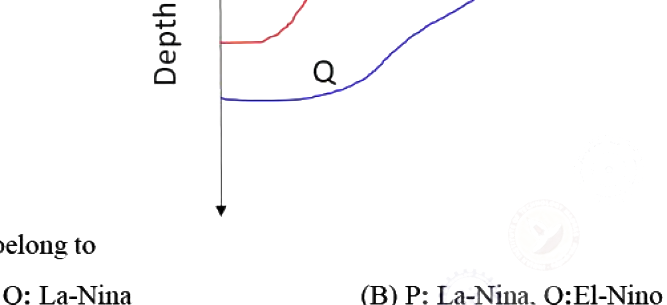
Mixed layer depths measured in the Pacific Ocean in two different years are schematically shown in the figure below.
Years P and Q belong to

Question diagram

Open complete paper
3
2017 · Engineering Sciences · Ocean Sciences · Ocean Properties, Circulation and Waves
Engineering Sciences (XE) 2017
The velocity of a tsunami wave in an ocean basin of depth 1 km is _________ m s⁻¹
Open complete paper
4
2017 · Engineering Sciences · Ocean Sciences · Ocean Properties, Circulation and Waves
Engineering Sciences (XE) 2017
In the month of April, the mixed layer in the Arabian Sea received a net heat flux of 50 W m⁻². If the mixed layer depth is 50 m, the increase in temperature at the end of April is ______ °C. [Density of seawater: 1025 kg m⁻³, Density of freshwater: 1000 kg m⁻³, Specific heat of seawater: 4200 J kg⁻¹ K⁻¹, Latent heat of evaporation: 2.45 × 10⁶ J kg⁻¹]
Open complete paper
5
2017 · Engineering Sciences · Ocean Sciences · Ocean Properties, Circulation and Waves
Engineering Sciences (XE) 2017
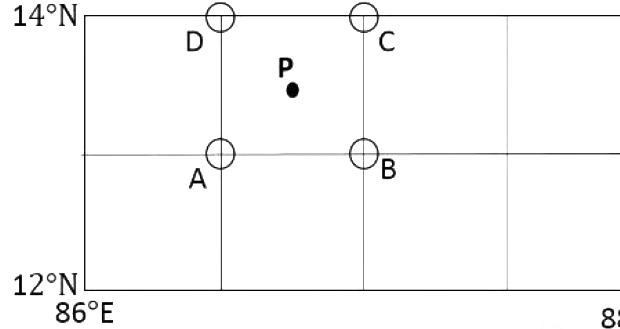
Sea surface height anomalies at the locations A, B, C and D are -10, -15, 5 and 0 cm respectively.

The magnitude of geostrophic velocity at P is __________ m s-1.
[Take 1° = 100 km, g = 10 m s-2, Angular velocity of the Earth: 7.27 × 10⁻⁵ rad s-1]

Question diagram

Open complete paper
6
2018 · Engineering Sciences · Ocean Sciences · Ocean Properties, Circulation and Waves
Engineering Sciences (XE) 2018
Atmospheric vertical profile of temperature is measured by radiosonde. Equivalent instruments for measuring ocean temperature profile among the following are:
(P) drifting buoy (Q) ARGO float (R) current mooring (S) XBT
Open complete paper
7
2018 · Engineering Sciences · Ocean Sciences · Ocean Properties, Circulation and Waves
Engineering Sciences (XE) 2018
When deep water sinks in the North Atlantic and moves away from where it formed, it gets
Open complete paper
8
2018 · Engineering Sciences · Ocean Sciences · Ocean Properties, Circulation and Waves
Engineering Sciences (XE) 2018
The speed of sound in the ocean depends on
Open complete paper
9
2018 · Engineering Sciences · Ocean Sciences · Ocean Properties, Circulation and Waves
Engineering Sciences (XE) 2018
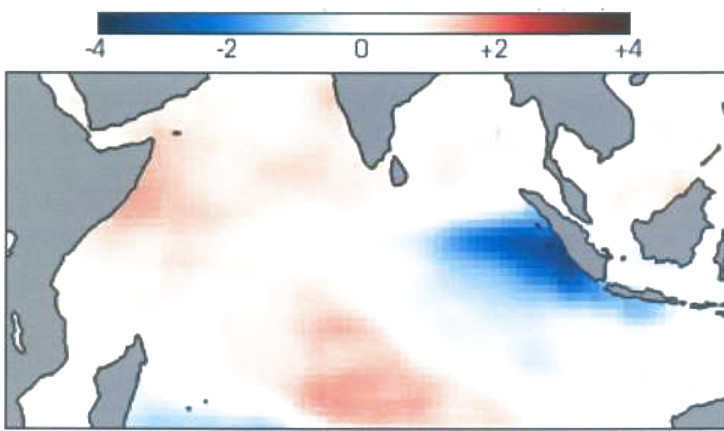
Figure below shows SST anomaly (in °C). It is associated with the phenomenon known as

Question diagram

Open complete paper
10
2018 · Engineering Sciences · Ocean Sciences · Ocean Properties, Circulation and Waves
Engineering Sciences (XE) 2018
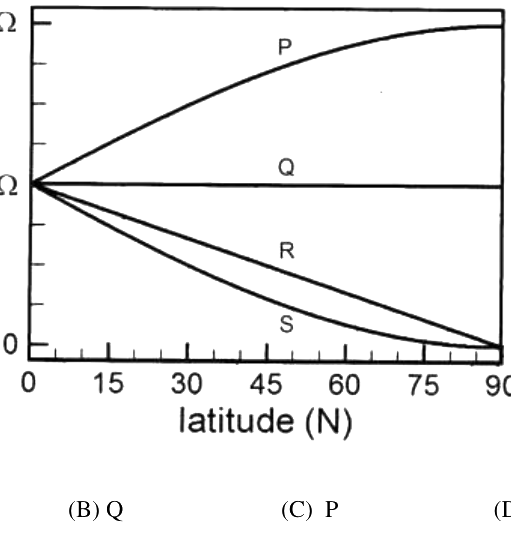
For an inviscid and barotropic ocean of constant depth (D), a water parcel with initial vorticity 2Ω is displaced from the equator to the north pole. Latitudinal variation of the parcel vorticity (ζ) is well represented by the curve

Question diagram

Open complete paper
11
2018 · Engineering Sciences · Ocean Sciences · Ocean Properties, Circulation and Waves
Engineering Sciences (XE) 2018
A wave progresses up an estuary of decreasing water depth. If friction is neglected, then
Open complete paper
12
2018 · Engineering Sciences · Ocean Sciences · Ocean Properties, Circulation and Waves
Engineering Sciences (XE) 2018
In the Ekman flow limit, directions of ocean surface current and the geostrophic wind are
Open complete paper
13
2018 · Engineering Sciences · Ocean Sciences · Ocean Properties, Circulation and Waves
Engineering Sciences (XE) 2018
If difference in sea surface elevation is 1 m in 100 km at 30° N latitude, the corresponding geostrophic current is _________ m s-1. (Give the answer to one decimal place.) Take g = 9.8 m s-2 and angular velocity of the Earth = 7.3×10⁻⁵ s-1.
Open complete paper
14
2019 · Engineering Sciences · Ocean Sciences · Ocean Properties, Circulation and Waves
Engineering Sciences (XE) 2019
Water level in an estuary rises and falls in response to tidal forces. Assume that the only tidal period in an estuary is 12 hours. The speed of the ebb current in that estuary would be maximum
Open complete paper
15
2019 · Engineering Sciences · Ocean Sciences · Ocean Properties, Circulation and Waves
Engineering Sciences (XE) 2019
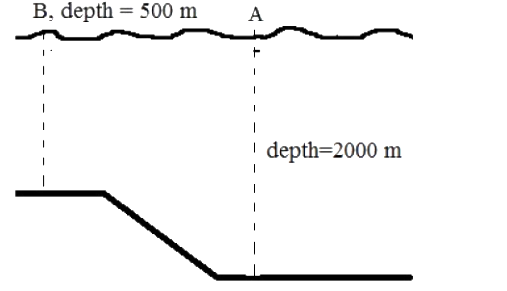
A tsunami is a long gravity wave, i.e. its wavelength is much larger than the depth of the ocean. A tsunami moves from point A to point B (see figure below); water depth at A is 2000 m, and water depth at B is 500 m. Assume no frictional losses. By energy conservation, \(C_g \) is constant, where \(C_g\) is group speed and \(\) is the total (potential plus kinetic) energy density of the wave field. If the amplitude of the tsunami at point A is 1 m, its amplitude at B is ________ m. (Round off to two decimal places.)

Question diagram

Open complete paper
16
2019 · Engineering Sciences · Ocean Sciences · Ocean Properties, Circulation and Waves
Engineering Sciences (XE) 2019
It rains 10 cm in a day over an ocean with a mixed layer depth of 5 m and initial salinity 30 g kg⁻¹. The rain water uniformly mixes with the existing mixed layer water. The final salinity after the rain is __________ g kg⁻¹. (Round off to one decimal place.)
Open complete paper
17
2019 · Engineering Sciences · Ocean Sciences · Ocean Properties, Circulation and Waves
Engineering Sciences (XE) 2019
A column of seawater from surface to 1000 m depth is initially at rest at the equator. The column is moved to 30°N with no change in column depth. In the absence of friction, the vertical component of relative vorticity of the water in the column at 30°N is ______ \( \times 10^{-5} \) s-1. (Round off to one decimal place.)
Open complete paper
18
2019 · Engineering Sciences · Ocean Sciences · Ocean Properties, Circulation and Waves
Engineering Sciences (XE) 2019
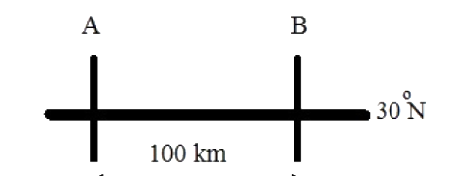
Consider two north-south (i.e. meridional) sections A and B in the ocean, separated by 100 km; section B is to the east of section A (as shown in figure below). The steady northward wind stress at A and B are 0.1 N/m2 and 0.2 N/m2, respectively; zonal wind stress is zero everywhere. Density of seawater is 1000 kg m-3. At 30°N, the vertical velocity at the base of the Ekman layer is ______ meters per day. (Round off to one decimal place.)

Question diagram

Open complete paper
19
2020 · Engineering Sciences · Ocean Sciences · Ocean Properties, Circulation and Waves
Engineering Sciences (XE) 2020
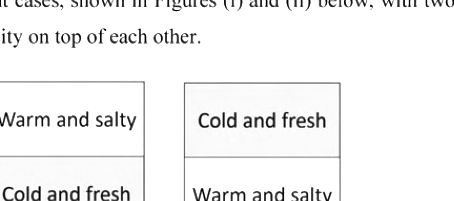
Consider two different cases, shown in Figures (i) and (ii) below, with two layers of water of same density on top of each other.

Which one of the following statements is true about convective plumes across the interface of the two layers?

Question diagram

Open complete paper
20
2020 · Engineering Sciences · Ocean Sciences · Ocean Properties, Circulation and Waves
Engineering Sciences (XE) 2020
A tsunami wave in the ocean is approaching the coast. Assuming \( g = 10 \; \text{ms}^{-2} \), the correct group speed of the wave at a depth of 1 km is
Open complete paper

Showing 20 of 61 questions