My Cart
Your Cart 0

    Your cart is empty.

  • Total (Amount) ₹0.00
Previous year question hub

Flow Descriptions, Derivatives and Flow Lines - Kinematics of Fluid Motion - Engineering Sciences Previous Year Questions

Practice Flow Descriptions, Derivatives and Flow Lines - Kinematics of Fluid Motion - Engineering Sciences previous year questions organised from real papers, with year-wise coverage and clear topic navigation.

20Papers
20Years
94Questions
1Topics

Flow Descriptions, Derivatives and Flow Lines question pattern

Every graph below is calculated only from this selection.

Questions by year

Year-wise coverage for Flow Descriptions, Derivatives and Flow Lines. Each bar uses a separate theme-derived color.

Difficulty distribution

How the classified questions are distributed by difficulty.

Easy 58 61.7%
Medium 36 38.3%

Question type distribution

MCQ, numerical, multiple-select and other formats found in these papers.

MCQ 66 70.2%
Numerical Answer Type (NAT) 21 22.3%
MSQ 5 5.3%
Fill in the blanks 2 2.1%

Subject weightage

Top subjects by unique question coverage.

Engineering Sciences
94 Qs

Most asked topics

Top topics across the included previous year papers.

Kinematics of Fluid Motion
94 Qs

Subtopic coverage

Top subtopics inside this exact selection.

Flow Descriptions, Derivatives and Flow Lines
94 Qs

Paper coverage

Question coverage for the most populated papers. Every active PYP paper remains listed below.

Engineering Sciences (XE) 2026
4 Qs
Engineering Sciences (XE) 2025
6 Qs
Engineering Sciences (XE) 2024
4 Qs
Engineering Sciences (XE) 2023
4 Qs
Engineering Sciences (XE) 2022
4 Qs
Engineering Sciences (XE) 2021
3 Qs
Engineering Sciences (XE) 2020
5 Qs
Engineering Sciences (XE) 2019
4 Qs
Engineering Sciences (XE) 2018
6 Qs
Engineering Sciences (XE) 2017
6 Qs
Engineering Sciences (XE) 2016
3 Qs
Engineering Sciences (XE) 2015
5 Qs
Engineering Sciences (XE) 2014
6 Qs
Engineering Sciences (XE) 2013
3 Qs
Engineering Sciences (XE) 2012
5 Qs
Engineering Sciences (XE) 2011
4 Qs
Engineering Sciences (XE) 2010
4 Qs
Engineering Sciences (XE) 2009
5 Qs
Engineering Sciences (XE) 2008
6 Qs
Engineering Sciences (XE) 2007
7 Qs

Included previous year papers

Newest papers appear first. Sort by year, question coverage or name.

PaperYear / sessionQuestions in this viewOpen
Engineering Sciences (XE) 202620264View paper
Engineering Sciences (XE) 202520256View paper
Engineering Sciences (XE) 202420244View paper
Engineering Sciences (XE) 202320234View paper
Engineering Sciences (XE) 202220224View paper
Engineering Sciences (XE) 202120213View paper
Engineering Sciences (XE) 202020205View paper
Engineering Sciences (XE) 201920194View paper
Engineering Sciences (XE) 201820186View paper
Engineering Sciences (XE) 201720176View paper
Engineering Sciences (XE) 201620163View paper
Engineering Sciences (XE) 201520155View paper
Engineering Sciences (XE) 201420146View paper
Engineering Sciences (XE) 201320133View paper
Engineering Sciences (XE) 201220125View paper
Engineering Sciences (XE) 201120114View paper
Engineering Sciences (XE) 201020104View paper
Engineering Sciences (XE) 200920095View paper
Engineering Sciences (XE) 200820086View paper
Engineering Sciences (XE) 200720077View paper

All Flow Descriptions, Derivatives and Flow Lines previous year questions

Practice every matching question in batches of 20, with every available option.

1
2007 · Engineering Sciences · Kinematics of Fluid Motion · Flow Descriptions, Derivatives and Flow Lines
Engineering Sciences (XE) 2007

Consider a two-dimensional laminar boundary layer with a constant freestream velocity. For a fluid particle very close to the wall, the signs of the material acceleration components in directions parallel and perpendicular to the solid surface are, respectively

Open complete paper
2
2007 · Engineering Sciences · Kinematics of Fluid Motion · Flow Descriptions, Derivatives and Flow Lines
Engineering Sciences (XE) 2007
Consider the mass balance equation \(\frac{\partial u}{\partial x} + \frac{\partial v}{\partial y} = 0\). The most appropriate set of conditions for this equation to hold good is:
Open complete paper
3
2007 · Engineering Sciences · Kinematics of Fluid Motion · Flow Descriptions, Derivatives and Flow Lines
Engineering Sciences (XE) 2007
Given that temperature \(T(x,y)\) does not change along a streamline in a steady two-dimensional, incompressible flow, the equation of the streamline is obtained from
Open complete paper
4
2007 · Engineering Sciences · Kinematics of Fluid Motion · Flow Descriptions, Derivatives and Flow Lines
Engineering Sciences (XE) 2007
For a two-dimensional incompressible irrotational flow, the x-component of velocity \( u = 2x + 3y \). The corresponding y-component of velocity is
Open complete paper
5
2007 · Engineering Sciences · Kinematics of Fluid Motion · Flow Descriptions, Derivatives and Flow Lines
Engineering Sciences (XE) 2007
For a certain two-dimensional steady incompressible flow, the horizontal and vertical velocity components are given by \( u = 6y \), \( v = 0 \), where \( y \) is the vertical distance. The angular velocity and rate of shear strain respectively are
Open complete paper
6
2007 · Engineering Sciences · Kinematics of Fluid Motion · Flow Descriptions, Derivatives and Flow Lines
Engineering Sciences (XE) 2007
In a steady two-dimensional incompressible flow, the stream function (\( \psi \)) obeys the equation \( \frac{\partial^2 \psi}{\partial x^2} + \frac{\partial^2 \psi}{\partial y^2} = 4 \). A solution of this equation is
Open complete paper
7
2007 · Engineering Sciences · Kinematics of Fluid Motion · Flow Descriptions, Derivatives and Flow Lines
Engineering Sciences (XE) 2007
In terms of the Cartesian unit vectors î and ĵ, the velocity at the point (0,1) is given as
Open complete paper
8
2008 · Engineering Sciences · Kinematics of Fluid Motion · Flow Descriptions, Derivatives and Flow Lines
Engineering Sciences (XE) 2008

A fluid particle can accelerate

Open complete paper
9
2008 · Engineering Sciences · Kinematics of Fluid Motion · Flow Descriptions, Derivatives and Flow Lines
Engineering Sciences (XE) 2008

A fluid element is said to have vorticity with respect to a reference frame if in that reference frame

Open complete paper
10
2008 · Engineering Sciences · Kinematics of Fluid Motion · Flow Descriptions, Derivatives and Flow Lines
Engineering Sciences (XE) 2008

Which of the following statements is true?

Open complete paper
11
2008 · Engineering Sciences · Kinematics of Fluid Motion · Flow Descriptions, Derivatives and Flow Lines
Engineering Sciences (XE) 2008

Which of the following is a valid velocity field for an incompressible flow?

Open complete paper
12
2008 · Engineering Sciences · Kinematics of Fluid Motion · Flow Descriptions, Derivatives and Flow Lines
Engineering Sciences (XE) 2008

To an observer standing on the ground the velocity of a cyclist is 12 m/s in the horizontal direction and that of rain drops falling vertically down is 6 m/s. The magnitude of the velocity of the rain drops relative to the cyclist is

Open complete paper
13
2008 · Engineering Sciences · Kinematics of Fluid Motion · Flow Descriptions, Derivatives and Flow Lines
Engineering Sciences (XE) 2008
For a given location in a flow, the rate of change of density following a fluid particle \(\left( \frac{D\rho}{Dt} = \frac{\partial \rho}{\partial t} + u \frac{\partial \rho}{\partial x} + v \frac{\partial \rho}{\partial y} + w \frac{\partial \rho}{\partial z} \right)\), is 2.4 kg/(m³·s). If the density at that point is 1.2 kg/m³, then the divergence of the velocity field (\( \nabla \cdot \vec{V} \)) at that point is:
Open complete paper
14
2009 · Engineering Sciences · Kinematics of Fluid Motion · Flow Descriptions, Derivatives and Flow Lines
Engineering Sciences (XE) 2009

Stream function CANNOT be defined for

Open complete paper
15
2009 · Engineering Sciences · Kinematics of Fluid Motion · Flow Descriptions, Derivatives and Flow Lines
Engineering Sciences (XE) 2009
Which one of the following is an irrotational flow ?
Open complete paper
16
2009 · Engineering Sciences · Kinematics of Fluid Motion · Flow Descriptions, Derivatives and Flow Lines
Engineering Sciences (XE) 2009

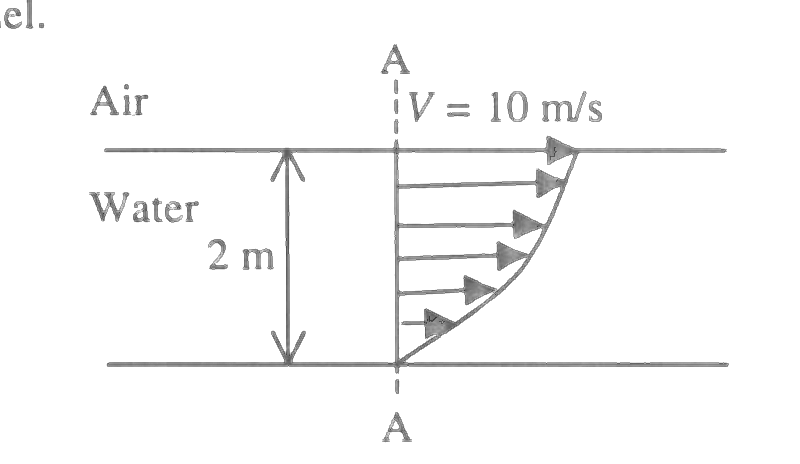
Consider incompressible flow through a two-dimensional open channel. At a certain section A-A, the velocity profile is parabolic. Neglecting air resistance at the free surface, find the volume flow rate per unit width of the channel.

Open complete paper
17
2009 · Engineering Sciences · Kinematics of Fluid Motion · Flow Descriptions, Derivatives and Flow Lines
Engineering Sciences (XE) 2009

The given velocity field is

Open complete paper
18
2009 · Engineering Sciences · Kinematics of Fluid Motion · Flow Descriptions, Derivatives and Flow Lines
Engineering Sciences (XE) 2009
Common Data for Questions 21 and 22:
The velocity field for a two dimensional flow is given by: \(\vec{V}(x, y, t) = \frac{x}{t} \hat{i} - \frac{y}{t} \hat{j}\)
The total acceleration is
Open complete paper
19
2010 · Engineering Sciences · Kinematics of Fluid Motion · Flow Descriptions, Derivatives and Flow Lines
Engineering Sciences (XE) 2010
Let \( \phi \) and \( \psi \) represent, respectively, the velocity potential and stream function of a flow field of an incompressible fluid. Which of the following statements are TRUE?
P: \( \phi \) exists for irrotational flows only
Q: \( \psi \) exists for both irrotational and rotational flows
R: \( \phi \) exists for rotational flows only
S: \( \psi \) exists for both rotational and irrotational flows
Open complete paper
20
2010 · Engineering Sciences · Kinematics of Fluid Motion · Flow Descriptions, Derivatives and Flow Lines
Engineering Sciences (XE) 2010
The wind is blowing east - west at time \( t < T \), and switches to south - north at \( t = T \). At \( t > T \), which of the following curves represent streamlines?
Open complete paper

Showing 20 of 94 questions